

TL;DR:
- The credit counseling requirement for bankruptcy mandates individuals complete a DOJ-approved session within 180 days before filing. This session must be documented and filed with the court, or the case will be dismissed. It is separate from the post-filing debtor education course and must be completed timely to avoid procedural errors.
The credit counseling requirement for bankruptcy is a mandatory pre-filing step that every individual must complete through a DOJ-approved agency within 180 days before filing their petition. Formally established under 11 U.S.C. §109(h) by the Bankruptcy Abuse Prevention and Consumer Protection Act of 2005 (BAPCPA), this rule applies to Chapter 7, Chapter 11, Chapter 12, and Chapter 13 filers. Skip it, and your case gets dismissed. Understanding what is credit counseling requirement bankruptcy means knowing both the pre-filing counseling and the separate post-filing debtor education course, each with its own deadline and legal consequence.
What is the credit counseling requirement for bankruptcy?
The bankruptcy credit counseling requirement is a federal law that blocks you from filing until you complete an approved session. The session must happen within the 180 days before you file your petition. There are 65 DOJ-approved credit counseling agencies operating in the U.S. as of Q1 2026. That number matters because you cannot use just any financial counselor. The agency must appear on the U.S. Trustee Program’s approved list.

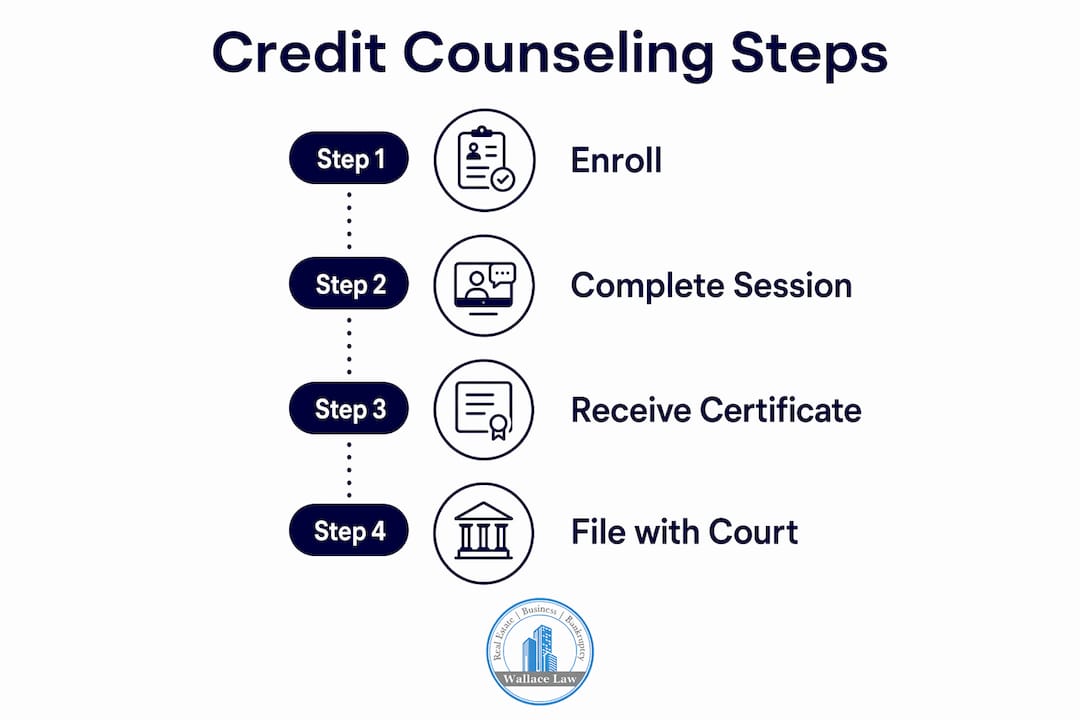
After completing the session, you receive a certificate. You must file that certificate with the court along with your bankruptcy petition. No certificate means no case. The court will dismiss your filing without exception.
This requirement applies to virtually every individual debtor. Businesses filing under Chapter 7 or Chapter 11 as corporations are not subject to it, but individual business owners filing personally are. The law exists to confirm that you reviewed your financial options before choosing bankruptcy.
Who must complete it and when?
Every individual filing under Chapter 7, Chapter 11, Chapter 12, or Chapter 13 must complete the mandatory credit counseling before filing. The 180-day window is strict and unforgiving. If you complete counseling but then delay your filing past that window, the certificate expires. You must retake the course, which doubles your cost and delay.
Very limited exceptions exist. Courts may waive the requirement only in cases of incapacity, disability, or active military duty in a combat zone. These exceptions are rare and require a court motion. Do not assume you qualify without speaking to an attorney first.
The approved methods for completing the session are flexible:
- Online: The most common method, available through most approved agencies 24 hours a day.
- By phone: Useful if you lack reliable internet access.
- In person: Available through some agencies, though less common post-2020.
All three methods produce the same valid certificate. The delivery method does not affect your compliance status.
Pro Tip: Check the U.S. Trustee Program’s website directly to confirm your chosen agency is on the approved list for your judicial district. Approval is district-specific, and a nationally listed agency may not be approved in your local court.
What does the credit counseling process involve?
A standard credit counseling session for bankruptcy runs 60–90 minutes. The counselor reviews your income, monthly expenses, and total debt load. The goal is to determine whether alternatives to bankruptcy, such as a debt management plan or negotiated repayment, could resolve your situation.
The process typically covers these steps:
- Financial intake: You provide income statements, a list of debts, and a monthly budget.
- Budget analysis: The counselor identifies where your money goes and calculates your disposable income.
- Alternatives review: The counselor presents options like debt consolidation or creditor negotiation.
- Certificate issuance: If no viable alternative exists, the counselor issues your completion certificate.
Credit counselors cannot advise you on whether or when to file bankruptcy. That decision is yours alone. The counselor’s role is educational, not legal. For legal strategy, you need a qualified bankruptcy attorney.
Session fees typically run $10–$50. Individuals below 150% of the federal poverty guidelines often qualify for a full fee waiver. Many filers overlook this option and pay out of pocket when they do not have to. Always ask the agency about a waiver before paying.
Pro Tip: Gather your last three months of bank statements, pay stubs, and a complete list of creditors before your session. Arriving prepared cuts the session time and produces a more accurate financial picture for your attorney.
Credit counseling vs. debtor education: what is the difference?
These two courses are the most commonly confused bankruptcy requirements. They are legally separate, serve different purposes, and cannot be combined into a single session. Agencies cannot offer both in one sitting, and completing one does not satisfy the other.
| Feature | Pre-filing credit counseling | Post-filing debtor education |
|---|---|---|
| When required | Within 180 days before filing | After filing, before discharge |
| Purpose | Explore alternatives to bankruptcy | Learn personal financial management |
| Chapter 7 deadline | Before petition is filed | Within 60 days after creditors’ meeting |
| Chapter 13 deadline | Before petition is filed | Before final payment under the plan |
| Approved providers | 65 DOJ-approved agencies (2026) | 126 approved providers nationally (2026) |
| Certificate filed with | Court, at time of filing | Court, before discharge is granted |
The debtor education course focuses on budgeting, using credit wisely, and managing finances after bankruptcy. It is longer and more detailed than the pre-filing session. Chapter 7 filers must complete it within 60 days after the creditors’ meeting. Chapter 13 filers must finish it before their final plan payment.
Failing the debtor education requirement is just as serious as failing the pre-filing counseling. The court will not grant your discharge without the certificate. A discharge is the legal order that wipes out your eligible debts. Without it, you went through the entire bankruptcy process and got nothing.
Common mistakes that derail bankruptcy counseling compliance
The bankruptcy counseling requirements trip up filers more often than you would expect. Most mistakes are procedural, not substantive. They are avoidable with the right preparation.
- Completing counseling too early. If you finish the session but wait more than 180 days to file, your certificate expires. The 180-day validity period is strictly enforced. You must retake the course and pay again.
- Forgetting to file the certificate. The court does not chase you for it. Failure to file the certificate results in automatic dismissal of your petition. Double-check your filing documents before submission.
- Skipping the fee waiver request. Filers with incomes below 150% of the federal poverty guidelines qualify for a full waiver. Many never ask. This is money you do not need to spend.
- Treating counseling as legal advice. Counselors analyze your budget and present options. They do not tell you which chapter to file under or how to protect your assets. That requires an attorney.
- Confusing the two courses. Completing debtor education before filing does not satisfy the pre-filing counseling requirement. Each course has a fixed timing window and a separate certificate.
The counseling session itself is actually useful preparation for your attorney consultation. Organizing your income and expense data during the session gives your attorney a ready-made financial snapshot. That speeds up petition preparation and reduces billable time. Think of it as doing your homework before the meeting, not just checking a legal box.
For a full picture of what to bring to your attorney after counseling, the attorney consultation guide from Wallacelawflorida walks through exactly what documents you need.
Key Takeaways
The credit counseling requirement for bankruptcy is a non-negotiable federal step that must be completed through a DOJ-approved agency within 180 days before filing, with a separate debtor education course required after filing before any discharge is granted.
| Point | Details |
|---|---|
| Mandatory pre-filing step | Complete an approved session within 180 days before filing or your case will be dismissed. |
| Certificate must be filed | Submit your completion certificate with your petition. Missing it causes automatic dismissal. |
| Fee waivers are available | Filers below 150% of the federal poverty guidelines qualify for a full fee waiver. Always ask. |
| Two separate courses required | Pre-filing counseling and post-filing debtor education are distinct requirements with different deadlines. |
| Counselors are not attorneys | Counselors review your budget and options. Legal strategy requires a qualified bankruptcy attorney. |
My honest take on what the counseling requirement actually does
The mandatory credit counseling requirement was written into law by BAPCPA in 2005 with good intentions. The idea was that debtors should pause and consider alternatives before filing. In practice, the requirement functions primarily as a compliance checkpoint, not a meaningful intervention. Most people who reach the point of filing have already exhausted their options. The counseling session rarely changes that decision.
What I have seen, working with clients in Boynton Beach and across South Florida, is that the real risk is not the counseling itself. It is the procedural traps around it. Filers miss the 180-day window. They forget to attach the certificate. They complete the wrong course at the wrong time. These are not knowledge failures. They are timing and logistics failures that a good attorney prevents.
The session does have one underrated benefit. It forces you to sit down and map out your finances in one place. That financial snapshot, your income, your debts, your monthly obligations, becomes the foundation of your bankruptcy petition. Clients who arrive at their attorney consultation with that data already organized move through the process faster and with less stress.
My advice is straightforward. Treat the counseling as step one of a larger process, not a standalone task. Use it to get organized. Then work with an attorney who knows the local courts and the specific timing rules for your district. The requirement is manageable. The mistakes around it are not.
— Steven
How Wallacelawflorida helps you meet bankruptcy requirements
Navigating the bankruptcy counseling requirements in Florida involves more than just booking a session online. Timing, certificate filing, and court-specific rules all create real risk for filers who go it alone.

Wallacelawflorida works directly with individuals in Boynton Beach and surrounding South Florida communities to manage every step of the bankruptcy process. The firm confirms that your credit counseling certificate is valid, filed correctly, and timed within the 180-day window. Attorneys at Wallacelawflorida also guide you through the post-filing debtor education requirement so nothing falls through the cracks before your discharge. If you are ready to get your bankruptcy filing on track, the team at Wallacelawflorida is ready to help. You can also download the free Florida bankruptcy eBook to build your foundational knowledge before your first consultation.
FAQ
What is the credit counseling requirement for bankruptcy?
The credit counseling requirement for bankruptcy is a federal rule under 11 U.S.C. §109(h) that requires every individual filer to complete an approved counseling session within 180 days before filing their petition. Skipping it results in automatic dismissal of your case.
How long does the bankruptcy credit counseling session take?
A standard pre-filing credit counseling session takes 60–90 minutes and can be completed online, by phone, or in person through a DOJ-approved agency.
What happens if I miss the 180-day deadline?
If your certificate expires before you file, you must retake the counseling course and pay the fee again. The 180-day window is strictly enforced with no grace period.
Is debtor education the same as credit counseling?
No. Pre-filing credit counseling and post-filing debtor education are two separate legal requirements. They cannot be combined, and completing one does not satisfy the other.
Can I get the credit counseling fee waived?
Yes. Filers with incomes below 150% of the federal poverty guidelines qualify for a full fee waiver. Ask the agency directly before paying any session fee.