

TL;DR:
- Preparing your financial documents thoroughly and organizing them clearly streamlines your bankruptcy consultation, enabling faster assessment and legal guidance.
- Bringing complete identification, accurate financial records, and honest lists of debts and assets is essential to avoid delays and potential legal issues.
- Effective preparation, including understanding deadlines and managing expectations, leads to a smoother process and reduces unnecessary stress during your case.
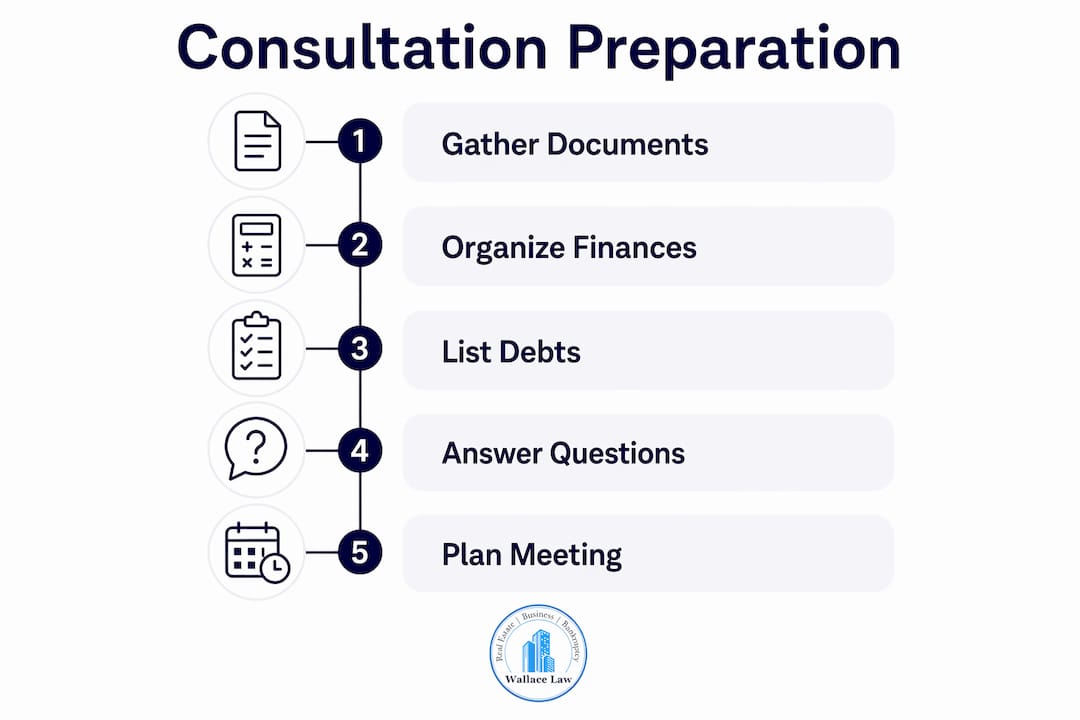
Bankruptcy attorney consultation preparation is the process of gathering your financial documents, organizing your debt and asset information, and preparing honest answers to legal questions before your first meeting with a bankruptcy lawyer. Walking into that meeting prepared is not just helpful. It directly affects how quickly your attorney can assess your eligibility, recommend the right chapter, and build your case strategy. Clients who bring organized documents and clear financial lists improve consultation efficiency and reduce overall case time. The formal term for this process in legal practice is debtor preparation, and understanding both terms helps you communicate clearly with your attorney from day one.
What documents do you need for a bankruptcy consultation?
The documents you bring to your consultation determine how much ground your attorney can cover in a single meeting. Missing paperwork does not just slow things down. It forces follow-up appointments, delays eligibility assessment, and can push back your filing date by weeks.

Government-issued identification and Social Security verification are non-negotiable starting points. You must bring a driver’s license or passport and your Social Security card or an equivalent document. Without both forms of ID, the trustee cannot begin substantive questions at the 341 meeting of creditors, and the meeting gets rescheduled. That delay costs you time and money.
Beyond identification, your financial paperwork tells the full story of your situation. Here is what to assemble before your consultation:
- Tax returns: Your two most recent federal income tax returns, including all schedules
- Pay stubs: Documentation of income for the past 60 days, covering all employment sources
- Bank statements: Statements from the past two to three months for every account you hold, including checking, savings, and investment accounts
- Debt records: Loan statements, credit card bills, medical bills, collection notices, and any court judgments against you
- Asset documentation: Property deeds, vehicle titles, retirement account statements, and any recent appraisals or valuations
- Monthly expense records: Utility bills, insurance premiums, rent or mortgage statements, and childcare costs
Means testing for Chapter 7 bankruptcy examines six months of income against allowable expenses published by the U.S. Trustee Program. This means your income and expense records are not just background information. They are the legal basis for determining whether you qualify for Chapter 7 at all.
Pro Tip: Organize your documents in labeled folders, either physical or digital. Create one folder per category: ID, income, debts, assets, and expenses. Attorneys and trustees cross-reference documents quickly, and a clear system prevents costly confusion during your meeting.
| Document category | What to include |
|---|---|
| Identification | Government photo ID and Social Security card or equivalent |
| Income records | Last two federal tax returns and 60 days of pay stubs |
| Bank statements | Two to three months of statements for all accounts |
| Debt records | Loan statements, collection letters, and court judgments |
| Asset records | Deeds, titles, retirement statements, and appraisals |
How should you organize your financial information before the meeting?
Organizing your financial information is not just about having the right papers. It is about presenting your situation clearly so your attorney can make accurate recommendations fast. A detailed list of debts, assets, income, and expenses helps your attorney recommend the right bankruptcy chapter and speeds up the entire case review process.
Start by writing out every debt you carry. Include the creditor name, account number, approximate balance, and whether the account is current, late, or in collections. Do the same for your assets. List every piece of property, vehicle, bank account, and retirement fund you own, along with your best estimate of its current value. Exact figures are not always required at the consultation stage. A reasonable approximation is far better than a blank.
Review your bank statements from the past three months before your meeting. Trustees pay close attention to large cash withdrawals, transfers to family members, or unusual deposits. Knowing your own transaction history prevents surprises and lets you explain anything that looks irregular. Your attorney needs to know about these transactions before the trustee does.
Common questions your attorney will ask during the consultation include:
- What is your total monthly income from all sources?
- Do you own real estate, and if so, what is its approximate value?
- Have you transferred any property or made large payments to anyone in the past year?
- Are any creditors currently suing you or garnishing your wages?
- Have you filed for bankruptcy before, and if so, when?
Pro Tip: Write your answers to these questions before the meeting. You do not need a polished script. A simple handwritten list of your key numbers and recent financial events is enough to keep you focused and accurate when the attorney asks.
Honesty is the single most important factor in this process. Attorneys cannot protect you from information they do not have. Omitting a debt or underreporting an asset does not make the problem disappear. It creates legal exposure that can complicate or even derail your case.
What legal deadlines and rules govern document submission?
Federal bankruptcy rules set specific deadlines for document submission, and missing them carries real consequences. Understanding these rules before your consultation puts you in a far stronger position.
Federal Rule of Bankruptcy Procedure 4002 governs a debtor’s duties regarding document production. Rule 4002(b)(3) mandates that you provide your most recent federal income tax return to the trustee at least seven days before the 341 meeting of creditors. Pay stubs covering the 60 days before filing are also required. These are not optional requests. They are federal obligations.
The 341 meeting itself is a formal proceeding where the trustee verifies your identity, reviews your petition, and asks questions under oath about your finances. Your bankruptcy petition lays the foundation for every question the trustee asks, so reviewing it carefully with your attorney before the meeting is critical. Errors or omissions in the petition become problems at the 341 meeting.
Here is a practical timeline to follow after filing:
- Day of filing: Confirm your 341 meeting date and add it to your calendar immediately
- Seven days before the 341 meeting: Submit your most recent tax return and pay stubs to the trustee
- Two to three days before the meeting: Review your filed petition with your attorney and confirm all documents are submitted
- Day of the meeting: Bring original government ID and Social Security verification, plus copies of all submitted documents
“Timing is a common pitfall in bankruptcy preparation. Document submission deadlines are keyed to the 341 meeting date, which means a single missed deadline can push your entire timeline back by weeks.”
Missing documents at the 341 meeting cause the meeting to be continued rather than dismissed, but that continuation still extends your timeline and adds stress. Proper calendar management eliminates this risk entirely. Use your phone’s calendar app or a physical planner to set reminders at least two weeks before each deadline.
How do you manage emotions and expectations during your consultation?
The bankruptcy consultation is a fact-finding meeting, not a courtroom. Your attorney is not there to judge your financial decisions. The meeting exists to gather information, assess eligibility, and build a legal strategy that protects you.
The consultation typically lasts 40 to 60 minutes and covers income, debts, and assets through direct questions. Knowing this scope in advance removes the fear of the unknown. You are not walking into an ambush. You are walking into a structured conversation with a professional who is on your side.
A few practical strategies help you show up at your best:
- Arrive on time or a few minutes early. Punctuality signals that you take the process seriously and respects your attorney’s schedule.
- Dress neatly but practically. You do not need formal attire. Clean, presentable clothing communicates respect without adding stress.
- Bring a notepad. Write down anything your attorney explains that you want to revisit later.
- Speak plainly. If you do not understand a legal term, ask for clarification immediately. Attorneys at firms like Wallacelawflorida expect and welcome these questions.
Preparation reduces anxiety because the bankruptcy process is fact-driven and document-focused rather than emotional or adversarial. When you know your numbers and have your paperwork in order, you shift from reactive to confident. That shift matters.
Pro Tip: Write down three to five questions you want to ask your attorney before the meeting ends. Good questions include: Which chapter fits my situation and why? What assets am I at risk of losing? How long will the process take from filing to discharge?
Key takeaways
Thorough bankruptcy attorney consultation preparation directly determines how fast your attorney can assess eligibility, select the right chapter, and protect your assets from the first meeting forward.
| Point | Details |
|---|---|
| Bring complete identification | Government photo ID and Social Security card are required before any substantive questions begin. |
| Organize documents by category | Labeled folders for income, debts, assets, and expenses prevent delays and confusion during review. |
| Know federal deadlines | Rule 4002 requires tax returns and pay stubs submitted to the trustee at least seven days before the 341 meeting. |
| Prepare honest financial lists | Written lists of all debts, assets, and income help your attorney recommend the right chapter faster. |
| Manage expectations going in | The consultation is a structured, fact-finding conversation that lasts 40 to 60 minutes, not an adversarial proceeding. |
What I have learned from watching clients walk in unprepared
After years of working with clients in financial distress, the single most consistent predictor of a smooth bankruptcy process is not the complexity of the debt. It is whether the client walked in prepared.
I have seen clients arrive with a grocery bag of unsorted mail and no idea of their total debt load. Those consultations take twice as long, cover half the ground, and often require a second meeting before any real strategy can form. Every extra meeting costs time, and in bankruptcy, time often means more creditor pressure, more interest, and more anxiety.
The clients who do best are the ones who treat the consultation like a business meeting. They have their numbers written down. They know roughly what they owe and to whom. They have reviewed their bank statements and can explain anything unusual. That level of preparation does not require a finance degree. It requires about two hours of focused work before the appointment.
One thing I push back on is the idea that you should wait until you have every single document before scheduling a consultation. That thinking keeps people stuck. Schedule the meeting, then use the time before it to gather what you can. Your attorney can work with approximations and flag what still needs to be collected. Waiting for perfection delays relief.
The bankruptcy filing mistakes I see most often are not legal errors. They are preparation errors. Missing a pay stub, forgetting a retirement account, or failing to disclose a recent property transfer. These are avoidable with a checklist and a clear head.
— Steven
How Wallacelawflorida helps you prepare for your consultation

Wallacelawflorida provides personalized bankruptcy consultation preparation support for individuals and families in Boynton Beach and throughout South Florida. The firm’s attorneys walk clients through document checklists, review financial summaries before filing, and prepare clients for trustee questions so nothing comes as a surprise. Unlike larger firms where you may meet a different attorney at every stage, Wallacelawflorida assigns experienced attorneys who stay with your case from the first consultation through discharge.
If you are ready to take the first step, the firm’s bankruptcy legal services page outlines how the team supports clients through every phase of the process. You can also download the 2026 bankruptcy filing checklist to start organizing your documents today before your first meeting.
FAQ
What documents should I bring to a bankruptcy consultation?
Bring government-issued photo ID, your Social Security card, two years of federal tax returns, 60 days of pay stubs, two to three months of bank statements, and a list of all debts and assets. Organized documents allow your attorney to assess your case and recommend a chapter in a single meeting.
How long does a bankruptcy attorney consultation last?
A bankruptcy consultation typically lasts 40 to 60 minutes and covers income, debts, and assets through direct questions. Arriving with organized documents and written answers keeps the meeting focused and productive.
What happens if I miss the document deadline before the 341 meeting?
Missing required documents causes the 341 meeting to be continued rather than dismissed, which extends your timeline and delays your discharge. Federal Rule 4002 requires tax returns to be submitted at least seven days before the meeting.
Do I need exact financial figures for my consultation?
Exact figures are helpful but not always required at the initial consultation stage. Reasonable approximations for asset values and debt balances are acceptable, and your attorney will identify which numbers need to be verified precisely before filing.
What questions should I ask my bankruptcy attorney?
Ask which chapter fits your situation and why, what assets you may be at risk of losing, how long the process takes from filing to discharge, and what your responsibilities are during the case. Writing these questions down before the meeting ensures you leave with clear answers.