

TL;DR:
- The automatic stay under 11 U.S.C. § 362 stops most creditor collection actions immediately upon filing without a court order. It halts lawsuits, foreclosure, garnishments, and repossessions but has statutory exceptions, and it lasts only until the case ends or a court grants relief. Proper filing and creditor notice are essential for the stay to effectively protect debtors.
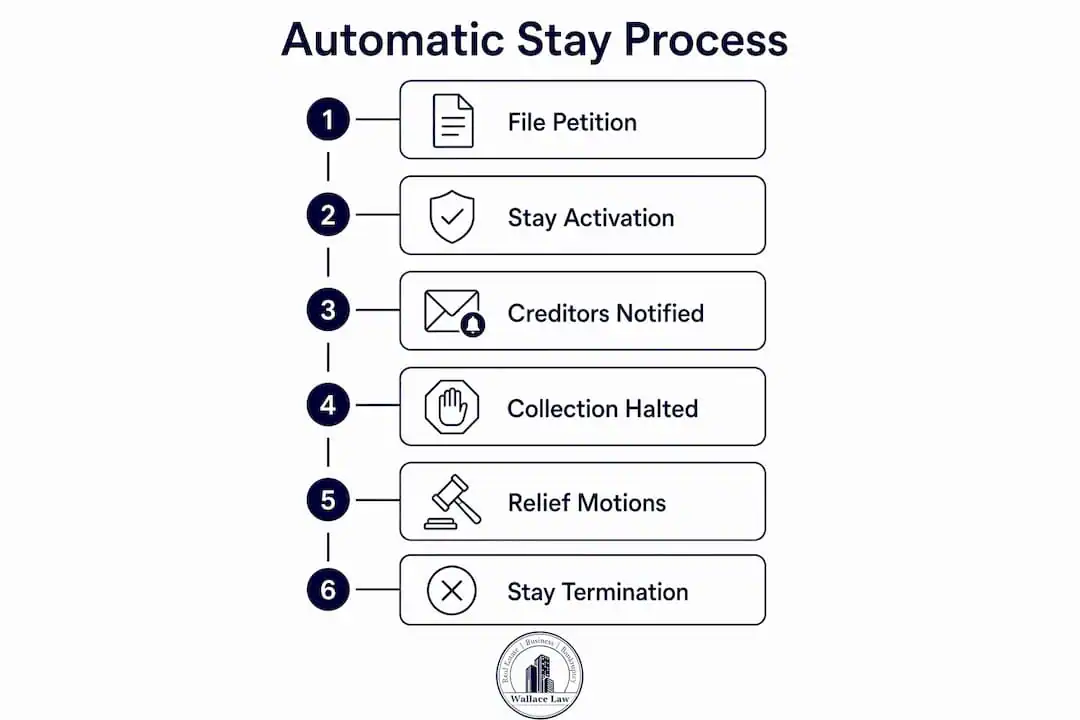
The automatic stay is a statutory injunction under 11 U.S.C. § 362 that immediately halts most creditor collection actions the moment a bankruptcy petition is filed — no court order required, no waiting period. It operates by operation of law, meaning it kicks in the instant your case number is assigned.
Here is what it stops right away:
- Active lawsuits and pending litigation against you
- Wage garnishments and bank levies
- Foreclosure proceedings and sheriff sales
- Vehicle repossessions
- Collection calls, letters, and demand notices
- Attempts to enforce or perfect liens against your property
The stay is temporary and has statutory exceptions under § 362(b). It creates breathing room, not a permanent fix. Understanding exactly how it works, where it ends, and what to do when a creditor ignores it is what this guide covers.
Note: This article is general legal information, not legal advice for your specific situation. Consult a qualified bankruptcy attorney for guidance on your case.
Table of Contents
- How the automatic stay works under 11 U.S.C. § 362
- Which creditor actions the stay stops immediately
- What the stay does not cover: statutory exceptions and limits
- How creditors seek relief from the stay
- When the automatic stay ends and how repeat filings affect it
- How the stay plays out in foreclosure, eviction, garnishment, and repossession
- What to do when a creditor violates the automatic stay
- How the stay operates differently across Chapter 7, 13, and 11
- Step-by-step actions to take immediately after filing
- What a bankruptcy attorney does to protect the stay
- Key Takeaways
- The stay is a tool, not a shield — here is what most guides miss
- Wallace Law can help you enforce your bankruptcy protections in Florida
- Useful sources
- FAQ
How the automatic stay works under 11 U.S.C. § 362
Section 362(a) of the Bankruptcy Code is the operative provision. When you file a petition under Chapter 7, 11, or 13, that filing itself acts as a nationwide injunction against virtually all pre-petition collection activity. No judge signs an order. No hearing is scheduled first. The stay takes effect the moment the petition hits the court’s docket.
The statute’s scope is broad by design. Congress described the automatic stay as “one of the fundamental debtor protections provided by the bankruptcy laws,” intended to give a debtor “a breathing spell” from creditors. Section 362(a) lists eight categories of stayed actions, from judicial proceedings and judgment enforcement to lien creation and tax court proceedings against individual debtors.
The bankruptcy clerk sends notice to every creditor listed in your petition. That process takes days, sometimes longer. The stay is legally effective before that notice arrives, but a creditor who does not yet know about the filing has a practical defense if they act before receiving notice. That gap matters, and it is why proactive notice from the debtor is so important.
| § 362 Subsection | What It Covers |
|---|---|
| § 362(a) | Creates the automatic stay upon filing; lists eight categories of stayed actions |
| § 362(b) | Lists statutory exceptions that continue despite the filing |
| § 362© | Governs automatic termination and repeat-filer limitations |
| § 362(d) | Allows creditors to seek relief from the stay after notice and hearing |
| § 362(e) | Sets the 30-day deadline for courts to rule on stay-relief requests |
| § 362(f) | Permits emergency relief from the stay to prevent irreparable harm |
The Central District of California Bankruptcy Court and other local courts publish FAQ pages that summarize these provisions for their specific jurisdictions, which is worth checking for local procedural details.
Which creditor actions the stay stops immediately
The stay functions as a hard stop on most pre-petition collection activity. If a creditor was coming after you before you filed, they generally must stop the moment your case is opened, although creditors might contest this through a fraudulent transfer claim to recover assets improperly moved before filing.
Specifically, the stay halts:
- Lawsuits and administrative proceedings filed before or that could have been filed before the bankruptcy case
- Enforcement of pre-petition judgments, including writs of execution and garnishment orders
- Wage garnishments already in effect at the time of filing
- Bank levies and setoffs of pre-petition debts
- Foreclosure actions, including scheduled sales and pending motions for summary judgment
- Repossession of vehicles or other secured collateral
- Collection calls, letters, and emails demanding payment on pre-petition debts
- Lien creation or perfection against estate property
- Utility disconnections for at least 20 days after filing
That last item deserves a closer look. Under 11 U.S.C. § 366, a utility provider cannot shut off service for the first 20 days after filing. After that window, the utility may request adequate assurance of future payment — typically a deposit — before continuing service. If you are behind on a power or water bill, filing buys you time to negotiate those terms.
A practical example: your mortgage servicer has scheduled a foreclosure sale for next Tuesday. You file Chapter 13 on Monday morning. That sale is stayed automatically. The servicer cannot proceed without first obtaining relief from the stay in bankruptcy court. Similarly, if a debt collector has a pending lawsuit against you in state court, that case freezes the moment your petition is filed — the stay stops lawsuits mid-stream, regardless of how far along the case is.
What the stay does not cover: statutory exceptions and limits
The stay is powerful, but it is not absolute. Section 362(b) lists more than two dozen exceptions, and several of them come up regularly in consumer cases.
Domestic support obligations. Actions to establish paternity, establish or modify a domestic support order, or collect support from property that is not part of the bankruptcy estate continue unaffected. Child support and alimony enforcement does not stop.
Criminal proceedings. A criminal case against the debtor proceeds regardless of the bankruptcy filing.
Police and regulatory actions. Government agencies exercising their police or regulatory powers are not stayed. The IRS can still audit you. A state agency can still pursue an enforcement action.
Certain tax actions. Tax audits, assessments, and demands for tax returns are generally not stayed, though collection of some tax debts may be.
Evictions with a pre-existing judgment of possession. If your landlord obtained a judgment of possession before you filed, the eviction may proceed in many states. Some courts allow the debtor to pay a deposit to invoke a 30-day stay, but this is jurisdiction-specific.
Post-petition obligations. The stay covers pre-petition debts. If you incur new debt after filing, those creditors are not stayed.
Non-dischargeable debts. The stay temporarily halts collection, but if a debt is non-dischargeable (student loans, recent taxes, fraud-based debts), the creditor can resume collection after the case ends. The stay is not the same as a discharge. For a deeper look at which debts survive, the guide on why debts survive bankruptcy covers this in detail.
Repeat filers. If you filed a bankruptcy case within the prior year that was dismissed, the stay may last only 30 days or may not take effect at all, depending on how many prior cases you have had. More on this in the duration section below.
Pro Tip: When reviewing an eviction notice or a landlord’s court filing, look at the date the judgment of possession was entered. If it predates your bankruptcy filing, the eviction may fall under the § 362(b)(22) exception and could proceed. This is one of the most commonly misunderstood limits of the stay.
How creditors seek relief from the stay
A creditor who wants to resume collection must file a motion for relief from the automatic stay under § 362(d). They cannot simply ignore the stay because they believe they have a strong case. The process requires court involvement.
Here is the typical sequence:
-
Creditor files the motion. The motion identifies the creditor, the collateral or claim at issue, and the legal grounds for relief. Common grounds include: lack of adequate protection for the creditor’s interest in collateral, the debtor has no equity in the property, and the property is not necessary for an effective reorganization.
-
Notice is served on the debtor and trustee. The debtor receives formal notice and has an opportunity to respond. Response deadlines vary by local court rules, but typically run 14 days.
-
Preliminary hearing is held. Under § 362(e), the court must hold a hearing within 30 days of the motion. At this stage, the court is not deciding the full merits. It is asking one narrow question: is there a reasonable likelihood the debtor will prevail at a final hearing? If yes, the stay continues. If no, it may be lifted or modified.
-
Final hearing, if needed. If the preliminary hearing results in a continued stay, a final hearing must be concluded within 30 days of the preliminary hearing unless the parties agree to extend or the court finds compelling circumstances.
-
Court rules. The court can terminate the stay, modify it (allowing the creditor to proceed only in certain ways), condition it (requiring the debtor to make payments or provide insurance), or deny relief entirely.
One important timing rule: if the court fails to rule within 30 days of the motion, the stay terminates automatically as to that creditor and that property. This is a hard statutory deadline that courts take seriously.
“Adequate protection” is the most common battleground. Courts look at whether the collateral is depreciating, whether the debtor is maintaining insurance, and whether the debtor is making any payments. Concrete forms of adequate protection include periodic cash payments to the creditor, an escrow deposit, or a replacement lien on other property. What satisfies the standard depends heavily on the specific collateral and the chapter of the case.
When the automatic stay ends and how repeat filings affect it
The stay does not last forever. Several events trigger its termination.
| Termination Event | Effect |
|---|---|
| Case dismissal | Stay ends immediately upon dismissal |
| Discharge entered | Stay as to the debtor ends; discharge injunction takes over |
| Case closure | Stay ends when the case is closed |
| Court grants relief from stay | Stay ends as to that creditor and property only |
| Repeat filer (one prior dismissal in prior year) | Stay limited to 30 days unless court extends it |
| Repeat filer (two or more prior dismissals in prior year) | No automatic stay; debtor must move to impose it |
The repeat-filer rules under § 362© are a significant trap for people who have filed and had cases dismissed before. If you had one case dismissed in the prior year, the stay in your new case lasts only 30 days. A creditor does not even need to file a motion — the stay simply expires. To extend it, the debtor must file a motion and demonstrate the new case was filed in good faith. That motion must be heard before the 30-day window closes.
Two or more prior dismissals in the preceding year means no automatic stay at all. The debtor must proactively ask the court to impose a stay and show good faith. Without that motion, creditors can proceed as if no bankruptcy was filed.
The discharge is also worth distinguishing from the stay. When a Chapter 7 discharge is entered, the automatic stay ends, but it is replaced by the discharge injunction under 11 U.S.C. § 524, which permanently bars collection of discharged debts. The stay is temporary; the discharge is permanent for covered debts.
How the stay plays out in foreclosure, eviction, garnishment, and repossession
These four situations are where the stay has the most immediate, tangible impact for most filers.
Foreclosure. Filing any bankruptcy chapter stops a pending foreclosure. The practical difference between chapters is significant. In Chapter 7, the stay buys time, but if you are behind on your mortgage and cannot cure the arrears quickly, the lender will likely file a motion for relief and obtain it within a few months. In Chapter 13, you can propose a plan that cures mortgage arrears over three to five years while keeping the home. Chapter 13 is the chapter designed for homeowners who want to save their property. Readers facing this situation should also review the common Chapter 13 mistake that derails many Florida filers.
Eviction. The stay’s protection here depends on timing. If your landlord has not yet obtained a judgment of possession, the stay halts the eviction proceeding. If a judgment of possession already exists before you file, the eviction may proceed under § 362(b)(22). Some courts allow a debtor to deposit one month’s rent with the court to invoke a 30-day stay even after a judgment, but this is not universal.
- Wage garnishment: Stops immediately on filing. Your employer must cease withholding once they receive notice of the case number.
- Bank levy: Any levy in process at the time of filing is stayed. Funds already seized may be recoverable depending on timing and exemptions.
- Vehicle repossession: The stay halts repossession. If the vehicle was already repossessed before filing, you may be able to demand its return, though this requires prompt action and sometimes a court order.
Time sensitivity warning: If a sheriff sale is scheduled for tomorrow or a repossession is imminent, same-day or emergency filing may be necessary. Courts can also grant emergency relief from the stay on an expedited basis, so a creditor facing genuine irreparable harm can move quickly. Do not assume you have days to act when hours may be what you have.
What to do when a creditor violates the automatic stay
Creditors sometimes continue collection activity after a bankruptcy is filed, either because they have not yet received notice or because they are ignoring the stay. The legal standard for enhanced remedies is a “willful” violation, meaning the creditor knew about the filing and intentionally took the action anyway.
A creditor who acts without knowledge of the filing is not automatically liable for damages. Once they receive notice, however, any continued collection activity is willful. Courts can award actual damages, costs, and attorney’s fees for willful violations under § 362(k).
Pro Tip: Document everything with timestamps. Save voicemails, screenshot emails, photograph written notices, and keep certified mail receipts. Courts rely heavily on contemporaneous records when evaluating stay-violation claims. A creditor’s attorney will argue the violation was inadvertent; your dated evidence is what counters that argument.
Here is what to collect and preserve:
- Dates and times of all collection calls, with caller ID records or voicemails saved
- Copies of any letters, emails, or texts received after the filing date
- Bank statements showing any post-filing levies or debits
- Copies of any court filings or process served after the filing date
- Certified mail receipts showing when the creditor received notice
To enforce the stay, the debtor files a motion for sanctions or contempt in the bankruptcy court. The court can order the creditor to return any money collected, pay actual damages (including emotional distress in egregious cases), and cover the debtor’s attorney’s fees. The process is handled in the bankruptcy court, not the state court where the original action was pending.
How the stay operates differently across Chapter 7, 13, and 11
The automatic stay provisions are the same statute regardless of chapter, but the practical experience differs significantly.
Chapter 7 is a liquidation. The stay stops collection immediately, but the case typically closes in three to six months. Secured creditors move quickly to file motions for relief, particularly on vehicles and real estate. If you want to keep secured property in Chapter 7, you generally need to be current on payments or reaffirm the debt. The stay gives you a window, not a long-term solution for secured debt problems.

Chapter 13 is where the stay becomes a genuine tool for keeping property. You can cure mortgage arrears through a three-to-five-year repayment plan, and the stay remains in effect for the life of the plan as long as you make plan payments and comply with court orders. Secured creditors still file motions for relief if payments lapse, but a debtor who stays current has strong protection. The bankruptcy exemptions guide explains what property you can protect alongside the stay’s protections.
Chapter 11 is primarily a business reorganization tool, though individuals with very high debt loads also use it. The stay in Chapter 11 is the same statute, but the dynamics are more complex. Large secured creditors move aggressively for relief, and the debtor-in-possession must demonstrate adequate protection quickly. Subchapter V of Chapter 11, available to small businesses, streamlines the process but the stay operates identically.
Across all chapters, the key practical difference is this: keeping collateral long-term requires a chapter that gives you a mechanism to cure arrears or restructure debt. Chapter 7 rarely does that. Chapter 13 usually can.
Step-by-step actions to take immediately after filing
The stay is legally effective the moment you file, but its real-world protection depends on what you do in the first 72 hours.
-
Confirm your case number. Get the case number from your attorney or the court’s PACER system. You will need it for every creditor contact.
-
Notify persistent creditors directly. Do not wait for the clerk’s notice to reach them. Call or send a written notice with your case number, the filing date, and the court name. Keep a log of every contact, including the name of the person you spoke with.
-
Contact your mortgage servicer immediately. Call the loss mitigation or bankruptcy department specifically, not general customer service. Provide the case number and request confirmation that the foreclosure or payment demands are stayed. Follow up in writing.
-
Notify your employer if a garnishment is in place. Your employer’s payroll department needs the case number to stop withholding. Do not assume the court notice will reach them in time for the next payroll cycle.
-
Preserve all post-filing communications. Any call, letter, or email from a creditor after your filing date is potential evidence of a stay violation. Save everything.
-
Check your bank accounts within 24 hours. If a levy was in process at the time of filing, you may need to act quickly to recover funds. Alert your attorney immediately.
-
Review your creditor list for completeness. If you forgot a creditor, they may not receive notice. A bankruptcy filing checklist can help you catch omissions before they become problems.
-
Do not make voluntary payments to pre-petition creditors without attorney guidance. Payments made after filing can create preference issues and may not be necessary given the stay.
Pro Tip: When calling a creditor to give notice, ask for the bankruptcy department specifically. General customer service representatives often cannot update the account status or stop automated collection systems. The bankruptcy department can. Get the representative’s name and employee ID if possible.
What a bankruptcy attorney does to protect the stay
Filing the petition correctly is the foundation. A single technical error in the petition, an omitted creditor, or a missed deadline can compromise the stay’s effectiveness. Attorneys who handle bankruptcy regularly know the local court’s procedural requirements, the trustee’s expectations, and the timing rules that trip up self-represented filers.
Beyond the filing itself, here is what experienced counsel does:
- Drafts and files the petition accurately, ensuring all creditors are listed so the clerk’s notice reaches them
- Provides immediate creditor notice, particularly to mortgage servicers and judgment creditors who need to act quickly
- Responds to motions for relief from stay, including filing written oppositions, gathering adequate protection evidence, and appearing at hearings
- Negotiates with secured creditors on adequate protection arrangements that keep the stay in place without requiring a contested hearing
- Files motions for sanctions when a creditor willfully violates the stay, pursuing damages and attorney’s fees on the debtor’s behalf
- Monitors the case for termination events and advises on timing for repeat filers who need a court order to impose or extend the stay
The role of a bankruptcy attorney goes well beyond paperwork. At a relief-from-stay hearing, the debtor bears the burden of showing adequate protection. Without counsel who understands what evidence courts find persuasive, that hearing can go badly fast.
Pro Tip: Bring a complete list of your assets, their approximate values, and your current monthly income and expenses to your first consultation. Attorneys can assess adequate protection arguments and stay-violation claims much faster with that information in hand.
Common filing errors that jeopardize the stay are documented in detail at 7 bankruptcy mistakes to avoid. Reviewing that list before or after filing is worth the time.
Key Takeaways
The automatic stay under 11 U.S.C. § 362 is the most immediate protection bankruptcy provides, halting most collection actions on filing, but its duration and scope depend on chapter choice, filing history, and active enforcement by the debtor.
| Point | Details |
|---|---|
| Stay starts on filing | 11 U.S.C. § 362 creates the stay instantly upon filing; no court order is needed. |
| Broad but not absolute | The stay halts lawsuits, garnishments, foreclosure, and repossession, but § 362(b) exceptions include domestic support and pre-existing eviction judgments. |
| Repeat filers face limits | One prior dismissal in 12 months limits the stay to 30 days; two or more means no automatic stay without a court motion. |
| Violations require documentation | Willful violations entitle the debtor to actual damages, costs, and attorney’s fees; preserve all post-filing creditor contacts. |
| Wallacelawflorida | Represents Florida debtors in Chapter 7 and Chapter 13 filings, stay-enforcement motions, and relief-from-stay hearings. |
The stay is a tool, not a shield — here is what most guides miss
Most articles on the automatic stay treat it as a magic button. File bankruptcy, everything stops, problem solved. That framing does real harm to people who rely on it.
The stay is a procedural injunction. It creates a window. What you do inside that window determines whether you come out of bankruptcy in a better position or simply delayed the same outcome by a few months. A homeowner who files Chapter 7 to stop a foreclosure but has no plan to cure arrears will face the same motion for relief from stay within 60 to 90 days, and the lender will get it. The stay bought time; it did not buy a solution.
What practitioners see regularly is debtors who misunderstand the stay as a permanent fix for secured debt. It is not. The discharge injunction that follows a completed case is permanent for dischargeable debts, but the stay itself is temporary. For secured creditors, the stay is a pause, not a resolution. The resolution comes from the chapter you file, the plan you propose, and whether you can demonstrate adequate protection.
The other thing most guides skip: the stay’s effectiveness depends entirely on correct, complete filing. A creditor omitted from the petition may not receive notice for weeks. An error in the petition can create grounds for a creditor to argue the stay never applied to them. These are not hypothetical risks. They happen in cases where people file without counsel or use document-preparation services that do not provide legal advice.
The stay is one of the most powerful tools in the Bankruptcy Code. Use it correctly and it genuinely changes outcomes. Misunderstand it as a permanent fix and you may find yourself back in the same position a few months later, with fewer options.
Wallace Law can help you enforce your bankruptcy protections in Florida
When a creditor calls the day after you file, or a foreclosure sale is scheduled for next week, the difference between knowing your rights and being able to enforce them is having the right attorney on your side.

Wallacelawflorida represents individuals and families throughout Florida, including Boynton Beach and surrounding areas, in Chapter 7 and Chapter 13 bankruptcy cases. The firm handles the full range of stay-related work: preparing and filing petitions, providing immediate creditor notice, opposing motions for relief from stay, and pursuing sanctions against creditors who violate the stay. If you are facing foreclosure, repossession, or aggressive collection activity, the bankruptcy practice at Wallace Law is built for exactly this situation.
For homeowners dealing with both bankruptcy and property issues, the firm also handles residential real estate matters in Florida, which often intersect with bankruptcy proceedings. To prepare for your first meeting, the consultation preparation guide explains what documents to bring and what to expect. Schedule a consultation with Wallace Law to get a clear picture of your options and what the stay can realistically do for your situation.
Useful sources
These primary and official sources are the best places to verify statute text and court guidance:
- 11 U.S.C. § 362 (Cornell LII) — Full text of the automatic stay statute, including all subsections and exceptions.
- Automatic Stay — Wex Legal Dictionary (Cornell LII) — Plain-language overview of the stay’s scope and operation.
- Bankruptcy Basics — United States Courts — Official federal court guidance on how the stay works across chapters.
- § 362© Repeat-Filer Rules — House.gov — Statutory text governing shortened and absent stays for repeat filers.
- Automatic Stay FAQ — Central District of California Bankruptcy Court — Local court FAQ explaining stay effects and procedural details for that district; check your local court for equivalent guidance.
- 11 U.S.C. § 366 — Utility Service Limitations (Cornell LII) — Governs the 20-day protection against utility disconnections after filing.
Check your local bankruptcy court’s website for district-specific rules on notice requirements, hearing schedules, and motion deadlines. Rules vary by district, and what applies in the Southern District of Florida may differ from other jurisdictions.
FAQ
What is the automatic stay in bankruptcy?
The automatic stay is a statutory injunction under 11 U.S.C. § 362 that halts most creditor collection actions the moment a bankruptcy petition is filed, with no court order required.
How long does the automatic stay last?
The stay remains in effect until the case is dismissed, a discharge is entered, the case is closed, or a court grants a creditor relief from the stay. For repeat filers with one prior dismissal in the past year, the stay lasts only 30 days unless extended by court order.
Can a creditor ignore the automatic stay?
No. A creditor who knowingly violates the stay can face actual damages, costs, and attorney’s fees under § 362(k). Documenting all post-filing contacts is critical to pursuing those remedies.
Does the automatic stay stop child support collection?
No. Domestic support obligations are explicitly excepted under § 362(b)(2). Actions to collect child support or alimony continue regardless of the bankruptcy filing.
What is the difference between the automatic stay and a discharge?
The automatic stay is temporary, pausing collection during the bankruptcy case. A discharge under 11 U.S.C. § 524 is permanent, eliminating the debtor’s personal liability for covered debts after the case concludes. The stay ends when the discharge is entered; the discharge injunction then takes over for discharged debts.