

TL;DR:
- Chapter 13 bankruptcy is a court-supervised repayment plan that allows individuals with regular income to repay debts over three to five years without losing their homes or cars. It offers legal asset protection, halts foreclosure and collection actions, and can discharge remaining unsecured debts upon successful completion. However, certain debts, such as child support, student loans, and recent taxes, do not qualify for discharge, emphasizing the importance of realistic planning and proper legal guidance.
Chapter 13 bankruptcy is a court-supervised repayment plan, sometimes called a “wage-earner’s plan,” that lets individuals with regular income repay all or part of their debts over three to five years without losing their home or car. Under 11 U.S.C. § 1322(d), the plan term is typically three years if your current monthly income falls below your state’s applicable median, and five years if it exceeds that threshold. No plan can run longer than five years. The moment you file, an automatic stay goes into effect, halting foreclosures, repossessions, and most collection calls. A court-appointed Chapter 13 trustee collects your monthly payments and distributes them to creditors according to the confirmed plan.
Here is what that means in practice:
- Who it’s for: Individuals (or spouses filing jointly) with regular income and debts below statutory caps set in 11 U.S.C. § 109.
- Plan length: Three years for below-median-income filers; five years for above-median filers (court may allow cause-based extensions for below-median filers).
- Payment flow: You pay the trustee, the trustee pays creditors in the order the confirmed plan specifies.
- Key actors: U.S. Courts oversee the process; the Chapter 13 trustee enforces compliance; attorneys like those at Wallacelawflorida draft and defend the plan.
- End result: Complete the plan, and most remaining qualifying unsecured debt balances are discharged.
Table of Contents
- Why do people choose Chapter 13 over other bankruptcy options?
- How a Chapter 13 plan is structured and how different debts are treated
- How are monthly payments calculated in Chapter 13?
- Who qualifies for Chapter 13 and what are the filing steps?
- What happens at the confirmation hearing?
- Worked payment examples: 36-month vs. 60-month plans
- What happens if you miss payments or can’t complete the plan?
- How does Chapter 13 compare to a debt management plan or Chapter 7?
- When should you call a bankruptcy attorney?
- Key Takeaways
- The part most filers underestimate about Chapter 13
- Wallacelawflorida can guide you through Chapter 13 in Florida
- Useful sources
- FAQ
Why do people choose Chapter 13 over other bankruptcy options?
The short answer: Chapter 13 lets you keep what you own while catching up on what you owe. That is the core appeal, and it separates this chapter from nearly every other debt-relief path.
Chapter 7 liquidates non-exempt assets to pay creditors and typically wraps up in a few months. Chapter 13 does the opposite. Instead of selling your home or car to satisfy debts, you protect assets during bankruptcy by committing future income to a structured repayment schedule. If you are three months behind on your mortgage and facing foreclosure, Chapter 13 can stop that process on the day you file and give you up to five years to cure the arrears. That is a concrete, legally enforceable protection that no voluntary debt arrangement can match.
Chapter 13 also carries the automatic stay, a federal court order that immediately freezes most collection actions. Wage garnishments stop. Foreclosure sales are postponed. Repossession agents stand down. A debt management plan (DMP) run by a nonprofit counseling agency cannot do any of that. A DMP is a voluntary agreement; creditors can still sue you, and the plan collapses the moment one creditor opts out.
Pro Tip: If your primary goal is saving your home from foreclosure, Chapter 13 is almost always the more effective tool. The automatic stay buys time; the plan structure buys years.
One important limitation: some debts cannot be discharged regardless of how faithfully you complete the plan. Domestic support obligations (child support, alimony), most student loans, recent income tax debts, and debts arising from fraud generally survive. Going in with realistic expectations about what will and will not be wiped out matters enormously for planning.
How a Chapter 13 plan is structured and how different debts are treated
A Chapter 13 plan is not a single lump-sum negotiation. It is a detailed payment schedule that allocates your monthly payment across several categories of debt, each with its own legal priority.
Priority claims come first and must be paid in full. These include domestic support obligations (child support and alimony), certain tax debts, and administrative costs including the trustee’s fee. There is no flexibility here: the Bankruptcy Code requires full payment of priority claims before unsecured creditors receive anything.
Secured claims are next. If you want to keep collateral (your home, your car), you must either maintain current ongoing payments and cure any arrears through the plan, or pay the creditor the value of the collateral. Mortgage arrears, for example, are spread across the plan term and paid to the trustee, while you continue making your regular monthly mortgage payment directly to the lender. In some limited situations, a “cramdown” can reduce a secured claim to the collateral’s current market value, but this is subject to strict timing and statutory rules and does not apply to primary residence mortgages.
Unsecured claims receive whatever disposable income remains after priority and secured obligations are satisfied. The plan must pay unsecured creditors at least as much as they would receive in a Chapter 7 liquidation. That floor is called the “best interest of creditors” test.
| Debt Category | Treatment in Plan | Must Be Paid in Full? |
|---|---|---|
| Priority claims (taxes, support) | Paid first from plan payments | Yes |
| Secured arrears (mortgage, car) | Cured over plan term | Yes (to retain collateral) |
| Ongoing secured payments | Paid directly or through plan | Yes (to retain collateral) |
| Nonpriority unsecured (credit cards) | Paid from disposable income | No (subject to Chapter 7 floor) |
Co-signers and joint debts deserve a specific note. The automatic stay protects you, but it does not automatically protect a co-signer on a consumer debt. Chapter 13 does include a “co-debtor stay” that can protect co-signers on consumer debts while your plan is active, provided the plan pays the co-signed debt in full. If the plan pays only a fraction, the co-signer remains exposed for the unpaid balance.
How are monthly payments calculated in Chapter 13?
The monthly payment is not simply “what you can afford.” It is the result of a specific legal calculation with several moving parts.
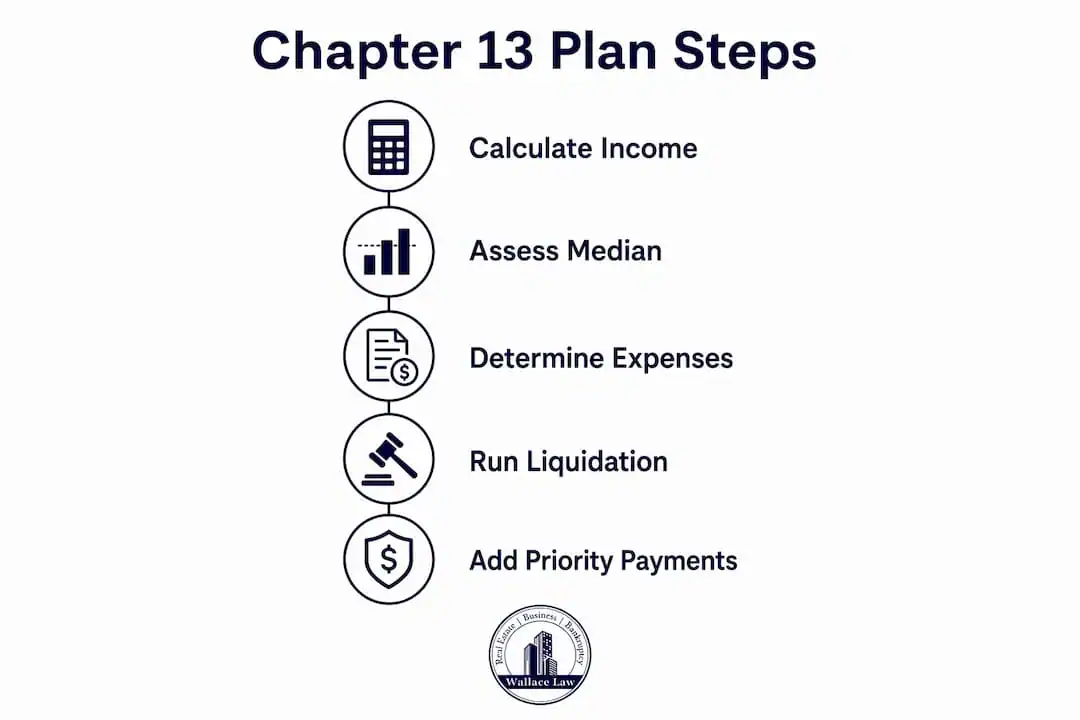
Step 1: Calculate current monthly income (CMI). CMI is the average monthly income you received over the six calendar months before filing. It includes wages, rental income, and most other regular receipts. Social Security income is excluded.
Step 2: Compare CMI to your state’s applicable median income. The U.S. Trustee Program publishes median income tables by state and household size. If your CMI falls below the median, your presumptive plan length is three years. Above the median, it is five years.

Step 3: Calculate disposable income. Disposable income equals CMI minus allowed living expenses. Allowed expenses follow IRS National and Local Standards for housing, transportation, food, and healthcare, with some room for actual documented costs. Every dollar of disposable income must go toward the plan.
Step 4: Apply the best interest of creditors test. Run a Chapter 7 liquidation analysis: what would your non-exempt assets net if sold today? Unsecured creditors must receive at least that amount across the plan. If your disposable income calculation produces a lower total, you must increase payments to meet the floor.
Step 5: Add required secured and priority payments. Mortgage arrears, car loan balances, and priority tax debts are layered on top of the disposable income figure.
The resulting formula looks like this:
Pro Tip: Trustee fees typically run around 5–10% of plan payments and are added on top of creditor distributions. Budget for them from day one, or your plan will be underfunded at confirmation.
Payments to the trustee must begin within 30 days of filing, even before the court confirms your plan. Early payments are held by the trustee and applied once the plan is confirmed. If the case is dismissed before confirmation, those funds may be refundable, but do not count on it.
| Variable | Below-Median Filer | Above-Median Filer |
|---|---|---|
| Presumptive plan length | 36 months | 60 months |
| Expense calculation method | Actual or IRS standards | IRS standards (means test) |
| Disposable income test | Simpler calculation | Full means test |
| Minimum unsecured payment | Chapter 7 liquidation value | Chapter 7 liquidation value |
For detailed guidance on preparing your Chapter 13 plan, including the documents trustees expect at confirmation, Wallacelawflorida has published a step-by-step walkthrough.
Who qualifies for Chapter 13 and what are the filing steps?
Eligibility has three hard requirements and one procedural gate you cannot skip.
- You must be an individual. Corporations and partnerships cannot file Chapter 13. Spouses may file jointly.
- You must have regular income. “Regular” does not mean salaried. Self-employment income, pension payments, and even regular contributions from a spouse can qualify, as long as the income is stable enough to fund a plan.
- Your debts must fall below statutory caps. The Bankruptcy Code sets separate limits for secured and unsecured debt. These figures have shifted in recent years, so confirm current thresholds before filing. Debt ceilings apply and filers who exceed them must look at Chapter 11 instead.
- You must complete approved credit counseling before filing as required. The course must come from a U.S. Trustee Program-approved agency. Skipping this step means your case will be dismissed. A full breakdown of the credit counseling requirement is available for Florida filers.
Filing steps:
- Complete the approved credit counseling course and obtain your certificate.
- Gather income statements (last six months of pay stubs or profit/loss records), two years of tax returns, a complete creditor list with balances, asset valuations, and monthly expense documentation.
- File the petition, schedules, and proposed plan with the bankruptcy court. The plan must be filed with the petition or within 14 days of filing per Federal Rule of Bankruptcy Procedure 3015.
- Begin making payments to the trustee within 30 days of the petition date.
- Attend the 341 meeting of creditors (usually 21–50 days after filing).
- Attend the confirmation hearing.
| Document | Purpose |
|---|---|
| Six months of income records | Establishes current monthly income |
| Two years of tax returns | Verifies income history and tax debts |
| Creditor list with balances | Forms the basis of the plan’s debt treatment |
| Asset valuations | Supports the Chapter 7 liquidation analysis |
| Credit counseling certificate | Mandatory pre-filing requirement |
| Proposed Chapter 13 plan | Filed with petition or within 14 days |
Use Wallacelawflorida’s bankruptcy filing checklist to make sure nothing is missing before you walk into court.
What happens at the confirmation hearing?
The confirmation hearing is where the judge decides whether your plan becomes legally binding. It is not a formality.
Before the hearing, the trustee reviews your income, expenses, and plan terms. Creditors have the right to object, and the trustee will almost certainly object if the budget looks padded, if disposable income appears understated, or if the plan fails the Chapter 7 baseline. The 341 meeting of creditors comes first, usually a brief session where the trustee asks questions under oath about your finances. Creditors may attend but rarely do.
At the confirmation hearing itself, the judge evaluates three things:
- Feasibility: Can you actually make these payments for the full plan term given your income and expenses?
- Good faith: Is the plan a genuine attempt to repay creditors, or does it appear designed to abuse the process?
- Best interest of creditors: Do unsecured creditors receive at least what they would get in a Chapter 7 liquidation?
If the plan passes all three tests, the judge confirms it. The confirmed plan becomes a binding court order. The trustee then distributes funds to creditors according to the plan’s priority structure, and you are locked into the payment schedule.
If the plan fails one of those tests, the judge may allow you to amend it, convert the case to Chapter 7, or dismiss the case entirely. Dismissal is the worst outcome at this stage: it lifts the automatic stay and creditors can immediately resume collection, including foreclosure.
Worked payment examples: 36-month vs. 60-month plans
These examples use hypothetical figures to show how the law translates into actual monthly payments. They are illustrative, not legal advice.
Shared inputs:
- Household size: 3
- Mortgage arrears: $12,000
- Priority tax debt: $6,000
- Nonpriority unsecured debt (credit cards): $30,000
- Non-exempt assets (Chapter 7 liquidation value): $5,000
- Trustee fee rate: 8% of plan payments
Example A: Below-median filer (36-month plan)
- CMI: $4,200/month
- Allowable expenses: $3,500/month
- Disposable income: $700/month
- Required secured arrears per month: $12,000 ÷ 36 = $333
- Required priority tax per month: $6,000 ÷ 36 = $167
- Chapter 7 baseline for unsecured: $5,000 ÷ 36 = $139
- Subtotal before trustee fee: $333 + $167 + $139 = $639
- Disposable income ($700) exceeds subtotal ($639), so $700 is the controlling figure.
- Trustee fee (8% of $700): $56
- Total monthly payment to trustee: approximately $756
- Total paid over 36 months: approximately $27,216
Example B: Above-median filer (60-month plan)
- CMI: $6,500/month
- Allowable expenses (IRS means test): $5,200/month
- Disposable income: $1,300/month
- Required secured arrears per month: $12,000 ÷ 60 = $200
- Required priority tax per month: $6,000 ÷ 60 = $100
- Chapter 7 baseline for unsecured: $5,000 ÷ 60 = $83
- Subtotal before trustee fee: $200 + $100 + $83 = $383
- Disposable income ($1,300) controls.
- Trustee fee (8% of $1,300): $104
- Total monthly payment to trustee: approximately $1,404
- Total paid over 60 months: approximately $84,240
| Metric | 36-Month Plan (Below Median) | 60-Month Plan (Above Median) |
|---|---|---|
| Monthly payment to trustee | ~$756 | ~$1,404 |
| Total paid over plan | ~$27,216 | ~$84,240 |
| Unsecured creditors receive | At least $5,000 | At least $5,000 |
| Expected discharge at completion | Remaining unsecured balances | Remaining unsecured balances |
Notice that the below-median filer pays far less in total, even though the monthly payment looks high relative to disposable income. The shorter plan term compresses the math. The above-median filer pays more in total but has a lower required monthly floor because the arrears and priority debts are spread over 60 months.
One detail that surprises many filers: ongoing mortgage payments continue outside the plan. The arrears go through the trustee; the regular monthly mortgage payment goes directly to the lender. Both must stay current or the lender can seek relief from the automatic stay.
What happens if you miss payments or can’t complete the plan?
Missing payments is the most common reason Chapter 13 cases fail, and the consequences move fast.
When payments fall behind, the trustee typically files a motion to dismiss. The court may give you a short window to catch up, but repeated defaults usually result in dismissal. Dismissal ends the automatic stay immediately. Creditors can resume garnishments, foreclosure proceedings restart, and repossession becomes possible again. The protection you filed for evaporates.
Modification is the better path when circumstances change. If your income drops or a major expense hits, you can ask the court to modify the plan. A modification can reduce monthly payments, extend the plan (within the five-year cap), or adjust how specific debts are treated. The trustee and creditors can object, and the modified plan must still pass the feasibility and best-interest tests.
Hardship discharge is available in narrow circumstances: if you cannot complete the plan due to circumstances beyond your control, the modification is not practical, and unsecured creditors have already received at least what they would have gotten in Chapter 7. It is a genuine safety valve, but it is not easy to obtain.
At successful completion, many remaining unsecured debt balances included in the plan are discharged. What survives: domestic support obligations, most student loans, recent tax debts, and debts based on fraud. A full list of debts dischargeable in bankruptcy is worth reviewing before you file.
Pro Tip: Filers are prohibited from taking on new unsecured debt during the plan without trustee or court approval. A new credit card or personal loan can trigger a motion to dismiss. Ask before you borrow anything.
On the credit side, a Chapter 13 filing stays on your credit report for seven years from the filing date. That sounds bad, but context matters. A completed Chapter 13 often looks better to future lenders than an ongoing string of missed payments, a foreclosure, or an unresolved wage garnishment. Some mortgage lenders will consider applicants two years after a Chapter 13 discharge, compared to four years after a Chapter 7 discharge, depending on loan type.
How does Chapter 13 compare to a debt management plan or Chapter 7?
The three paths serve different situations, and choosing the wrong one costs time and money.
Chapter 13 vs. a debt management plan (DMP): A DMP is a voluntary repayment arrangement, typically run by a nonprofit credit counseling agency, that consolidates your unsecured payments and may negotiate lower interest rates. There is no automatic stay, no court oversight, and no discharge. If one creditor refuses to participate, the plan falls apart. DMPs focus on full repayment with negotiated terms, not debt elimination. Chapter 13, by contrast, invokes federal court authority, stops collection actions on the filing date, and can discharge remaining unsecured balances at the end. For someone facing foreclosure or repossession, a DMP offers no meaningful protection.
Chapter 13 vs. Chapter 7: Chapter 7 is faster (typically three to six months) and eliminates most unsecured debt without a repayment plan. The trade-off is that non-exempt assets can be liquidated to pay creditors. If you have significant home equity, a car worth more than your state’s exemption, or other assets you want to keep, Chapter 7 may force you to give them up. Chapter 13 lets you keep those assets by paying their value to creditors over time. Chapter 7 also has income limits; if you earn too much to pass the means test, Chapter 13 may be your only liquidation-alternative option.
- Choose a DMP when: Your debts are primarily unsecured, your income is steady, and you can realistically repay in full within five years without court protection.
- Choose Chapter 7 when: You have little non-exempt property, your income is below the means test threshold, and you need a fast, clean discharge.
- Choose Chapter 13 when: You have secured arrears to cure, assets worth protecting, income above the Chapter 7 means test limit, or complex debts that require court-supervised restructuring.
When should you call a bankruptcy attorney?
Some Chapter 13 cases are straightforward. Most are not. Here are the situations where attempting to file without legal help is likely to cost you more than the attorney’s fee.
Red flags that mean call now:
- Foreclosure is scheduled or imminent.
- Your wages are being garnished.
- You have multiple mortgages or a second lien you want to strip.
- You owe significant tax debts, especially to the IRS. Tax debt treatment in bankruptcy is complex, and resources on IRS bankruptcy options can help frame the issues before your consultation.
- A creditor is disputing the value of collateral.
- You have non-exempt assets that would create a large Chapter 7 liquidation value, raising your required plan payment.
- You have already had a prior bankruptcy dismissed within the last year (which limits the automatic stay).
How an attorney changes the outcome:
- Accurate collateral valuation to support cramdown arguments or avoid overpaying secured creditors.
- A budget that passes trustee scrutiny without leaving you unable to live on what remains.
- Plan provisions that protect co-signers where possible.
- Representation at the 341 meeting and confirmation hearing, where trustee objections are most likely.
- Filing modifications or hardship petitions if your circumstances change mid-plan.
What to bring to a first consultation:
- Last six months of pay stubs or income records
- Two years of federal tax returns
- A list of all creditors with balances and account numbers
- Recent mortgage statements and any foreclosure notices
- Vehicle titles and recent appraisals if relevant
- Any pending lawsuits or garnishment orders
Wallacelawflorida handles Chapter 13 plan drafting, confirmation representation, and plan modifications for clients in Boynton Beach and surrounding areas in Florida. Understanding the role of a bankruptcy attorney before your first meeting helps you ask the right questions and get more out of the consultation.
Key Takeaways
Chapter 13 is a three-to-five-year court-supervised repayment plan that protects assets, cures secured arrears, and discharges remaining qualifying unsecured debt upon completion, provided payments stay current and the plan meets the Chapter 7 baseline for unsecured creditors.
| Point | Details |
|---|---|
| Plan length is income-driven | Below-median filers get a 36-month plan; above-median filers must complete 60 months per 11 U.S.C. § 1322(d). |
| Payments start before confirmation | First payment to the trustee is due within 30 days of filing, regardless of whether the plan is confirmed yet. |
| Unsecured creditors have a floor | The plan must pay unsecured creditors at least what they would receive in a Chapter 7 liquidation. |
| Missed payments can end the protections of the bankruptcy. | Dismissal lifts the automatic stay immediately, allowing creditors to resume foreclosure or repossession. |
| Wallacelawflorida can help | The firm drafts Chapter 13 plans, handles confirmation hearings, and files modifications for Florida filers. |
The part most filers underestimate about Chapter 13
Most people walk into a Chapter 13 consultation focused on the monthly payment number. That is understandable. But the payment is almost never the hardest part. What actually determines whether a plan succeeds or fails is the budget.
Trustees and judges review expense schedules closely. If your claimed food budget is well above IRS standards for your household size, expect an objection. If your transportation costs include a car payment on a vehicle you plan to surrender, that line item will get cut. The plan has to be realistic in both directions: tight enough to satisfy the best-interest test, but livable enough that you can actually make payments for three to five years without defaulting.
The filers who struggle most are those who file with a budget that looks good on paper but does not reflect how they actually spend money. Six months in, an unexpected car repair or medical bill breaks the plan. The smarter approach is to build a small buffer into the budget from the start, document every expense category carefully, and treat the plan term like a financial commitment you cannot walk away from.
Chapter 13 is not a punishment. It is a structured path out of a situation that would otherwise end in foreclosure, repossession, or years of wage garnishment. The filers who complete it successfully tend to be the ones who went in with clear eyes about what the plan required, not just what it promised.
Wallacelawflorida can guide you through Chapter 13 in Florida
Facing a Chapter 13 filing without experienced local counsel is one of the more avoidable ways to make a hard situation harder. Wallacelawflorida works with individuals in Boynton Beach and the surrounding South Florida area on exactly these cases: plan drafting that holds up at confirmation, representation when trustees or creditors object, and modifications when life changes mid-plan.

The firm’s bankruptcy practice area covers the full Chapter 13 process, from the first document review through discharge. If you want to understand your options before committing to anything, the firm also offers a free Florida bankruptcy eBook covering Chapter 13 strategies and what to expect at each stage. For homeowners specifically, protecting home equity during a Chapter 13 plan is one of the firm’s core areas of focus. Contact Wallacelawflorida to schedule a consultation and bring the documents listed in the filing checklist above. The earlier you call, the more options you have.
Useful sources
- Chapter 13 Bankruptcy Basics, U.S. Courts — primary overview of Chapter 13 rules, trustee role, and plan requirements.
- 11 U.S.C. § 1322(d) via U.S. Courts Instructions for Individual Debtors — statutory authority for plan length limits and eligibility.
- Federal Rules of Bankruptcy Procedure, Rule 3015, Cornell LII — timing rules for plan filing and first payment.
- Chapter 13 Plan, Official Form 113, U.S. Courts — the required plan form used in all Chapter 13 cases.
- Median Income Tables, U.S. Trustee Program — current state-by-state median income figures for determining plan length.
- Chapter 13 Plan, Cornell LII Wex — plain-language explanation of plan structure and creditor treatment.
- Wallacelawflorida Chapter 13 Repayment Plan Setup Guide — local practice notes and setup walkthrough for Florida filers.
FAQ
What is a bankruptcy repayment plan?
A bankruptcy repayment plan, specifically a Chapter 13 plan, is a court-approved schedule under which an individual with regular income repays all or part of their debts over three to five years, with a court-appointed trustee collecting and distributing payments to creditors.
Is a debt repayment plan the same as bankruptcy?
No. A debt management plan (DMP) is a voluntary, non-court arrangement run by a nonprofit counseling agency that consolidates payments but provides no automatic stay and no debt discharge. Chapter 13 bankruptcy is a federal court process with legal protections, trustee oversight, and the possibility of discharging remaining qualifying debt at completion.
What happens if you can’t pay back bankruptcy?
If you miss Chapter 13 payments, the trustee can file a motion to dismiss your case. Dismissal ends the automatic stay immediately, allowing creditors to resume foreclosure, repossession, and garnishment. Alternatively, you may be able to modify the plan or, in limited hardship situations, seek an early discharge.
Can you negotiate the terms of a Chapter 13 plan?
The debtor proposes the plan, so there is significant room to structure payments, treatment of secured arrears, and the amount paid to unsecured creditors, as long as the plan meets the statutory requirements. Creditors and the trustee can object, and the court has final approval, but an experienced attorney can negotiate plan provisions that satisfy legal requirements while protecting your priorities.
How long does Chapter 13 stay on your credit report?
A Chapter 13 filing remains on your credit report for seven years from the filing date. Completing the plan successfully can position you more favorably with future lenders than an unresolved foreclosure or ongoing garnishment, and some mortgage programs allow applications as soon as two years after discharge.