

A notice of foreclosure sale is the formal legal document that tells you your property is scheduled for a public auction to satisfy a defaulted mortgage debt. This is not a warning or a preliminary step. By the time you receive it, the foreclosure process is already well advanced, and the clock is running on your options.
Here is what the notice must include, according to legal requirements:
- Property description: The legal address and identifying details of the home being sold
- Total amount owed: Principal, accrued interest, late fees, and foreclosure costs
- Sale date, time, and location: The specific auction details, usually at a courthouse or public venue
- Trustee or sheriff information: Name, address, and contact details of the party conducting the sale
- Statement of public auction: A clear declaration that the property will be sold to the highest bidder
Delivery typically happens by certified mail, and in most states the notice must also be published in a local newspaper and posted on the property itself.
What are the legal requirements for a foreclosure sale notice?
State and federal law impose strict rules on what a notice must contain, how it gets delivered, and how far in advance it must be issued. Lenders cannot simply set a sale date and send a letter. They must follow a defined process, and any deviation can give you grounds to challenge the sale.

Timing requirements vary significantly by state. In Texas, the servicer must provide the notice at least 21 days before the sale date. California requires a 90-day waiting period after the notice of default is recorded before a notice of sale can even be filed, and then at least 21 more days must pass before the auction can occur. These deadlines are not suggestions. Courts have invalidated sales where lenders cut corners on timing.
Publication and service rules are equally strict. Under California law, the notice must be:
- Sent to the homeowner by certified mail
- Published weekly in a newspaper of general circulation in the county for three consecutive weeks before the sale
- Posted on the property and in a public place, typically the local courthouse
Most states follow a similar framework, though the exact publication period and posting requirements differ. Federal rules from the Consumer Financial Protection Bureau add another layer, requiring servicers to follow loss mitigation procedures before proceeding to sale.
Content errors can invalidate the notice entirely. Misspelled names, incorrect property descriptions, or wrong sale details are not minor clerical issues. Strict drafting standards exist precisely because the notice also functions as a public advertisement for the auction, and title clarity depends on it.
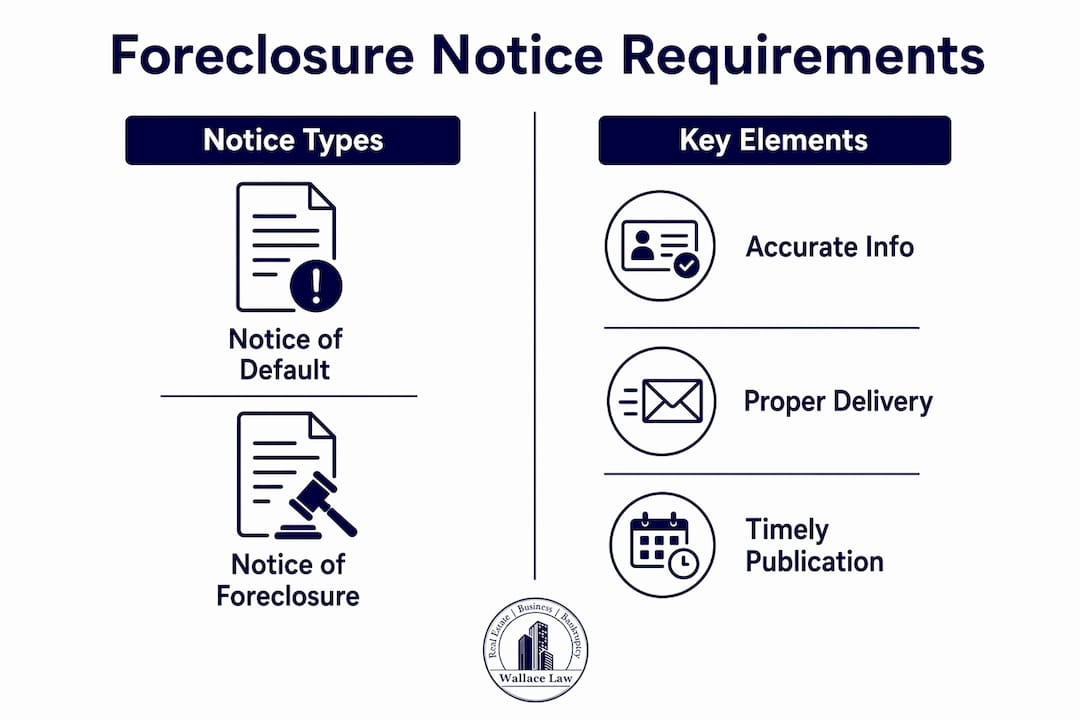
How does a notice of default differ from a notice of foreclosure sale?
These two documents mark completely different stages of the foreclosure process, and confusing them costs homeowners time they cannot afford to lose.

A notice of default is the opening move. It signals that you have missed payments and that the lender is formally initiating the foreclosure process. In nonjudicial foreclosures, it gets recorded with the county recorder’s office and triggers a reinstatement or cure period, typically three months in California, during which no notice of sale can be recorded. In Texas, a similar document called a “Notice of Default” starts a 20-day right-to-reinstate period. This is your widest window to catch up on payments, negotiate a modification, or explore other options.
A notice of foreclosure sale comes later and carries a fundamentally different message. It does not ask you to cure anything. It tells you a sale date has been set. Your options narrow considerably at this point, though they do not disappear entirely.
Key distinctions at a glance:
| Notice of Default | Notice of Foreclosure Sale | |
|---|---|---|
| When issued | Early in foreclosure process | After cure period expires |
| Purpose | Signals default, starts cure period | Schedules the public auction |
| Homeowner options | Reinstate, modify, negotiate | Reinstate (limited window), contest, file bankruptcy |
| Foreclosure type | Both judicial and nonjudicial | Both judicial and nonjudicial |
In a judicial foreclosure, the court issues a judgment ordering the sale, and the clerk prepares an order directing the sheriff to proceed. In a nonjudicial foreclosure, the trustee handles the process without court involvement, but the notice sequence still applies.
What happens during the foreclosure sale process after you receive the notice?
Once the notice of foreclosure sale is issued, the timeline moves quickly. Here is the standard sequence:
- Notice issued: The trustee or sheriff records and serves the notice, starting the statutory countdown.
- Waiting period: Depending on your state, you have a defined window (21 days in Texas, at least 21 days after recording in California) before the auction can legally occur.
- Auction day: The sale is held at a public location, often the courthouse steps. The auction runs as public bidding, with the property sold to the highest bidder.
- Credit bidding by the lender: The lender typically bids the full amount of the debt owed rather than paying cash. A third-party buyer must exceed that amount with certified funds or cash to win the property.
- Transfer of title: The winning bidder receives a trustee’s deed or sheriff’s deed once the sale is confirmed.
- REO status: If no third party outbids the lender, the property becomes real estate owned (REO) by the bank.
One thing many homeowners do not realize: foreclosure sales are frequently cancelled or rescheduled due to ongoing negotiations, bankruptcy filings, or lender procedural errors. The sale date on the notice is not necessarily final. Staying in contact with your servicer through the entire period can matter.
Some states also provide a redemption period after the sale, during which you can reclaim the property by paying the full debt. That window is short and varies by state, so acting before the auction is always the better position.
What rights do you have after receiving a notice of foreclosure sale?
Receiving this notice does not mean the outcome is decided. You retain several legal rights, and exercising them quickly is what separates homeowners who save their homes from those who lose them.
Reinstatement rights let you stop the foreclosure by paying all past-due amounts plus fees before a firm deadline. In California, that deadline falls five days before the sale. In other states, reinstatement may be possible up to the moment bidding begins. Check your state’s statute and your loan documents for the exact cutoff.
Contesting the notice is a real option when the lender made procedural errors. Incorrect property descriptions, wrong names, or missed publication deadlines can render the notice invalid and provide grounds to challenge the sale in court. These are not technicalities courts ignore. Title clarity depends on proper procedure, and judges take it seriously.
Loss mitigation and loan modification remain available even at this late stage. The CFPB requires servicers to review complete loss mitigation applications before proceeding to sale in many circumstances. Applying immediately after receiving the notice can pause the process.
Bankruptcy is the most powerful short-term tool. Filing triggers an automatic stay that halts the foreclosure sale immediately. Whether Chapter 7 or Chapter 13 is the right fit depends on your financial situation, but the foreclosure defense options available through bankruptcy are worth understanding before the sale date arrives.
Credit impact is real and lasting. A completed foreclosure sale appears on your credit report and stays there for seven years from the date of your first missed payment. That affects your ability to get a mortgage, rent an apartment, or qualify for certain jobs. Acting before the sale closes is the only way to avoid that outcome.
Pro Tip: Contact your mortgage servicer the same day you receive the notice and ask specifically about loss mitigation options. The CFPB’s guidance makes clear that protections diminish the closer you get to the sale date, so waiting even a few days can cost you options that were available the week before.
Facing a foreclosure sale notice in Florida? Wallacelawflorida can help.

A notice of foreclosure sale is serious, but it is not the end of the road. Wallacelawflorida works with homeowners in Boynton Beach and across South Florida who are navigating exactly this situation. The attorneys at Wallacelawflorida understand Florida’s foreclosure statutes, the deadlines that matter, and the legal strategies that can delay or stop a sale entirely.
Whether you need to contest a procedurally defective notice, explore residential real estate legal help, or understand how bankruptcy might protect your home, Wallacelawflorida offers the kind of direct, personal attention that larger firms rarely provide. Contact Wallacelawflorida today before the sale date on your notice gets any closer.
Key Takeaways
A notice of foreclosure sale is a legally binding document that schedules your home for public auction, and your rights to reinstate, contest, or delay the sale expire on firm statutory deadlines that vary by state.
| Point | Details |
|---|---|
| Definition and purpose | A formal legal document scheduling a public auction to satisfy a defaulted mortgage debt. |
| Timing requirements | Texas requires at least 21 days’ notice before sale; California requires 90 days after notice of default before a notice of sale can be recorded. |
| Notice of default vs. notice of sale | Notice of default starts the cure period; notice of sale sets the auction date and narrows your options. |
| Reinstatement deadline | In California, reinstatement rights expire five days before the scheduled sale date. |
| Credit impact | A completed foreclosure sale stays on your credit report for seven years from the first missed payment. |
FAQ
What is a notice of foreclosure sale?
A notice of foreclosure sale is a formal legal document informing a homeowner that their property is scheduled for a public auction to satisfy a defaulted mortgage debt, including the sale date, location, and total amount owed.
Do you get any money from a foreclosure sale?
You only receive money if the property sells for more than the total debt and foreclosure costs owed to the lender. Surplus funds after all debts are paid go to the homeowner, but this outcome is uncommon since lenders typically bid the full amount owed.
How many notices do you get before foreclosure?
Homeowners typically receive two key notices: a notice of default, which starts the cure period, followed by a notice of foreclosure sale once that period expires. Additional breach letters and servicer communications may precede both.
What happens at a foreclosure sale?
The property is auctioned at a public location, usually a courthouse. The lender bids the amount of the debt owed as a credit bid, and third-party buyers must pay more in cash or certified funds to win. The successful bidder receives a deed once the sale is confirmed.
How can you respond to a foreclosure sale notice?
You can reinstate the loan by paying all arrears before the state deadline, apply for loss mitigation or a loan modification, contest the notice if it contains legal errors, or file for bankruptcy to trigger an automatic stay that halts the sale.