

TL;DR:
- An LLC is a state-created legal entity that shields owners’ personal assets from business debts. Formation involves filing articles of organization, paying fees, and creating an operating agreement to maintain liability protections. IRS treats LLCs based on membership and elections, offering pass-through taxation and management flexibility.
A limited liability company, or LLC, is a state-authorized business entity that shields its owners’ personal assets from business debts while allowing profits and losses to pass directly through to their personal tax returns. This structure sits between a sole proprietorship and a corporation, combining the legal protection of a corporation with the tax simplicity of a partnership. For entrepreneurs in Florida and across the United States, understanding the LLC definition is the first step toward making a sound decision about how to structure a business. The LLC structure overview matters because the wrong choice can expose your personal savings, home, and other assets to business creditors.
What is LLC explained: the core definition
An LLC is defined as a separate legal entity created under state law, distinct from its owners (called members). That separation is the foundation of everything the structure offers. The IRS does not treat an LLC as a single tax classification. Instead, tax filing depends on the chosen business form and the number of members, which means the LLC benefits explained below operate on two distinct layers: state law grants liability protection, and IRS classifications determine tax treatment.

The LLC definition covers a wide range of business types. A solo freelancer, a two-person real estate partnership, and a multi-investor holding company can all operate as LLCs. What does LLC mean in practice? It means your business has a legal identity of its own. If the business is sued or owes a debt, creditors pursue the business’s assets, not your personal bank account. That protection, however, is not automatic or permanent. It requires active maintenance, which is covered in detail below.
How to form an LLC: steps, fees, and requirements
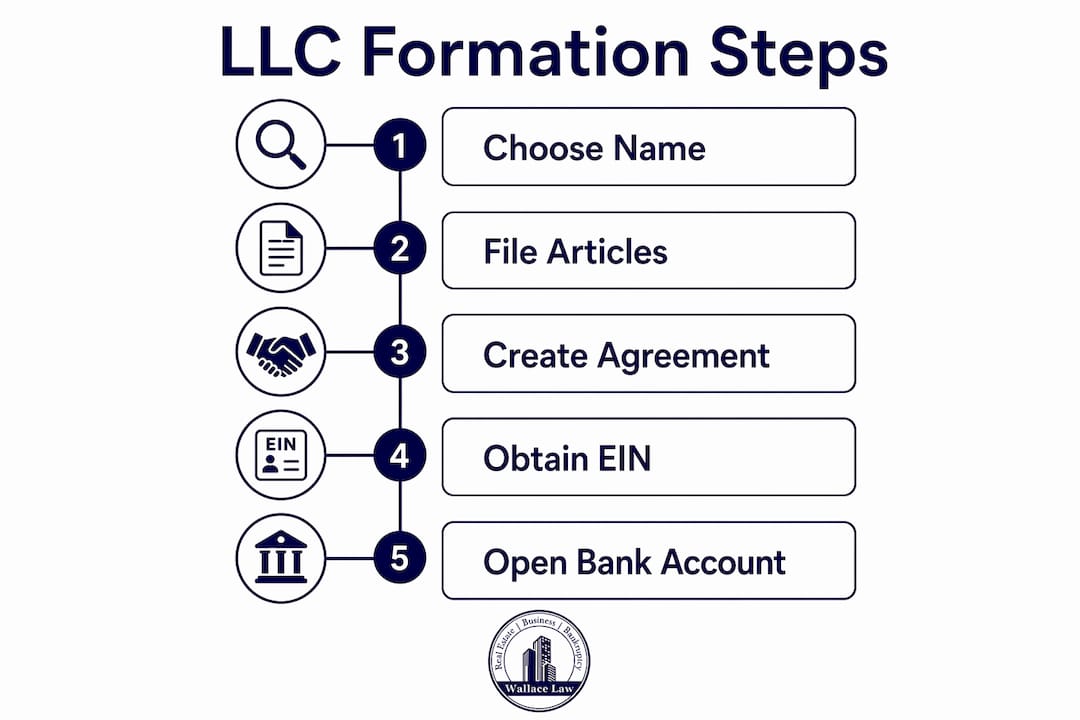
Formation is a state-level process, and every state has its own rules, fees, and timelines. The general process follows a predictable sequence.
- Choose a state of formation. Most small businesses form in the state where they operate. Florida entrepreneurs, for example, file with the Florida Division of Corporations.
- Select a business name. The name must be unique within the state and include “LLC,” “L.L.C.,” or “Limited Liability Company.”
- File Articles of Organization. This is the primary formation document. Filing fees range from $50 to $500 depending on the state. Florida’s fee is currently $125.
- Receive state certification. Once the state approves the filing, you receive a certificate of formation. This document enables you to open a business bank account and apply for an Employer Identification Number (EIN) from the IRS.
- Draft an operating agreement. States typically do not require operating agreements but strongly recommend them. This internal document defines ownership percentages, voting rights, profit distribution, and management procedures.
- Obtain required licenses and permits. Depending on your industry and location, additional Florida business license requirements may apply before you can legally operate.
Pro Tip: Draft your operating agreement before you open a bank account or sign any contracts. Courts and creditors look at this document to determine whether your LLC is genuinely separate from you as an individual. A well-written agreement strengthens that separation.
The operating agreement also serves a critical function beyond governance. It helps the LLC withstand legal challenges to its separate existence, which matters enormously if you are ever sued.
How are LLCs taxed at the federal level?
The IRS does not recognize the LLC as a distinct tax category. Instead, it classifies LLCs using existing tax frameworks based on how many members the LLC has and whether the owners make an election to change the default treatment.
| LLC type | Default IRS treatment | Key form filed |
|---|---|---|
| Single-member LLC | Disregarded entity (sole proprietor) | Schedule C on Form 1040 |
| Multi-member LLC | Partnership | Form 1065 with Schedule K-1s |
| LLC electing S-Corp status | S corporation | Form 1120-S |
| LLC electing C-Corp status | C corporation | Form 1120 |
Single-member LLCs report income on Schedule C of the owner’s personal return, meaning no separate federal LLC tax return is filed. This simplifies compliance significantly for solo entrepreneurs. Multi-member LLCs file Form 1065 and issue Schedule K-1s to each member, who then reports their share on their personal returns.
All default LLC structures use pass-through taxation. Profits pass directly to members’ personal returns, avoiding the double taxation that C corporations face, where the company pays corporate income tax and shareholders pay tax again on dividends. For most small business owners, this is one of the most tangible LLC benefits explained in plain terms.
The S-Corp election deserves special attention. This option benefits LLCs with net profits above $60,000 to $80,000 because it allows owners to split income into a reasonable salary and distributions. Only the salary portion is subject to self-employment taxes (currently 15.3%), while distributions are not. The savings can be substantial at higher income levels.
Pro Tip: The S-Corp election is not right for every LLC. It adds payroll obligations and IRS scrutiny around what counts as a “reasonable salary.” Consult a tax professional before making this election, especially if your net profit is near the $60,000 threshold.
What liability protections does an LLC provide?
An LLC creates a legal wall between you and your business. Creditors generally pursue only the LLC’s assets, not your personal savings, home, or vehicle. This protection is the primary reason entrepreneurs choose the LLC structure over operating as a sole proprietor or general partner.
That said, commingling funds and personal guarantees can cause veil piercing, where courts disregard the LLC’s separate existence and hold owners personally liable. Veil piercing is not rare. Courts examine factors including undercapitalization, mixing personal and business finances, failure to follow operating agreement procedures, and fraudulent conduct.
Common scenarios that break LLC protection include:
- Paying personal bills from the LLC’s bank account
- Signing a personal guarantee on a business loan
- Failing to maintain any business records or meeting minutes
- Operating the LLC without adequate capital to cover foreseeable liabilities
- Committing fraud or intentional misconduct through the business
Maintaining separate bank accounts and business records is the single most effective practice for preserving LLC liability protection. Open a dedicated business checking account the day your EIN arrives. Never use it for personal expenses.
“The LLC shield is only as strong as the discipline behind it. Owners who treat the business account like a personal wallet often discover the hard way that courts agree with them.”
Personal liability also applies when an owner is directly negligent. If you personally cause harm while performing business activities, the LLC does not protect you from claims arising from your own misconduct. The entity protects against business debts and third-party claims against the business, not against your individual actions.
How does LLC management work?
LLC management structure is defined in the operating agreement and falls into two categories. LLCs allow member-management or manager-management structures, and the choice affects who has authority to sign contracts, open accounts, and make operational decisions.
Key features of each structure:
- Member-managed: All owners participate in day-to-day decisions. This works well for small LLCs where all members are active in the business.
- Manager-managed: One or more designated managers (who may or may not be members) run the business. This suits LLCs with passive investors who want returns without operational involvement.
- Ownership by membership interests: Unlike corporations that issue shares, LLCs represent ownership through membership interests. These can be structured with different economic rights and voting rights for different members.
- Voting rights: The operating agreement defines whether decisions require a simple majority, supermajority, or unanimous consent.
- Flexibility for small businesses: A two-person LLC can give one partner 60% economic interest and equal voting rights, or any other combination that fits the business relationship.
This hybrid flexibility is one of the defining advantages of the LLC structure overview compared to corporations, which must follow rigid governance rules under state corporate law.
What are the main benefits and limitations of an LLC?
The LLC structure offers a compelling combination of protection and simplicity, but it is not the right choice for every situation.
Primary benefits:
- Personal asset protection from business liabilities (when properly maintained)
- Pass-through taxation that avoids corporate double taxation
- Flexible management structures without corporate formality requirements
- Credibility with banks, vendors, and clients compared to operating as a sole proprietor
- Ability to elect S-Corp or C-Corp tax treatment without changing the state entity structure
Common limitations:
- State filing fees and annual report fees add ongoing costs
- Self-employment taxes apply to active members under default tax treatment
- LLC protections are not absolute and require consistent operational discipline
- Some states impose franchise taxes or gross receipts taxes on LLCs regardless of profitability
- Raising investment capital is harder than with a corporation, since venture capital firms typically prefer C-Corp structures
Pro Tip: If you plan to seek venture capital or issue stock options to employees, a Delaware C corporation may serve you better than an LLC. The LLC is ideal for businesses that prioritize simplicity, tax efficiency, and liability protection without complex equity structures.
For most solo entrepreneurs and small business owners, the LLC remains the most practical starting point. If you are converting from a sole proprietorship, the transition is straightforward and the liability protection gained is immediate upon formation.
Key takeaways
An LLC provides legally recognized personal asset protection and pass-through taxation, but both benefits require active maintenance and informed tax elections to deliver their full value.
| Point | Details |
|---|---|
| Core LLC definition | An LLC is a state-created entity that separates personal assets from business liabilities. |
| Formation basics | File Articles of Organization with your state and pay fees ranging from $50 to $500. |
| Default tax treatment | Single-member LLCs use Schedule C; multi-member LLCs file Form 1065 with K-1s. |
| Liability protection limits | Commingling funds or signing personal guarantees can expose owners to personal liability. |
| Management flexibility | LLCs can be member-managed or manager-managed, with ownership defined by membership interests. |
What I have learned from watching LLC owners get this wrong
After working with entrepreneurs across Florida on business formation and compliance, the pattern I see most often is not a failure to form the LLC. It is a failure to operate it correctly after formation.
Most people assume the LLC shield is automatic once the state approves the filing. It is not. The protection exists on paper, but courts look at behavior. I have seen owners lose that protection because they used one bank account for everything, paid a personal credit card from the business account, or never signed a single document as “Manager” of the LLC. Those details matter in litigation.
The tax side surprises people too. Many owners assume pass-through taxation means no tax complexity, but self-employment taxes on active income can reach 15.3% before federal income tax. The S-Corp election is a real strategy, not a loophole, and it is worth modeling once your net profit clears $60,000 consistently.
My honest recommendation: get professional legal guidance during formation. The filing itself is simple. The decisions around operating agreements, management structure, and tax elections are where most people leave money and protection on the table. A one-time conversation with an attorney who knows your state’s rules is worth far more than fixing problems after the fact.
— Steven
Get the right legal support for your LLC in Florida

Forming an LLC is one of the most important decisions you will make as a business owner, and the details matter far more than most online guides suggest. Wallacelawflorida provides tailored business legal support for entrepreneurs in Boynton Beach and throughout Florida, covering LLC formation, operating agreements, compliance, and ongoing protection. The team at Wallace Law understands Florida’s specific requirements and works directly with clients to get the structure right from day one. If you want to form your LLC without costly missteps, review the Florida LLC formation guide or contact Wallace Law directly for personalized guidance.
FAQ
What does LLC mean in legal terms?
LLC stands for Limited Liability Company, a state-authorized business entity that separates its owners’ personal assets from business debts and liabilities. The IRS does not treat it as a single tax category; classification depends on member count and any tax elections made.
How much does it cost to form an LLC?
State filing fees for LLC formation range from $50 to $500 depending on the state. Florida’s current Articles of Organization fee is $125, with additional annual report fees required to keep the LLC active.
Does an LLC protect personal assets in all situations?
No. LLC liability protection fails when owners commingle personal and business funds, sign personal guarantees, or engage in fraud. Courts can pierce the LLC veil and hold owners personally liable when the business is not genuinely operated as a separate entity.
How is a single-member LLC taxed?
A single-member LLC is taxed as a disregarded entity by default, with income reported on Schedule C of the owner’s personal Form 1040. No separate federal tax return is required unless the owner elects corporate tax treatment.
Can an LLC elect to be taxed as an S corporation?
Yes. An LLC can file IRS Form 2553 to elect S-Corp tax status, which allows owners to split income into salary and distributions. This election benefits LLCs with consistent net profits above $60,000 to $80,000 by reducing self-employment tax exposure.