

TL;DR:
- Chapter 7 bankruptcy is a federal process that liquidates nonexempt assets to discharge most unsecured debts. It typically takes 3 to 6 months, giving individuals a fresh financial start while protecting essential property through exemptions. Most debts like credit cards and medical bills are eliminated, but obligations such as child support, student loans, and recent taxes remain.
Chapter 7 bankruptcy is defined as a federal legal process that eliminates most unsecured debts by liquidating a debtor’s nonexempt assets and issuing a discharge order. Known formally as liquidation bankruptcy, it gives individuals and families a legal fresh start when debt becomes unmanageable. The Chapter 7 bankruptcy process typically runs 3–6 months from filing to discharge, making it one of the fastest debt relief options available under federal law. Understanding what is chapter 7 bankruptcy, who qualifies, and what it actually costs can mean the difference between years of financial paralysis and a real path forward.
What is Chapter 7 bankruptcy and how does it work?
Chapter 7 bankruptcy is a liquidation proceeding governed by Title 11 of the United States Code. A court-appointed bankruptcy trustee reviews your assets, pays creditors from any nonexempt property, and then the court issues a discharge that legally eliminates your remaining qualifying debts. The entire process is designed to give honest debtors a clean slate, not to punish them.

The phrase “liquidation bankruptcy” sounds alarming, but the reality is far less dramatic for most filers. Most Chapter 7 cases are “no-asset” cases, meaning the trustee finds no nonexempt property to sell. Federal and state exemptions protect your home equity up to a limit, your car, household goods, retirement accounts, and other essentials. You walk away from the process with your possessions intact and your qualifying debts gone.
The discharge order is the core benefit. Once issued, creditors are permanently barred from collecting on discharged debts. That means no more collection calls, no wage garnishments, and no lawsuits over those specific balances.
How does the Chapter 7 bankruptcy process work step by step?
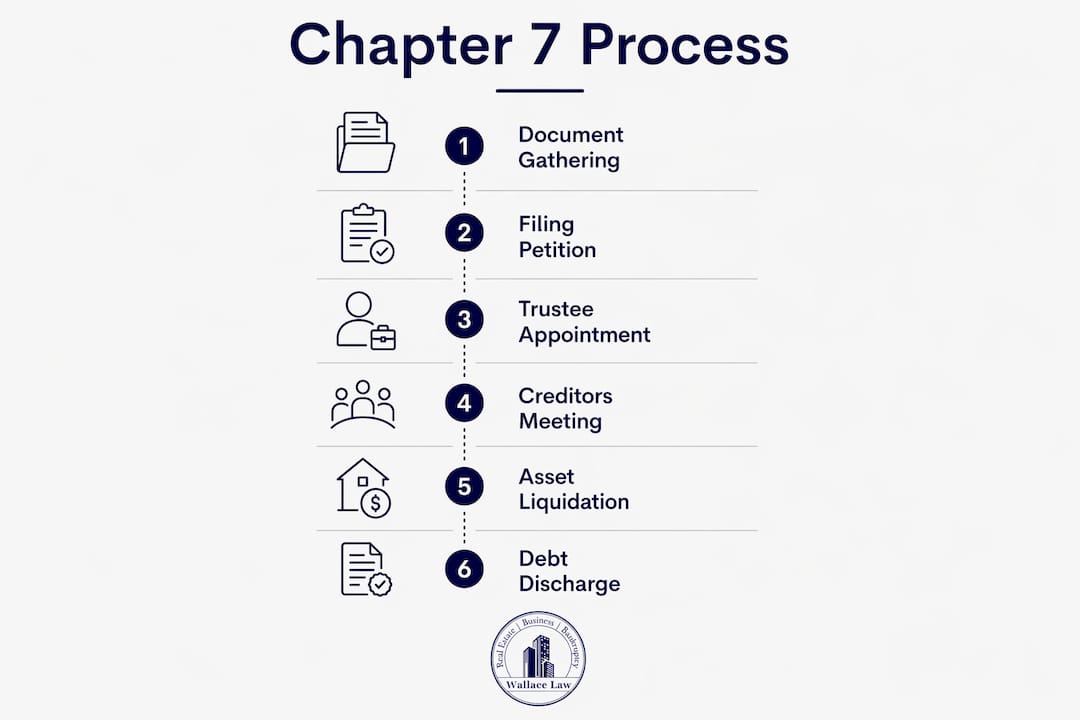
The Chapter 7 bankruptcy process follows a defined sequence. Each step has a legal purpose, and skipping any one of them can delay or block your discharge.
-
Complete pre-filing credit counseling. Before you file, federal law requires you to complete an approved credit counseling course. The pre-filing course costs $10–$50 and takes about one hour online. This is not optional. Courts reject petitions filed without it.
-
File your bankruptcy petition. You submit a petition, schedules of assets and liabilities, a statement of financial affairs, and your means test calculation to the federal bankruptcy court. Filing triggers the automatic stay immediately.
-
The automatic stay activates. The automatic stay halts most creditor collection actions the moment your petition is filed. Wage garnishments stop. Foreclosure proceedings pause. Creditor lawsuits freeze. This protection is immediate and legally enforceable.
-
A trustee is appointed. The court assigns a bankruptcy trustee to your case. The trustee reviews your paperwork, identifies any nonexempt assets, and represents the interests of your creditors.
-
Attend the 341 meeting of creditors. Roughly 30–45 days after filing, you attend a brief meeting where the trustee asks questions about your finances under oath. Creditors may attend but rarely do in consumer cases. The meeting typically lasts under 10 minutes.
-
Complete the debtor education course. After filing but before discharge, you must complete a second approved course on personal financial management. Failing to complete this course can delay or block your discharge entirely.
-
Receive your discharge order. If no objections are filed, the court issues a discharge order, typically 60–90 days after the 341 meeting. The total time from filing to discharge is typically 90–120 days to 6 months.
Pro Tip: Gather all financial documents, including pay stubs, tax returns, bank statements, and a complete list of creditors, before you file. Incomplete paperwork is the most common cause of delays.
Who qualifies for Chapter 7 bankruptcy?
Eligibility for Chapter 7 is determined primarily by the means test, a calculation that compares your average monthly income to the median income for a household of your size in your state. If your income falls below the state median, you automatically qualify. If it exceeds the median, you must pass a second calculation showing you lack enough disposable income to repay debts under Chapter 13.
Beyond income, Chapter 7 eligibility requires meeting several additional criteria:
- Residency. You must have lived or had a domicile, a place of business, or property in the United States.
- Credit counseling. You must complete the approved pre-filing credit counseling course within 180 days before filing.
- No recent discharge. You cannot receive a Chapter 7 discharge if you received one in a prior Chapter 7 case within the past 8 years, or a Chapter 13 discharge within the past 6 years.
- No recent dismissal. If a prior bankruptcy case was dismissed within the past 180 days for cause, such as fraud or failure to follow court orders, you may be barred from refiling.
- Good faith filing. The court can dismiss a case if it finds the filing was an abuse of the bankruptcy system.
If you do not qualify for Chapter 7, Chapter 13 bankruptcy is the most common alternative. Chapter 13 allows you to repay debts over a 3–5 year plan rather than discharging them outright.
What debts are discharged in Chapter 7 and what property could you lose?
Chapter 7 discharges most unsecured debts. Credit card balances, medical bills, personal loans, utility arrears, and certain older tax debts are all typically eliminated. Secured debts like mortgages and car loans are handled differently. You can surrender the collateral and discharge the debt, or reaffirm the loan and keep making payments.
Not every debt survives the discharge process cleanly. Certain debts are excluded from discharge by federal law and remain your legal obligation after bankruptcy:
| Dischargeable debts | Non-dischargeable debts |
|---|---|
| Credit card balances | Child support and alimony |
| Medical bills | Most student loans |
| Personal loans | Recent federal income tax debts |
| Utility arrears | Debts from fraud or willful misconduct |
| Older qualifying tax debts | Criminal fines and restitution |
Understanding which debts survive bankruptcy is critical. Many filers are surprised to learn that student loans remain after discharge. The same applies to child support and alimony. These obligations do not disappear, and failing to recognize them before filing can create unexpected financial pressure after your case closes.
On the property side, federal and state exemptions protect most consumer assets. Florida, for example, offers a generous homestead exemption that can protect unlimited home equity for permanent residents. Retirement accounts under ERISA, Social Security benefits, and a vehicle up to a set value are also typically protected. The trustee can only liquidate property that exceeds your exemption limits.
Pro Tip: Florida filers should review both federal and state exemption options carefully. Florida requires you to use state exemptions, but the homestead protection is among the strongest in the country.
How does Chapter 7 bankruptcy affect your credit and financial future?
A Chapter 7 filing stays on your credit report for up to 10 years from the filing date. That is the honest reality. Your credit score will drop significantly immediately after filing, and lenders will see the bankruptcy notation on every credit check during that period.
The recovery trajectory is more encouraging than most people expect. Practical steps to rebuild after discharge include:
- Open a secured credit card. Secured cards from issuers like Discover or Capital One report to all three credit bureaus and help rebuild payment history quickly.
- Monitor your credit reports. Use AnnualCreditReport.com to verify that discharged debts show a zero balance. Errors are common and can suppress your score unnecessarily.
- Pay all remaining obligations on time. Any debts that survived discharge, such as a reaffirmed car loan, must be paid consistently. On-time payments are the fastest way to rebuild your score.
- Avoid new high-interest debt. Predatory lenders target recent bankruptcy filers. Resist offers with triple-digit APRs.
- Build an emergency fund. Even $500–$1,000 in savings reduces the likelihood of future financial crisis and signals stability to future lenders.
The most common misconception about bankruptcy is that your financial life is permanently ruined. Many filers qualify for FHA mortgage loans within 2 years of discharge. For a deeper look at the credit recovery process, bankruptcy’s credit impact is more manageable than most people assume before they file.
Chapter 7 vs. other debt relief options: which is right for you?
Chapter 7 is not the right solution for every debt problem. Knowing when to choose it, and when to consider alternatives, is as important as understanding the process itself.
- Chapter 13 bankruptcy lets you keep nonexempt assets while repaying debts over 3–5 years. It is the better choice if you have significant home equity above your exemption limit, are behind on a mortgage and want to stop foreclosure, or earn too much to pass the Chapter 7 means test.
- Debt negotiation involves working directly with creditors to settle balances for less than owed. This can work for one or two large accounts but rarely resolves widespread debt across multiple creditors efficiently.
- Debt management plans through nonprofit credit counseling agencies like the National Foundation for Credit Counseling consolidate payments and reduce interest rates. These plans do not discharge debt; they restructure it over 4–5 years.
- Doing nothing is a choice some people make, but it carries real risks. Creditors can sue, obtain judgments, and garnish wages or bank accounts.
Chapter 7 makes the most sense when you have primarily unsecured debt, limited nonexempt assets, and income that qualifies under the means test. A comparison of Chapter 7 vs. debt relief options can help you weigh the trade-offs before committing to any path. Always consult a qualified bankruptcy attorney before filing. The means test, exemption planning, and timing of filing all affect your outcome in ways that are difficult to navigate without legal guidance.
Key takeaways
Chapter 7 bankruptcy discharges most unsecured debts within 3–6 months, and most filers keep their essential property because exemptions cover the majority of consumer assets.
| Point | Details |
|---|---|
| Fast discharge timeline | Most cases close within 90–120 days to 6 months from the filing date. |
| Automatic stay is immediate | Filing stops wage garnishments, lawsuits, and foreclosures the moment the petition is submitted. |
| Most filers keep their property | Federal and state exemptions protect homes, vehicles, and retirement accounts in the majority of cases. |
| Not all debts are eliminated | Child support, alimony, most student loans, and recent tax debts survive Chapter 7 discharge. |
| Credit impact lasts 10 years | The bankruptcy notation stays on your credit report for a decade but recovery begins immediately after discharge. |
What I’ve learned after years of watching people file Chapter 7
The biggest myth I see repeated is that filing Chapter 7 means losing everything you own. It does not. The exemption system exists precisely to protect the basics: your home, your car, your retirement savings, and your household goods. In the overwhelming majority of consumer cases, the trustee closes the case without selling a single asset. People walk in expecting to lose their furniture and walk out with their debts gone and their possessions intact.
What actually trips people up is timing and preparation. Filing too soon after a large asset transfer, or too close to a prior bankruptcy case, can create serious complications. Repeat filings within a short period can limit or eliminate the automatic stay protection, which is often the most valuable part of the entire process. That protection is not guaranteed if you have filed before.
The other thing I tell people is to take the non-dischargeable debt list seriously before they file. If your primary financial burden is student loans or recent tax debt, Chapter 7 may not solve your core problem. Understanding that distinction upfront saves people from filing, receiving a discharge, and then realizing their biggest creditor is still calling.
Work with a qualified bankruptcy attorney. The means test, exemption elections, and timing decisions are not areas where guessing serves you well. The cost of a consultation is small compared to the cost of a dismissed case or a missed exemption.
— Steven
How Wallacelawflorida can help you file Chapter 7 in Florida
Facing debt is stressful enough without trying to decode federal bankruptcy law on your own. Wallacelawflorida works with individuals and families in Boynton Beach and throughout South Florida to guide them through every stage of the Chapter 7 process, from the initial means test to the final discharge order.

The team at Wallacelawflorida takes time to understand your specific financial situation before recommending any course of action. Whether you need help determining eligibility, protecting your Florida homestead exemption, or simply understanding what comes next, the firm provides clear answers without the legal runaround. Start with the bankruptcy filing checklist to organize your documents, or download the free Florida bankruptcy eBook for a plain-language overview. When you are ready to talk to an attorney, local bankruptcy help is available from a team that knows Florida law and treats every client as a priority.
FAQ
What is the difference between Chapter 7 and Chapter 13 bankruptcy?
Chapter 7 discharges most unsecured debts through asset liquidation and closes within 3–6 months. Chapter 13 requires a 3–5 year repayment plan and is better suited for filers with nonexempt assets they want to keep or income too high for Chapter 7.
How long does Chapter 7 bankruptcy stay on your credit report?
A Chapter 7 filing remains on your credit report for up to 10 years from the filing date. Its impact on your credit score diminishes over time, and active credit rebuilding can accelerate recovery.
Can I keep my house and car if I file Chapter 7?
Most filers keep their home and car. Florida’s homestead exemption protects significant home equity, and a vehicle exemption covers a car up to a set value. Keeping a financed vehicle typically requires reaffirming the loan and continuing payments.
What debts cannot be discharged in Chapter 7 bankruptcy?
Child support, alimony, most student loans, recent federal income tax debts, and debts arising from fraud are not dischargeable. These obligations survive the bankruptcy and remain legally enforceable after your case closes.
Do I need an attorney to file Chapter 7 bankruptcy?
You are not legally required to hire an attorney, but the means test, exemption elections, and procedural requirements make professional guidance strongly advisable. Errors in your petition can result in dismissal or loss of property you could have protected.