

TL;DR:
- Many entrepreneurs underestimate the strategic importance of proper entity formation, risking costly future issues.
- Attorneys evaluate ownership, tax, governance, and compliance factors to build a protected, scalable business structure from the start.
Most entrepreneurs assume forming a business entity is mostly a paperwork exercise. File the articles, pay the state fee, and you are protected. That assumption costs businesses real money every year. The role of attorney in entity formation goes far beyond document submission. A qualified attorney shapes which entity you choose, how your governance is structured, how liability protections actually hold up over time, and how your business handles everything from investor relationships to ownership changes. Getting this right from day one is not cautious thinking. It is strategic thinking.
Table of Contents
- Key takeaways
- The role of attorney in entity formation starts with structure
- Governance documents: the real work after filing
- Ongoing compliance and structural changes
- Special rules for professional entities
- My perspective on why this investment pays off
- Build your business on solid legal ground with Wallacelawflorida
- FAQ
Key takeaways
| Point | Details |
|---|---|
| Entity choice is strategic | Attorneys evaluate tax, capital, and ownership factors before recommending an entity type. |
| Governance documents matter more than filing | Operating agreements and bylaws define real protections that state filings alone cannot provide. |
| Compliance is an ongoing obligation | Proper liability shielding requires continuous attorney-guided recordkeeping and management practices. |
| Professional entities have unique ethics rules | Attorneys must design ownership structures that comply with strict professional ethics requirements. |
| Early legal investment prevents late legal costs | Attorney consultation at formation prevents expensive restructuring and disputes down the road. |
The role of attorney in entity formation starts with structure
Before any document gets filed with a state agency, the most consequential work an attorney does is help you choose the right entity type. This decision shapes your taxes, your exposure to personal liability, your ability to raise capital, and how your ownership structure evolves. Choosing poorly means you will likely pay to fix it later, and restructuring an operating business is expensive, complicated, and disruptive.
The main entity types most entrepreneurs consider are sole proprietorships, general partnerships, limited liability companies, S corporations, and C corporations. Each one carries different tax treatment, governance requirements, and ownership flexibility. An attorney does not just explain these differences in the abstract. They map your actual business situation against each option.
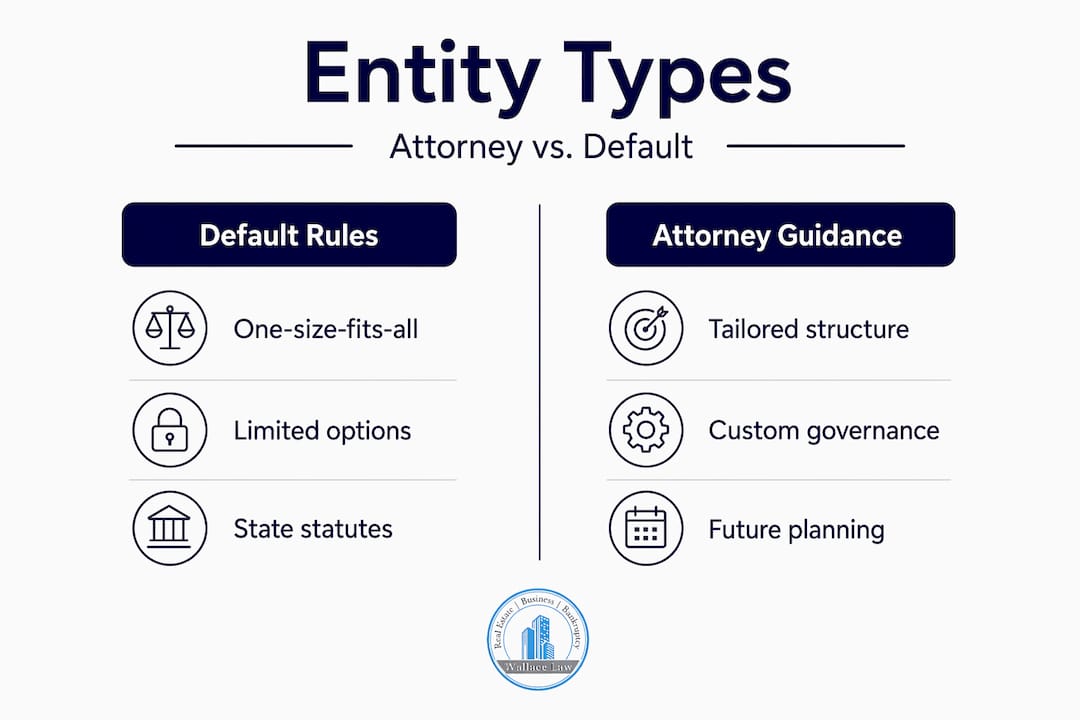
A Forbes Finance Council analysis recommends pressure-testing entity decisions across four key dimensions: capital strategy, tax priorities, ownership complexity, and operational discipline. That framework matters because what works for a solo consultant is completely wrong for a two-founder tech startup planning a Series A in three years.
Here is what attorneys specifically evaluate when advising on entity selection:
- Capital strategy: Will the business seek outside investment? C corporations are generally required for venture capital and institutional investors. LLCs can accept investors but with more friction.
- Tax implications: Pass-through taxation in an LLC or S corporation avoids double taxation but adds complexity for owners with high earned income. C corps pay corporate rates but allow retained earnings strategies.
- Ownership complexity: Multiple founders, unequal contributions, and varying vesting schedules require governance structures that hold up legally. A general partnership offers almost none of that.
- Operational discipline: Some entities, particularly corporations, require formal board meetings, resolutions, and minutes. An attorney will tell you honestly if your team will actually maintain that discipline, since failing to do so can collapse your liability protections.
The Ohio Bar Association recommends attorney consultation before any entity selection to protect both personal assets and business interests. That advice applies whether you are in Ohio or Florida.
Pro Tip: Ask your attorney to walk through two or three entity scenarios side by side with projected numbers from your accountant before you decide. Seeing the actual tax difference on paper changes the conversation entirely.
Governance documents: the real work after filing
Filing your articles of organization or articles of incorporation with the state takes about fifteen minutes online. What happens in the weeks after that filing is where an attorney earns every dollar of their fee.

Internal governance documents are what give your entity real legal teeth. Without them, your business runs under default state rules, and those defaults almost never reflect what the owners actually want. They are written for the average business, not yours.
The table below shows what generic default rules typically provide versus what attorney-drafted governance documents can specify:
| Governance area | Default state rules | Attorney-drafted provisions |
|---|---|---|
| Profit distribution | Proportional to ownership percentage | Custom splits based on contribution, role, or milestones |
| Voting rights | One vote per membership unit | Weighted voting, supermajority requirements, veto rights |
| Member exit and buyout | Dissolution or court action | Defined buy-sell terms, valuation methods, payment schedules |
| Dispute resolution | State civil courts | Mandatory mediation, arbitration, or specific jurisdiction |
| New member admission | Majority or unanimous consent (varies) | Defined approval process with right of first refusal |
A formation attorney maps complex owner intentions, including profit splits, voting structures, and buy-sell rights, into tailored governance documents right after filing to minimize future disputes. A generic operating agreement template from a legal website cannot do this. It fills in blanks. It does not capture the actual relationship between your founding team.
One Ohio Bar Association resource specifically advises early execution of operating agreements and codes of regulations following entity formation, because the liability shield you filed for begins to erode the moment management practices drift from what the documents require.
The Secretary of State filing is only the starting line. You can read more about what goes into comprehensive governance preparation to understand what the state actually requires versus what attorneys add on top to protect you.
Pro Tip: Never sign personal contracts or open business bank accounts before your operating agreement is executed. Courts look at the behavior of members from day one when evaluating whether your liability shield is legitimate.
Ongoing compliance and structural changes
Formation is not a one-time event. The attorney’s role in entity formation extends into the life of your business, and that ongoing involvement is where many entrepreneurs fall short.
Proper liability shielding depends on ongoing compliance practices supported by counsel, not just the fact that an entity exists on paper. Courts routinely pierce the corporate veil of businesses that failed to maintain separate finances, hold required meetings, or properly document major decisions. An attorney keeps that from happening.
Here are the most common post-formation situations where legal counsel is not optional:
- Adding or removing members: Ownership transfers require formal documentation, consent processes defined in your operating agreement, and often state filings.
- Amending governance documents: As the business grows, voting rights, management structures, and compensation arrangements need updates. Informal verbal agreements are legally worthless.
- Raising capital: Whether from friends and family, angels, or institutional investors, each funding round introduces securities law considerations that require attorney review.
- Redomestication: Moving your company from one state to another is one of the most complex structural changes an entity can undergo. It requires investor consents and review of lender covenants, and getting it wrong can trigger default events on existing loans or contracts.
- Dissolution or wind-down: Closing a business incorrectly exposes owners to personal liability for unsatisfied debts and obligations.
The importance of lawyers in forming entities does not end when the secretary of state sends your certificate. Think of your formation attorney as the person who builds the foundation, and ongoing legal counsel as the person who makes sure the structure above it stays sound. Wallacelawflorida covers this distinction well in their guide to general counsel in business growth.
Special rules for professional entities
If your business delivers licensed professional services — law, medicine, dentistry, accounting, engineering — the rules governing entity formation are stricter and more complex. This is not widely understood among founders in professional fields, and the gaps create real compliance risk.
Professional corporations and professional LLCs exist specifically for licensed service providers. They provide liability protection while keeping the professional regulatory framework intact. Attorneys forming these entities must navigate both corporate law and professional ethics rules simultaneously. Here is how that plays out in practice:
- Ownership restrictions apply. In many states, only licensed professionals in the same field can own shares in a professional corporation. A dentist cannot take on a non-dentist business partner as a shareholder.
- Fee-sharing rules govern structure. Ethics rules like New York’s Rule 5.4 prohibit nonlawyer ownership or fee sharing in professional corporations. NY State Bar Ethics Opinion 1288 goes further, prohibiting even trusts that hold a permanent ownership interest from receiving legal fees.
- Management control matters. Some ethics rules require that licensed professionals retain meaningful control over professional decisions. An attorney must design the ownership and management structure to satisfy this requirement while still allowing business flexibility.
- Cross-state practice creates complications. Professional license requirements differ by state. An attorney helping a multi-state practice structure its entity must account for where licenses are held and where revenue is earned.
Attorneys must carefully design ownership structures in professional entities to comply with ethics rules that ordinary business formation does not require. If you are in a licensed profession and you used an online formation service, there is a real chance your structure violates rules you did not know applied to you.
My perspective on why this investment pays off
I have watched founders make the same mistake repeatedly. They spend money on branding, on a website, on their first hire, and then balk at attorney fees for entity formation. Then, three years later, they are back in a lawyer’s office dealing with a dispute between co-founders over voting rights that a well-drafted operating agreement would have resolved in a paragraph.
The formation stage is where the cost of legal advice is lowest and the value is highest. Once a business is running, every structural problem requires working around existing relationships, existing contracts, and existing expectations. That is a much harder job.
What I have seen work consistently is treating the initial attorney consultation not as a compliance task but as a planning session. The attorney who helps you choose between an LLC and an S corp is also the person who should understand your three-year vision, your co-founder dynamics, and your capital plans. That context makes every document they draft more useful.
State filing is simple, but building an entity that actually protects you requires legal advice and governance documents that reflect your real situation. The entrepreneurs who get this right early almost never regret it. The ones who skip it frequently do.
— Steven
Build your business on solid legal ground with Wallacelawflorida

Wallacelawflorida works directly with Florida entrepreneurs and business owners who want to get entity formation right from the start, not fix it later. Their attorneys guide clients through entity type selection, draft custom operating agreements and bylaws tailored to each business’s ownership structure, handle all required state filings, and advise on the ongoing compliance practices that keep liability protections intact.
If you are starting a new venture, adding partners, or restructuring an existing business, their Florida business formation services include a personal consultation where an attorney reviews your goals and recommends a structure built for your actual situation. You can also explore how attorney-driven corporate protection applies to your business specifically. Wallacelawflorida serves Boynton Beach and the surrounding South Florida region with the personalized attention that larger firms rarely offer.
FAQ
What does an attorney do during entity formation?
An attorney advises on entity type selection, drafts governance documents like operating agreements and bylaws, handles state filings, and ensures compliance practices are in place to maintain liability protections from day one.
Why can’t I just use an online formation service?
Online services file the paperwork but do not draft custom governance documents, advise on tax implications, or account for your specific ownership structure. As attorneys note, state filing is only the beginning of what it takes to build a protected entity.
How does an attorney help with choosing between an LLC and a corporation?
An attorney evaluates your capital strategy, tax goals, ownership complexity, and operational capacity, then recommends the structure that fits your actual business rather than a generic default. A Forbes Finance Council expert recommends pressure-testing these decisions before filing.
Do professional service businesses need special legal help for entity formation?
Yes. Licensed professionals face ethics rules that restrict ownership and fee sharing. An attorney must design the entity structure to comply with both corporate law and professional conduct rules simultaneously.
When should I consult an attorney for entity formation?
Before you choose your entity type. The Ohio Bar Association recommends attorney consultation before entity selection so that both documentation and structure are aligned with your business goals from the start.