

TL;DR:
- Subchapter V bankruptcy is a streamlined, cost-effective option designed to help small businesses reorganize debts under $3,424,000 while retaining control. It requires strict eligibility criteria, including debt classification and active business status, with preparation crucial to prevent challenges. This process typically completes within six to nine months and offers substantial advantages such as lower fees, waived disclosure requirements, and the ability to keep ownership, making it a vital tool for business survival.
Subchapter V bankruptcy is a specialized form of Chapter 11 bankruptcy created specifically to help small businesses reorganize debt faster, cheaper, and with far less complexity than a traditional Chapter 11 filing. Enacted under the Small Business Reorganization Act of 2019, this subchapter gives eligible business owners a real path to financial recovery without surrendering control of their company. If your business carries debt under $3,424,000 and you are struggling to keep operations afloat, Subchapter V may be the most practical debt restructuring option available to you right now.
What are the eligibility requirements for Subchapter V bankruptcy?
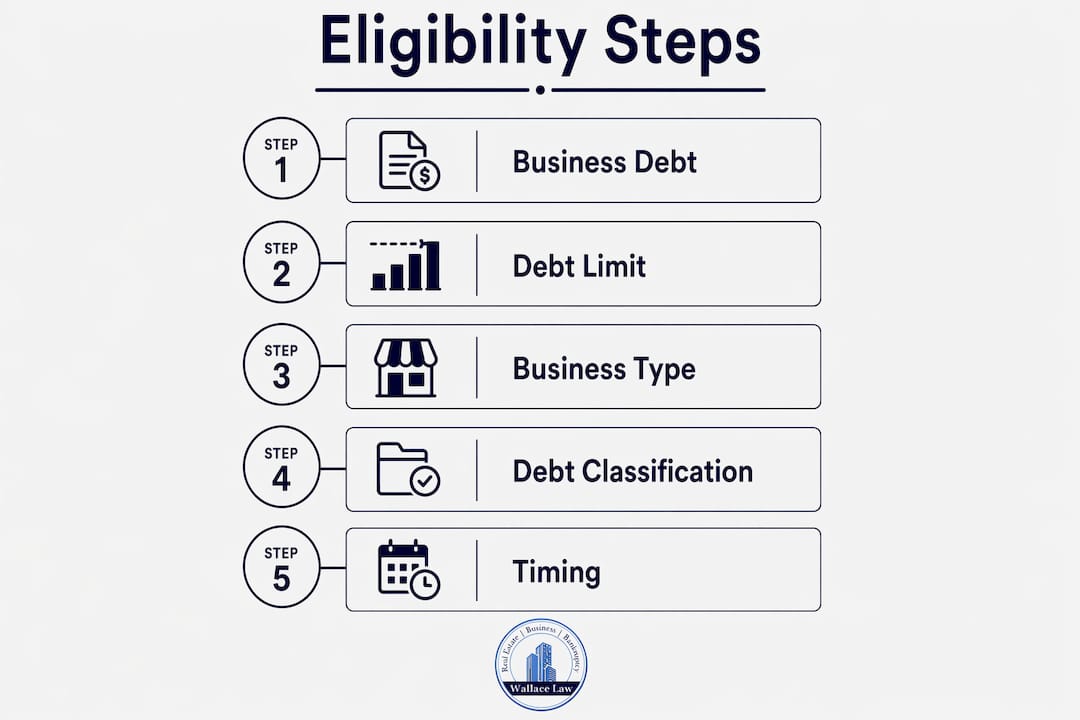
Subchapter V eligibility is defined by four concrete criteria, and meeting all four is non-negotiable. Get one wrong and the U.S. Trustee or a creditor can challenge your designation, potentially converting your case to a traditional Chapter 11.
The criteria are:
- Debt cap: As of April 1, 2025, your aggregate noncontingent, liquidated secured and unsecured debts must not exceed $3,424,000. This figure is adjusted periodically, so verify the current ceiling at the time you file.
- Business debt source: At least 50% of your debts must arise from commercial or business activities, not personal obligations like a mortgage or car loan.
- Active business: You must be engaged in active commercial or business activity at the time of filing. A dormant entity does not qualify.
- Entity type: Publicly traded companies and single asset real estate cases are explicitly excluded, regardless of debt size.
The 50% business debt requirement catches many owners off guard. If you personally guaranteed a large home equity loan to fund your business, that debt may be classified as personal rather than commercial, which could push you below the threshold. Accurate debt classification is not a formality. It is the foundation of your entire case.
Challenges to eligibility often arise in borderline cases and rely heavily on timely, document-backed debt classifications. Improper filings risk conversion or dismissal. That means gathering bank statements, loan agreements, and creditor schedules before you file is not optional preparation. It is your first line of defense.
Pro Tip: Work with a bankruptcy attorney to categorize every debt as commercial or personal before filing. A single misclassified obligation can disqualify your entire Subchapter V election.
How does the Subchapter V process work, step by step?
The Subchapter V process is structured, time-bound, and designed to move quickly. Here is what happens from petition to plan confirmation:
- File the petition and elect Subchapter V. You file a standard Chapter 11 petition and check the Subchapter V election box. This single step triggers the entire streamlined process.
- Automatic stay takes effect immediately. The moment you file, an automatic stay halts all creditor collection actions, lawsuits, foreclosures, and repossessions. This breathing room is immediate and powerful.
- A Subchapter V trustee is appointed. Unlike a Chapter 7 trustee who takes control of assets, the Subchapter V trustee acts as a facilitator, not a manager. You keep running your business. The trustee monitors feasibility and helps facilitate a consensual plan between you and your creditors.
- You file your reorganization plan within 90 days. Subchapter V imposes a strict 90-day deadline to file a reorganization plan. This accelerates resolution compared to traditional Chapter 11, which has no specific timeline. Courts can extend this deadline for cause, but extensions are not guaranteed.
- No disclosure statement is required. Traditional Chapter 11 requires a lengthy, expensive disclosure statement before creditors can even vote. Subchapter V eliminates this requirement entirely, saving time and legal fees.
- Plan confirmation proceeds on one of two tracks. A consensual plan is confirmed if all creditor classes accept it. A cramdown plan is confirmed without creditor approval if the plan is fair, equitable, and commits all of the debtor’s projected disposable income to plan payments for three to five years.
- Administrative expenses are paid over time. In traditional Chapter 11, administrative expenses must be paid in full at confirmation. Subchapter V allows these costs to be spread across the plan term, which protects your cash flow during the most vulnerable phase of reorganization.
The typical timeline from filing to plan confirmation runs six to nine months. That is a fraction of the 18 months or longer that traditional Chapter 11 cases routinely require.
Pro Tip: Start drafting your reorganization plan before you file. The 90-day clock starts at petition, not at your first meeting with the trustee. Arriving prepared shortens the process and signals good faith to the court.

What are the key benefits of Subchapter V vs. traditional Chapter 11?
The differences between Subchapter V and traditional Chapter 11 are not minor procedural tweaks. They are structural advantages that fundamentally change the economics and odds of a successful reorganization.
| Feature | Subchapter V | Traditional Chapter 11 |
|---|---|---|
| Professional fees | ~77% lower than traditional Chapter 11 | High; disclosure statements alone cost tens of thousands |
| Creditor committee | Not required | Often required, adding cost and complexity |
| Disclosure statement | Eliminated | Required before creditor voting |
| Absolute priority rule | Waived | Enforced; owners cannot retain equity without paying unsecured creditors in full |
| Administrative expense timing | Paid over plan term | Paid in full at confirmation |
| Plan confirmation rate | ~51% of cases | ~25% for small business cases |
| Post-confirmation survival | 86% remain operating | Significantly lower |
The most consequential benefit is the waiver of the absolute priority rule. Under traditional Chapter 11, owners cannot retain equity unless unsecured creditors are paid in full. This rule effectively forces many small business owners to choose between losing their company and paying debts they cannot afford. Subchapter V eliminates that forced choice. You can propose a plan that pays creditors what the business can reasonably afford, keep your equity, and continue operating.
The survival statistics reinforce the case. Roughly 86% of businesses that confirm a Subchapter V plan remain operating afterward. That compares favorably to traditional Chapter 11 outcomes and reflects the practical advantage of a process designed for businesses that are fundamentally viable but temporarily overwhelmed by debt.
For Florida small business owners specifically, understanding Florida bankruptcy law changes and how they interact with federal Subchapter V rules is worth reviewing before you file.
What pitfalls should small business owners know before filing?
Subchapter V offers real relief, but it does not eliminate every financial obligation you carry. Several critical limitations can surprise owners who file without complete preparation.
- Personal guarantees survive. Personal guarantees are not discharged by Subchapter V. If you personally guaranteed a business loan, the lender can still pursue you individually after your business reorganizes. This is one of the most misunderstood limits of the process.
- Eligibility can be challenged. The U.S. Trustee or creditors can challenge your Subchapter V election if debts exceed the cap or the 50% business debt threshold is not met. A successful challenge can result in dismissal or conversion to traditional Chapter 11, which is far more expensive.
- Incomplete documentation creates risk. Courts and trustees scrutinize debt schedules closely. Missing or inaccurate filings invite objections and delay confirmation.
- Mixing personal and business debts carelessly is dangerous. If personal debts inflate your total above the cap, or dilute the 50% commercial debt requirement, you lose eligibility. Keep financial records clean and categorized before you approach the filing date.
- The trustee monitors plan feasibility. The Subchapter V trustee is not adversarial, but they are not passive either. If your proposed plan does not appear financially feasible, the trustee will say so. An unrealistic plan will not be confirmed.
Understanding business bankruptcy restructuring options in full context helps you weigh Subchapter V against alternatives like Chapter 7 liquidation or out-of-court workouts before committing to a path.
Pro Tip: Before filing, pull a complete list of every debt you personally guaranteed. Discuss each one with your attorney so you understand exactly what relief Subchapter V provides and where your personal exposure remains.
How can you maximize your chances of a successful reorganization?
Preparation before filing is the single biggest factor separating successful Subchapter V cases from those that stall or convert. These steps give your case the strongest possible foundation:
- Conduct a full debt audit. Categorize every obligation as secured, unsecured, commercial, or personal. Verify that your total falls under the debt cap and that at least 50% is business-related. Review the Subchapter V eligibility rules in detail before you finalize your numbers.
- Document current business operations. Courts want evidence that your business is viable. Current financial statements, tax returns, and cash flow projections demonstrate that reorganization serves a real purpose.
- Engage the trustee as a resource. The Subchapter V trustee is there to facilitate a consensual outcome. Owners who treat the trustee as an adversary miss an opportunity. Proactive communication often leads to smoother plan negotiations.
- Build a realistic repayment plan. Your plan must commit all projected disposable income to creditor payments for three to five years. Overpromising creates confirmation problems. Underpromising invites creditor objections. Work with your attorney to model multiple scenarios before settling on a number.
- Understand local court procedures. Federal bankruptcy rules apply nationwide, but individual districts have local rules that affect filing requirements, deadlines, and trustee expectations. Florida courts, for example, have specific procedural nuances that matter. For context on local filing trends, reviewing recent Florida patterns can inform your timeline expectations.
- Consider alternatives if you do not qualify. If your debts exceed the cap or the business debt threshold is not met, traditional Chapter 11 or a negotiated out-of-court restructuring may still be viable. For owners with tax debt as a major component, business tax debt resolution options may complement or precede a bankruptcy filing.
Key takeaways
Subchapter V bankruptcy is the most accessible and cost-effective reorganization tool available to small businesses with debts under $3,424,000, offering lower costs, faster timelines, and ownership retention that traditional Chapter 11 cannot match.
| Point | Details |
|---|---|
| Debt cap and business source | Debts must be under $3,424,000, with at least 50% from commercial activity. |
| Cost and time advantage | Subchapter V costs roughly 77% less and resolves in 6 to 9 months versus 18-plus for traditional Chapter 11. |
| Ownership retention | The absolute priority rule is waived, allowing owners to keep equity without paying unsecured creditors in full. |
| Personal guarantees remain | Business reorganization does not discharge personal guarantees; owners stay individually liable for those debts. |
| Preparation is decisive | Accurate debt classification and complete documentation before filing determine whether eligibility holds up to challenge. |
Why Subchapter V changed how I think about small business survival
I have worked with small business owners in financial distress long enough to remember what their options looked like before Subchapter V existed. Traditional Chapter 11 was theoretically available to them, but practically out of reach. The legal fees alone could exceed $100,000 before a plan was ever confirmed. Most owners gave up and liquidated businesses that were fundamentally worth saving.
Subchapter V changed that calculus. The 77% reduction in professional fees is not just a number. It is the difference between a restaurant owner in Boynton Beach being able to afford reorganization and being forced to close. The elimination of the absolute priority rule is equally significant. I have seen owners walk away from viable businesses simply because they could not pay unsecured creditors in full under the old rules. That outcome was economically irrational and personally devastating.
What I tell every client now is this: bankruptcy is a legal tool, not a moral verdict. Subchapter V in particular was designed by Congress with the explicit goal of keeping small businesses operating. Using it strategically is no different from using any other legal mechanism to protect what you built.
The area where I see the most avoidable mistakes is personal guarantee exposure. Owners assume that because the business reorganizes, their personal liability disappears. It does not. That gap between business relief and personal liability is where careful planning before filing makes the biggest difference. The owners who come in prepared, with clean financial records and a realistic picture of what they owe and to whom, consistently get better outcomes than those who file in crisis mode.
Subchapter V is not a magic solution. It is a structured process that rewards preparation and penalizes shortcuts. Treat it that way, and it can genuinely put your business back on track.
— Steven
How Wallacelawflorida can help you file Subchapter V
If you are a small business owner in Florida weighing your debt relief options, Wallacelawflorida provides the kind of hands-on, attorney-led guidance that Subchapter V cases require. The firm handles eligibility assessments, debt classification, plan preparation, and creditor negotiations for businesses in Boynton Beach and surrounding areas.
Wallacelawflorida’s bankruptcy attorneys understand both the federal Subchapter V framework and the local Florida court procedures that affect your case. From your first consultation through plan confirmation, you work directly with experienced counsel who knows the details that protect your eligibility and your ownership stake. Visit the Wallace Law bankruptcy practice page to schedule a consultation, or download the free Florida bankruptcy eBook to start building your understanding of the process before your first meeting.
FAQ
What is the debt limit for Subchapter V eligibility?
As of April 1, 2025, the debt limit is $3,424,000 in aggregate noncontingent, liquidated secured and unsecured debts. At least 50% of that total must arise from commercial or business activities.
Can a sole proprietor file Subchapter V bankruptcy?
Yes. Subchapter V is available to individuals engaged in commercial or business activity, including sole proprietors, as long as they meet the debt cap and business debt percentage requirements.
How long does a Subchapter V case take?
Most Subchapter V cases move from filing to plan confirmation in six to nine months, significantly faster than traditional Chapter 11 cases, which routinely take 18 months or longer.
Does Subchapter V eliminate personal guarantees?
No. Personal guarantees are not discharged through Subchapter V. Business owners who personally guaranteed loans remain individually liable for those obligations even after the business reorganizes.
What happens if my Subchapter V eligibility is challenged?
If the U.S. Trustee or a creditor successfully challenges your eligibility, the court may dismiss your case or convert it to a traditional Chapter 11 proceeding. Accurate debt documentation before filing is the primary defense against a successful challenge.