

TL;DR:
- A real estate LLC separates your personal assets from property liabilities, providing legal protection against lawsuits. Proper formation, operation, and layered strategies like trusts and insurance ensure this protection holds up in court. Transferring property into an LLC should occur before legal issues arise to avoid being deemed a fraudulent transfer.
A real estate LLC is a legal entity that separates your personal wealth from liabilities tied to your investment property, shielding your savings, home, and other assets from lawsuits or debts connected to your rentals. Real estate LLC asset protection works by placing your property inside a structure governed by state LLC statutes, so creditors pursuing the property cannot automatically reach your personal bank account. The IRS treats single-member LLCs as pass-through entities by default, meaning you keep the tax simplicity of sole ownership while gaining a legal firewall. Proper formation and ongoing compliance are what make that firewall hold up in court.
How does real estate LLC asset protection actually work?
An LLC functions as a separate legal person. When a tenant sues over a slip-and-fall at your rental, the lawsuit targets the LLC, not you personally. Your personal home, retirement accounts, and savings sit outside the reach of that claim, provided you operate the LLC correctly.
The critical legal concept here is “piercing the corporate veil.” Courts apply this doctrine when an investor blurs the line between personal and business finances. If a judge finds that the LLC was never truly separate, personal assets become fair game. Mixing personal and business funds negates protections entirely, and courts have consistently ruled this way.
Creditor remedies also differ by LLC structure. In a multi-member LLC, a personal creditor’s primary remedy is a charging order, which limits the creditor to receiving distributions if and when the LLC pays them out. Charging order protection is stronger in multi-member LLCs. Single-member LLCs often lack these safeguards, allowing a personal creditor to foreclose on the member’s entire interest.
To keep your LLC’s protection intact, follow these core rules:
- Open a dedicated business checking account and never pay personal bills from it
- Sign every lease, contract, and vendor agreement in the LLC’s name only
- Keep written records of major business decisions, even informal ones
- File annual reports and pay state fees on time to avoid administrative dissolution
- Maintain a separate LLC operating agreement that reflects actual business operations
Pro Tip: If you own property in your own name and want to transfer it into an LLC, check your mortgage first. Many lenders include a “due-on-sale” clause that can trigger full loan repayment upon transfer.
What are the practical steps to form and maintain a real estate LLC?
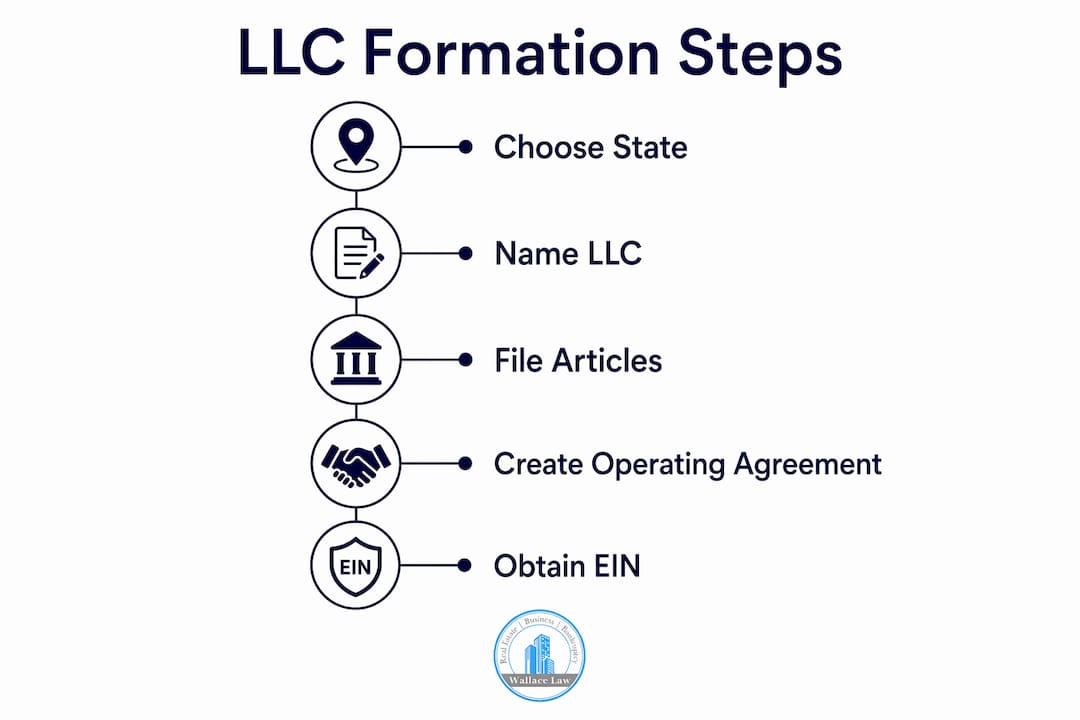
Formation starts with choosing a state. Wyoming, Delaware, and Nevada are popular choices because they offer strong charging order protections and privacy rules. Florida investors often form in Florida to avoid the complexity of registering a foreign LLC in the state where the property sits.

LLC setup fees typically range from $100 to $800, with formation fees as low as $39 in some states. Registered agent fees average $125 per year. Annual report filings are mandatory in most states to avoid dissolution. These costs are real but modest compared to the liability exposure they offset.
The formation process follows these steps:
- Choose your state of formation based on property location and legal protections
- File Articles of Organization with the state and pay the filing fee
- Appoint a registered agent to receive legal notices on behalf of the LLC
- Draft and sign an operating agreement that outlines ownership, decision-making, and profit distribution
- Obtain an EIN from the IRS for tax filing and banking purposes
- Open a dedicated business bank account before conducting any transactions
- Transfer property title into the LLC name and update insurance policies accordingly
| Ongoing requirement | Frequency | Typical cost |
|---|---|---|
| Registered agent service | Annual | ~$125/year |
| State annual report | Annual | $50–$500 depending on state |
| LLC tax return or schedule | Annual | Varies by structure |
| Operating agreement review | As needed | Attorney fees vary |
Pro Tip: Set a calendar reminder 60 days before your state’s annual report deadline. Missing it can trigger dissolution, which wipes out your liability protection retroactively.
Florida investors should review the Florida LLC formation requirements before filing, since the state has specific rules around registered agents and annual report deadlines that differ from other states.
Should you use one LLC or multiple LLCs for multiple properties?
The one-LLC-per-property approach is the gold standard for risk compartmentalization. If a lawsuit arises from Property A, it cannot reach the equity sitting in Property B because each property lives in its own legal entity. Best practice for asset compartmentalization is one LLC per property, especially for high-value or short-term rental properties.
The trade-off is administrative load. Ten properties mean ten LLCs, ten bank accounts, ten annual reports, and ten sets of books. That overhead adds up in both time and money.
How to decide which properties need their own LLC:
- High-value properties with significant equity always warrant separate LLCs
- Short-term rentals carry higher liability exposure due to guest turnover and should be isolated
- Low-value properties with minimal equity may not justify the cost of a separate entity
- Properties in different states almost always require separate LLCs due to foreign registration rules
- Commercial properties with tenant liability risks benefit from individual entity separation
A practical middle ground for investors with large portfolios is grouping lower-risk properties into one LLC while giving high-value or high-liability properties their own entity. This approach cuts administrative costs without leaving major assets exposed.
| Strategy | Best for | Main trade-off |
|---|---|---|
| One LLC for all properties | Small portfolios, low-value assets | One lawsuit can threaten all properties |
| One LLC per property | High-value or high-liability properties | Higher administrative and filing costs |
| Hybrid grouping | Mid-size portfolios with mixed risk | Requires careful risk assessment |
What advanced asset protection strategies complement LLCs?
An LLC alone is not a complete defense. Sophisticated investors layer multiple tools to create protection that holds up against serious legal challenges.
“Layered asset protection uses LLCs as a ‘castle’ and insurance as the ‘moat,’ complemented by trusts that protect ownership interests, providing a multi-tier defense against risks. Umbrella policies cover liabilities exceeding LLC limits, while trusts protect membership interests from personal creditors.”
Irrevocable trusts and Domestic Asset Protection Trusts (DAPTs) take this further. Sophisticated strategies hold LLC membership interests inside irrevocable trusts or DAPTs, shielding ownership from personal creditors while the LLC limits property liability. This dual layer means a creditor pursuing you personally cannot easily reach your LLC interest, and a creditor pursuing the LLC cannot reach your personal assets.
Key advanced strategies to consider:
- Add a second member to your LLC, such as an irrevocable trust, to strengthen charging order protection
- Purchase an umbrella insurance policy to cover claims that exceed your LLC’s assets
- Use a DAPT to hold your LLC membership interest if your state permits it
- Consult a real estate asset protection attorney to build a plan tailored to your portfolio size and risk profile
Timing is the most overlooked factor in advanced planning. Legal protections established well before claims arise are respected by courts. Transferring assets into LLCs after a lawsuit starts is deemed a fraudulent transfer and can be voided entirely. Build your structure before you need it.
What are the common mistakes that jeopardize LLC protection?
Most investors who lose their LLC protection do not lose it because the law failed them. They lose it because of operational errors that courts treat as proof the LLC was never a real separate entity.
The most common mistakes that destroy LLC protection:
- Commingling funds: Paying personal expenses from the LLC account, or depositing rental income into a personal account, gives courts grounds to pierce the corporate veil
- Signing contracts personally: Every lease, repair contract, and vendor agreement must be signed as “Your Name, Manager of [LLC Name],” not in your personal name
- Missing annual filings: States dissolve LLCs that miss annual reports, and a dissolved LLC provides zero protection
- Relying on a single-member LLC without added protections: Courts may allow personal creditors to foreclose on single-member LLC membership interests, undermining protection unless you add members or trusts
- Transferring property after legal threats arise: Courts scrutinize transfers made after lawsuits begin as fraudulent, and they will void them
Pro Tip: Review your LLC’s operating agreement and bank account activity once a year with your attorney. Catching a commingling issue early is far cheaper than defending a veil-piercing claim in court.
The pitfalls of real estate investing extend well beyond LLC mistakes, but these operational errors are the most preventable and the most costly when ignored.
Key Takeaways
An LLC protects real estate investors only when it is properly formed, consistently operated as a separate entity, and supported by insurance and trusts for complete coverage.
| Point | Details |
|---|---|
| Legal separation is the core benefit | An LLC shields personal assets from lawsuits and debts tied to investment properties. |
| Veil-piercing is the biggest risk | Mixing personal and LLC finances gives courts grounds to expose your personal assets. |
| One LLC per property is the safest structure | Isolating each property limits liability exposure to that single asset. |
| Advanced strategies add critical layers | Trusts and umbrella insurance protect what the LLC alone cannot cover. |
| Timing determines whether protection holds | Courts void transfers made after legal threats arise as fraudulent. |
What I’ve learned about LLC protection after years of real estate cases
The investors who call me after a lawsuit has already started share one thing in common: they formed the LLC but never truly operated it as a separate business. The paperwork was filed, but the bank accounts were mixed, the leases were signed in their personal name, and the annual report was missed two years running. The LLC existed on paper and nowhere else.
The financing angle catches people off guard more than anything else. LLCs do not qualify for government-backed loans like FHA, VA, Fannie Mae, or Freddie Mac. That means investors who transfer properties into LLCs often lose access to the most favorable loan terms and must refinance into commercial or DSCR loans at higher rates. This is not a reason to avoid LLCs. It is a reason to plan the transition carefully with both a lender and an attorney before you move any title.
The trust component is underused. Adding an irrevocable trust as a second LLC member costs more upfront but dramatically strengthens charging order protection in states where single-member LLCs are vulnerable. I have seen this single structural change make the difference between a creditor walking away and a creditor successfully foreclosing on an investor’s LLC interest.
My honest advice: build the structure before you buy the next property, not after. Protection that exists before a claim arises is protection that courts will respect.
— Steven
How Wallacelawflorida helps protect your real estate investments
Real estate investors in Florida face a specific set of legal risks, from tenant liability to creditor claims, that require more than a generic LLC template downloaded from the internet.

Wallacelawflorida works with investors in Boynton Beach and surrounding areas to form LLCs correctly, draft operating agreements that hold up in court, and build layered protection plans that include trusts and insurance coordination. The firm’s attorneys understand Florida’s specific LLC statutes and the financing trade-offs that come with property transfers. For investors who want a clear picture of their legal exposure and a plan to address it, the real estate investor legal tips resource is a strong starting point. Wallacelawflorida also offers direct legal guidance through its Florida real estate practice for investors ready to take the next step.
FAQ
What does an LLC actually protect in real estate?
An LLC protects your personal assets, including your home, savings, and personal bank accounts, from lawsuits and debts tied to your investment property. The protection applies only when the LLC is properly formed and operated as a separate entity.
Can a creditor take my personal assets if I own property through an LLC?
A creditor generally cannot reach your personal assets through an LLC claim, but they can if a court pierces the corporate veil due to commingled funds or improper operation. Single-member LLCs carry additional risk because charging order protection is weaker than in multi-member structures.
How much does it cost to form a real estate LLC?
Formation fees range from $100 to $800 depending on the state, with ongoing costs including registered agent fees averaging $125 per year and mandatory annual report filings.
Is one LLC enough for multiple rental properties?
One LLC for multiple properties creates cross-liability risk, meaning a lawsuit from one property can threaten equity in all others. One LLC per property is the safer approach for high-value or high-liability assets.
When is the best time to transfer property into an LLC?
Transfer property into an LLC before any legal threats arise. Courts treat transfers made after lawsuits begin as fraudulent and will void them, eliminating the protection entirely.