

TL;DR:
- South Florida’s closing costs typically range from 2% to 5% of the property’s price, with all-in costs averaging $19,842. Buyers face various taxes, title insurance fees, lender costs, and prepaids, which vary by county and property type. Negotiating seller credits and working with local legal experts can help mitigate these substantial and often misunderstood expenses.
Real estate closing costs in South Florida are the mandatory fees and taxes buyers and sellers pay at the property’s transaction closing, typically adding 2% to 5% of the purchase price to the total cost of the deal. Florida’s average closing costs sit at 4.8% of the home sale price, compared to 3.2% nationally, with typical all-in costs averaging $19,842 for a median-priced home. What makes South Florida distinct are state-specific charges like documentary stamp taxes, intangible taxes on new mortgage notes, and title insurance structures that vary by county. Knowing each component before you reach the closing table is the difference between a smooth transaction and a costly surprise.
1. Real estate closing costs in South Florida: the full breakdown
South Florida buyers face a layered set of fees that fall into four broad categories: government taxes, title-related costs, lender fees, and prepaid items. Each category carries its own calculation method, and missing even one can throw off your budget by thousands of dollars.
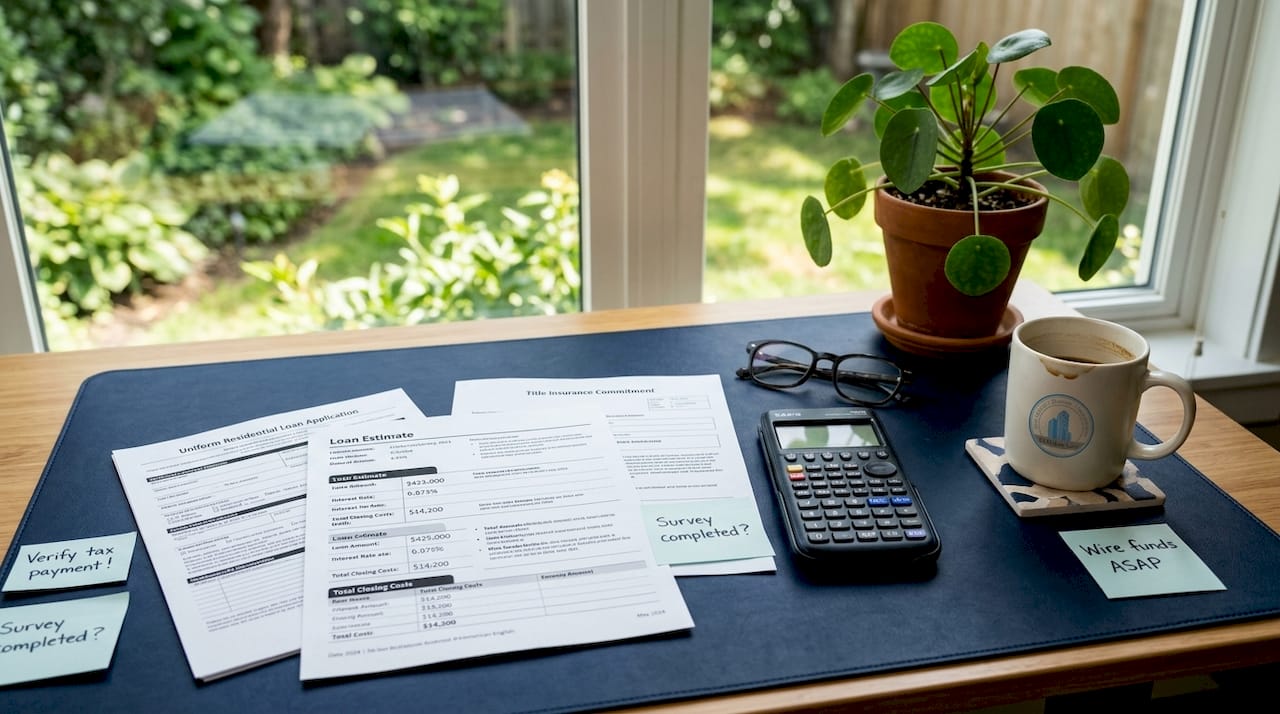
Documentary stamp tax on mortgages is charged at $0.35 per $100 of the loan amount. On a $440,000 loan, that comes to roughly $1,540. Buyers also pay an intangible tax of 0.20% on new mortgage notes, adding approximately $880 on the same loan. Cash buyers skip both of these entirely.
Title insurance comes in two forms: lender’s title insurance, which protects the bank, and owner’s title insurance, which protects you. In most South Florida counties, the seller traditionally pays for the owner’s policy, but this is negotiable and varies by county. Lender’s title insurance is always a buyer expense.
Lender fees include loan origination charges, appraisal fees, credit report fees, and underwriting costs. These are disclosed on your Loan Estimate within three business days of application, and many are negotiable before you lock in with a lender.
Prepaid items are not fees in the traditional sense. They are advance deposits for property tax escrow, homeowners insurance, and prepaid mortgage interest. Prepaids often dominate the cash-to-close total, surprising buyers who focused only on the fee side of the ledger.
Pro Tip: Request your Loan Estimate from at least two lenders and compare Section A (origination charges) line by line. Lenders cannot change those fees after you lock, so the comparison window is narrow but powerful.
For FHA loans, buyers pay a 1.75% upfront mortgage insurance premium added to closing costs, though it can be rolled into the loan. VA loans carry a funding fee that varies by down payment and service history, but VA borrowers pay no ongoing mortgage insurance, which offsets the upfront cost over time.
2. How closing costs differ across Miami-Dade, Broward, and Palm Beach
The three major South Florida counties share the same state tax framework but diverge in meaningful ways that affect your total bill.
Miami-Dade operates a two-part deed documentary stamp tax structure. The base rate is $0.60 per $100 of sale price for single-family homes, lower than the statewide $0.70 rate. However, non-single-family residential properties, including condos, multifamily buildings, and commercial assets, carry an additional $0.45 surtax, bringing the combined rate to $1.05 per $100. That is the highest effective deed tax rate in Florida for those property classes.
Broward and Palm Beach counties apply the standard statewide deed stamp rate of $0.70 per $100 with no surtax. For a $500,000 purchase, that means $3,500 in deed stamps in Broward versus up to $5,250 in Miami-Dade for a non-single-family property. The difference is material for investors buying multifamily or commercial assets.
Title insurance responsibility also shifts by county. In Miami-Dade and Broward, the buyer typically selects and pays for title insurance. In Palm Beach County, the seller traditionally pays for the owner’s title policy. This single convention can shift $2,000 to $5,000 between parties depending on the sale price.
The table below summarizes the key differences across the three counties for a buyer using a mortgage.
| County | Deed stamp rate | Buyer pays title? | Typical all-in buyer costs (10% down) |
|---|---|---|---|
| Miami-Dade | $0.60 + $0.45 surtax (non-SFR) | Yes | $12,000 to $16,000 |
| Broward | $0.70 per $100 | Yes | $11,000 to $15,000 |
| Palm Beach | $0.70 per $100 | No (seller pays owner’s policy) | $11,000 to $15,000 |
Pro Tip: If you are buying a condo or multifamily property in Miami-Dade, run the deed stamp calculation using the combined $1.05 rate, not the $0.60 base rate. Most online calculators default to the lower rate and will underestimate your cost.
3. Negotiation strategies to reduce your closing costs
South Florida’s current market gives buyers more leverage than they have had in years. Broker Javier Zepeda notes that seller concessions have increased steadily over the past 18 months as inventory has risen, meaning sellers are now more willing to cover a portion of buyer closing costs to close deals.
Here is how to use that leverage effectively:
- Request a seller credit instead of a price reduction. A $10,000 price reduction saves you roughly $50 per month on a 30-year mortgage. A $10,000 closing cost credit saves you $10,000 at the table today. For buyers with limited cash reserves, the credit is far more valuable.
- Specify the credit amount in the contract. Vague language like “seller to assist with closing costs” creates disputes. Name the dollar amount and confirm it does not exceed lender-allowed limits, which typically cap seller credits at 3% to 6% of the purchase price depending on loan type.
- Compare lender fees before committing. Section A of your Loan Estimate shows origination charges that lenders set themselves. These are negotiable, especially if you have strong credit or are bringing a large down payment.
- Consult a local real estate attorney before signing. An attorney familiar with South Florida closing customs can identify fee allocations that deviate from local norms and flag items worth pushing back on.
- For investors using refinancing: structure your initial purchase to minimize cash-to-close, then plan refinancing costs as a separate line item in your investment model. Florida’s refinancing costs average $5,250, the second highest nationally, so underestimating them erodes returns.
4. Closing costs that are often misunderstood in South Florida
Several components of the South Florida closing cost structure catch buyers off guard, not because they are hidden, but because they are misclassified or miscalculated.
- Prepaids are not fees. Buyers often lump prepaids together with closing fees, but they serve a different purpose. Prepaids fund your escrow account and cover the first year of homeowners insurance. They are mandatory cash-to-close items, but they are not costs you lose. The escrow balance belongs to you and is refunded if you sell or refinance.
- Closing date changes your prepaid interest. Closing on the 28th of the month means you prepay only two or three days of mortgage interest. Closing on the 5th means you prepay 25 days. That difference on a $400,000 loan at 7% interest is roughly $1,900. Prepaid amounts shift materially with closing date, so update your cash-to-close estimate after every contract milestone.
- Miami-Dade’s surtax catches investors off guard. The two-part deed tax structure in Miami-Dade is the most common source of calculation errors in the county. Buyers purchasing condos or investment properties frequently use the single-family rate and arrive at closing short on funds.
- FHA and VA upfront fees integrate into closing costs. The FHA upfront mortgage insurance premium of 1.75% of the loan amount appears on the Closing Disclosure as a closing cost, even when financed. Buyers who do not account for it in their initial budget misread their actual cash-to-close figure.
- Homeowners insurance in coastal South Florida is not a standard line item. Premiums in Miami-Dade, Broward, and Palm Beach counties run significantly higher than state averages due to hurricane exposure. A policy that costs $2,500 annually inland may cost $6,000 or more in a coastal zip code, and the full first-year premium is due at closing.
5. How refinancing closing costs affect South Florida investors
Refinancing is a standard tool for South Florida real estate investors, used to pull equity out of appreciated properties or restructure debt after acquisition. The cost of doing so in Florida is among the highest in the country.
Florida’s refinance closing costs average $5,250, or approximately 1.36% of the average refinance loan amount of $385,454. That ranking places Florida second nationally. The primary drivers are the same taxes that apply to purchase transactions: documentary stamp taxes on the new mortgage note and the intangible tax on the new loan balance.
Key components of a Florida refinance closing include:
- Mortgage documentary stamp tax at $0.35 per $100 of the new loan amount
- Intangible tax at 0.20% of the new mortgage note
- Title insurance on the new lender’s policy (required by the lender)
- Recording fees for the new deed of trust and mortgage documents
- Appraisal and underwriting fees charged by the new lender
For a cash-out refinance on a $600,000 property with a new $480,000 loan, the documentary stamp tax alone reaches $1,680 and the intangible tax adds another $960. Investors who model refinancing as a cost-free event in their pro forma are consistently surprised by the actual bill. Build these figures into your acquisition model from day one, not after you decide to refinance.
Key takeaways
South Florida closing costs run higher than the national average because of state-specific documentary stamp taxes, intangible taxes, and county-level surtax structures that add up fast for buyers and investors alike.
| Point | Details |
|---|---|
| Florida costs exceed national average | Florida closing costs average 4.8% of sale price versus 3.2% nationally. |
| Miami-Dade surtax hits investors hardest | Non-single-family properties in Miami-Dade face a combined deed stamp rate of $1.05 per $100. |
| Prepaids can exceed fees | Homeowners insurance, tax escrow, and prepaid interest often surpass all lender and title fees combined. |
| Seller credits beat price cuts | A closing cost credit saves cash at the table; a price reduction saves only a few dollars per month. |
| Refinancing costs are significant | Florida refinance closings average $5,250, the second highest nationally, requiring separate budget planning. |
What I have learned about South Florida closing costs after years at the table
The single biggest mistake I see buyers make is treating closing costs and prepaids as one number. They are not. Fees are what you pay to complete the transaction. Prepaids are what you deposit to start the relationship with your lender and insurer. Conflating them leads to underfunded closings and last-minute scrambles.
Miami-Dade’s surtax is the other consistent blind spot. I have reviewed deals where the buyer’s attorney used the $0.60 base rate for a condo purchase and the client arrived at closing needing an additional $4,000 they did not have. The fix is simple: confirm the property type before running any tax calculation, and use the combined $1.05 rate for anything that is not a single-family home in Miami-Dade.
On negotiation, the current market is genuinely favorable for buyers. Inventory is up, and sellers who need to move are open to concessions. The key is asking for a specific dollar credit in the contract rather than vague language. Vague language gets resolved in the seller’s favor at the closing table.
My strongest advice is to work with a South Florida real estate attorney who reviews your Loan Estimate and Closing Disclosure before you sign. The numbers on those documents are not fixed. Errors happen, and fees that should not be there sometimes appear. An attorney who knows local closing customs will catch them.
— Steven
How Wallacelawflorida can help you close with confidence
Wallacelawflorida provides hands-on legal support for homebuyers and investors navigating South Florida real estate closings. The firm’s attorneys review Loan Estimates and Closing Disclosures line by line, identify fee allocation errors, and advise on county-specific tax obligations that affect your final cash-to-close figure.
Whether you are purchasing a single-family home in Palm Beach County, acquiring a multifamily property in Miami-Dade, or planning a cash-out refinance in Broward, Wallacelawflorida brings local knowledge that protects your interests. The firm also handles title insurance concerns and contract review for buyers who want clarity before they commit. If you are preparing for a closing and want an experienced attorney in your corner, visit Wallacelawflorida’s real estate services page to schedule a consultation.
FAQ
What are average closing costs in Florida for buyers?
Florida buyer closing costs average 4.8% of the home sale price, with typical all-in costs around $19,842 for a median-priced home. This is significantly higher than the national average of 3.2%.
Who pays title insurance in South Florida?
In Miami-Dade and Broward counties, the buyer typically pays for title insurance. In Palm Beach County, the seller traditionally covers the owner’s title policy, though all of these conventions are negotiable in the purchase contract.
What is the documentary stamp tax in Florida?
Florida charges a deed documentary stamp tax of $0.70 per $100 of sale price in most counties. Miami-Dade charges $0.60 for single-family homes but adds a $0.45 surtax for non-single-family properties, making the combined rate $1.05 per $100.
Can sellers pay closing costs in South Florida?
Yes. Sellers can provide closing cost credits to buyers, and current market conditions with rising inventory have made seller concessions more common. Lender guidelines typically cap seller credits at 3% to 6% of the purchase price depending on loan type.
Are refinancing closing costs different from purchase closing costs?
Refinancing in Florida carries many of the same taxes as a purchase, including documentary stamp taxes and intangible taxes on the new loan. Florida refinance closing costs average $5,250, ranking second highest nationally, and investors should budget for them separately from acquisition costs.