

TL;DR:
- Florida business compliance involves continuously managing entity filings, tax registrations, and licensing to stay in good standing and avoid dissolution or penalties.
- Proper coordination of these obligations ensures legal operation, with timely filings like the annual report due by May 1, and active sales tax registration before making taxable sales.
Florida business compliance is defined as the ongoing process of meeting state-mandated entity filings, tax registrations, and licensing requirements to operate legally and maintain good standing. Every Florida business owner needs to understand three core obligations: annual report filings through the Florida Division of Corporations, sales and use tax registration with the Florida Department of Revenue, and industry-specific licensing through agencies like the Department of Business and Professional Regulation (DBPR). Miss any one of these, and you risk administrative dissolution, tax revocation, or operating without a valid license. This guide breaks down each requirement so you can build a compliance process that actually holds up.
How Florida business compliance works: the core framework
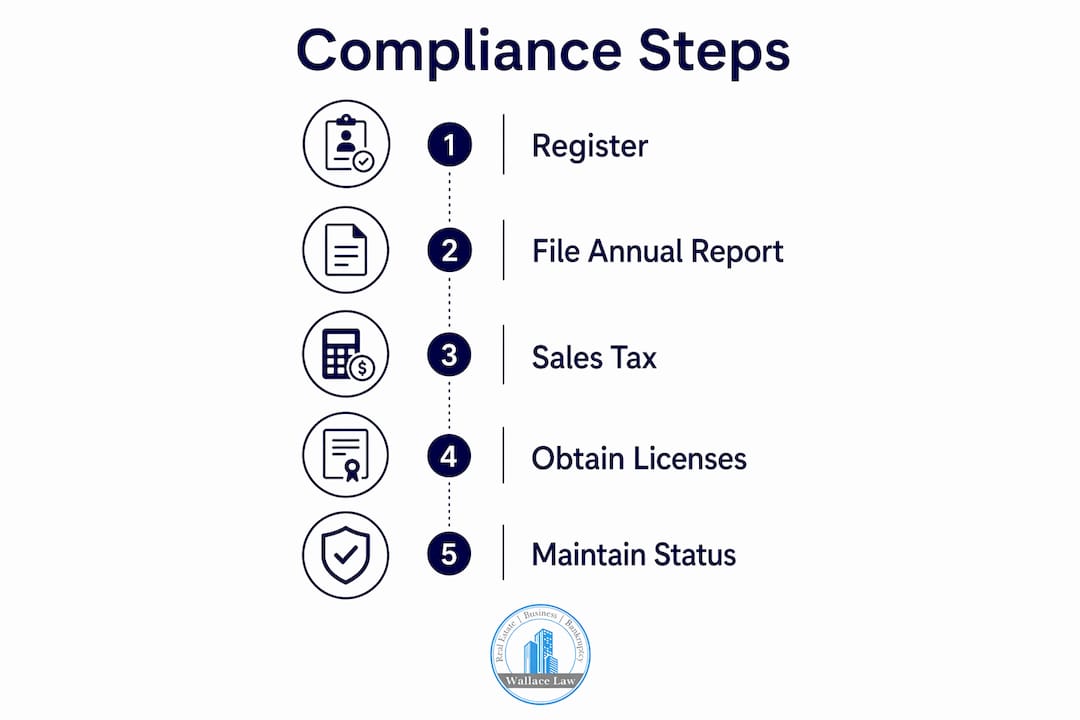
Florida business compliance operates across three parallel tracks. Your entity must stay in good standing with the Florida Division of Corporations. Your tax obligations must be registered and current with the Florida Department of Revenue. Your licenses must be active through the DBPR, local governments, or other relevant state agencies. These tracks are not independent. A lapse in one directly affects the others. For example, entity status lapses cause rejection or delay in licensing applications, which means a missed annual report can stall your entire business operation.

The standard industry term for this process is “regulatory compliance,” and it covers everything from formation filings to ongoing renewals. Florida business regulations are administered by multiple agencies, which is why many business owners get tripped up. There is no single compliance checklist that covers every business type. Your obligations depend on your entity structure, your industry, and your city or county.
What are Florida annual report requirements for businesses?
The annual report is the most time-sensitive compliance obligation for Florida businesses. Filing is required by May 1 each year for all LLCs, corporations, limited partnerships, and limited liability partnerships registered in Florida. The filing window opens January 1, and missing the May 1 deadline triggers a $400 late fee immediately on May 2.
Practitioners describe the Florida annual report as a “status preservation” filing rather than a financial disclosure. It confirms your registered agent information, principal address, and officer or member details. No income data, no tax figures, no financial statements. The sole purpose is to confirm your entity is still active and correctly registered.
Here is the step-by-step process for filing your annual report:
- Go to Sunbiz.org, the official Florida Division of Corporations portal.
- Search for your business by name or document number.
- Click “File Annual Report” and review your current entity details.
- Update any information that has changed, including your registered agent.
- Pay the filing fee online. LLCs pay $138.75; corporations pay $150.
- Save your confirmation number as proof of filing.
If you do not file by the third Friday of September, the Florida Division of Corporations will administratively dissolve or revoke your entity. Reinstatement is possible, but it requires paying all outstanding fees plus a reinstatement fee, and your business cannot legally operate during the dissolution period.
Pro Tip: Avoid any third-party service that mails you an official-looking notice offering to file your annual report for a fee. The Florida Secretary of State has specifically warned businesses about these scams. File directly at Sunbiz.org for the standard state fee.
How do Florida sales tax registration and compliance work?
Any Florida business that sells taxable goods or services must register with the Florida Department of Revenue before making its first taxable sale. Florida’s state sales tax rate is 6%, with local surtaxes that vary by county. Registration is completed online through the Department of Revenue’s website, and the process issues you a Certificate of Registration along with a Florida Annual Resale Certificate.
Your filing frequency depends on how much sales tax you collect. High-volume businesses file monthly. Lower-volume businesses may qualify for quarterly or semiannual filing. The Department of Revenue assigns your frequency based on your estimated tax liability at registration. Missing a filing or failing to remit collected taxes is not treated as a minor oversight.
The enforcement consequences are serious:
- Penalties and interest accrue immediately on unpaid or late remittances.
- Audits can be triggered by inconsistent filing patterns or gaps in reporting.
- Registration revocation is the most severe outcome. The Florida DOR revoked a business’s sales tax registration under final order DOR-2026-008-FOE for a repeated pattern of failure to file and remit taxes. A revoked registration means you cannot legally collect sales tax, which effectively shuts down taxable operations.
- Criminal liability is possible in cases of willful tax evasion.
Sales tax compliance also intersects with your annual entity filings. An active Certificate of Registration requires your business entity to be in good standing. If your LLC or corporation is administratively dissolved, your tax registrations can be affected as well.
What licenses and permits do Florida businesses need?
Florida does not issue a single general statewide business license. This surprises many first-time business owners. Instead, licensing is state agency and jurisdiction specific, meaning your obligations depend entirely on what you do and where you do it.
Here is a comparison of the main licensing categories Florida businesses encounter:
| License type | Issuing authority | Examples |
|---|---|---|
| Regulated profession/industry | DBPR (MyFloridaLicense.com) | Contractors, real estate agents, cosmetologists, accountants |
| Food, agriculture, or animal services | DACS (Florida Dept. of Agriculture) | Food manufacturers, nurseries, pest control |
| Child or adult care facilities | DCF (Dept. of Children and Families) | Daycares, assisted living facilities |
| Local business tax receipt | City or county government | Required by most Florida municipalities for any business operating locally |
| Zoning and building permits | Local government | Required before opening a physical location |
The local business tax receipt (formerly called an occupational license) is the one requirement that applies to nearly every Florida business operating within a city or county. Palm Beach County, Miami-Dade County, and Broward County each have their own application processes and fee schedules. You need to check with your specific municipality.
Pro Tip: Check the Florida business licensing requirements guide from Wallacelawflorida before you apply for any DBPR license. Submitting an application while your entity is not in active status is one of the most common and easily avoidable delays.
How to coordinate compliance steps for smooth business operations
The biggest operational mistake Florida business owners make is treating compliance as a series of one-time tasks rather than a continuous process. Constant compliance monitoring is what separates businesses that run without interruption from those that face sudden shutdowns or rejected applications.
Here is how to build a coordination system that works:
- Sequence your filings correctly. Form your entity first through Sunbiz, then register for sales tax with the Department of Revenue, then apply for DBPR or local licenses. Each step depends on the previous one being complete and active.
- Use official portals only. Sunbiz handles entity filings, MyFloridaLicense.com handles DBPR licenses, and the Department of Revenue’s e-Services portal handles tax registrations. Bookmark all three.
- Set calendar reminders for every renewal. Annual reports are due May 1. DBPR licenses have their own renewal cycles, often every one or two years. Local business tax receipts typically renew October 1.
- Keep your registered agent information current. If your registered agent address is outdated, you may miss official notices about compliance deadlines or legal actions.
- Coordinate entity status and licensing renewals in parallel. Handling these steps together rather than sequentially prevents the stalls that happen when one filing is pending while another expires.
Businesses that build these reminders into a shared calendar or project management tool like Asana or Google Calendar avoid the scramble that leads to late fees and lapses.
What are the penalties and consequences of Florida business noncompliance?
Noncompliance in Florida follows a predictable escalation pattern. Understanding it helps you recognize when you are at risk before the consequences become irreversible.
- $400 late fee. Triggered on May 2 if your annual report is not filed. This is the first and most avoidable penalty.
- Administrative dissolution. If you still have not filed by the third Friday of September, the Florida Division of Corporations dissolves or revokes your entity. Your business name becomes available for others to register.
- Loss of liability protection. Once dissolved, the legal protections your LLC or corporation provided to you personally are no longer in effect. Personal liability exposure becomes real.
- License rejection or revocation. State agencies including the DBPR will not process license applications or renewals for entities that are not in active standing.
- Sales tax registration revocation. Repeated failure to file and remit sales tax results in revocation of your Certificate of Registration, which legally bars you from conducting taxable sales.
Reinstatement is possible after administrative dissolution, but it requires paying all accumulated fees plus a reinstatement fee and filing all outstanding reports. Your business cannot legally operate during the dissolution period, which creates gaps that affect contracts, bank accounts, and vendor relationships.
The reinstatement process is handled through Sunbiz and can restore your entity to active status, but the reputational and operational damage from a dissolution period is harder to undo than the filing itself.
Key takeaways
Florida business compliance requires active management of three parallel obligations: entity filings, tax registrations, and licensing renewals, all of which are interconnected and time-sensitive.
| Point | Details |
|---|---|
| Annual report deadline | File by May 1 at Sunbiz.org to avoid a $400 late fee and risk of dissolution. |
| Sales tax registration | Register with the Florida Department of Revenue before your first taxable sale and file on your assigned schedule. |
| No general state license | Obtain a local business tax receipt from your city or county plus any DBPR or agency-specific licenses for your industry. |
| Sequence matters | Keep your entity in active status before applying for licenses; lapses cause application rejections. |
| Noncompliance escalates | Missed filings lead from late fees to dissolution to personal liability exposure in a predictable progression. |
Why I treat Florida compliance as a system, not a checklist
Most business owners I work with come in after something has already gone wrong. They missed the May 1 annual report deadline, or they applied for a DBPR license while their LLC was technically dissolved. These are not careless people. They are busy people who treated compliance as a one-time setup task rather than an ongoing system.
The insight that changes how you approach this is simple: Florida’s compliance framework is designed around active status. Every agency, from the Department of Revenue to the DBPR to your local county office, checks whether your entity is in good standing before processing anything. That means your annual report is not just a bureaucratic formality. It is the foundation that every other compliance obligation rests on.
I have also seen businesses get burned by third-party filing services that charge $150 to $300 to file an annual report that costs $138.75 directly through Sunbiz. The scam works because the notices look official. File directly, always.
The businesses that handle Florida compliance well are not the ones with the most sophisticated legal teams. They are the ones that built a simple calendar system, used the official portals, and treated the May 1 deadline as non-negotiable. That discipline is worth more than any compliance software.
— Steven
How Wallacelawflorida supports your Florida compliance needs
Compliance questions rarely arrive at convenient times, and the cost of getting them wrong is high.
Wallacelawflorida works directly with Florida business owners on the compliance issues that matter most: annual report filings, sales tax registration questions, DBPR licensing coordination, and the reinstatement process after administrative dissolution. The firm’s Florida business law practice is built around personal attention from attorneys who know local regulations in Boynton Beach and across South Florida. If you are starting a new business or trying to get an existing one back into good standing, Wallacelawflorida offers the kind of direct, practical guidance that larger firms rarely provide. Reach out to discuss your specific situation.
FAQ
What is the annual report deadline for Florida businesses?
Florida businesses must file annual reports by May 1 each year through Sunbiz.org. Missing this deadline triggers a $400 late fee, and entities that still have not filed by the third Friday of September face administrative dissolution.
Does Florida require a general statewide business license?
Florida does not issue a single general business license. Businesses must obtain a local business tax receipt from their city or county, plus any industry-specific licenses through the DBPR or other state agencies relevant to their field.
What happens if my Florida LLC is administratively dissolved?
An administratively dissolved LLC loses its legal protections, cannot operate legally, and may have license applications rejected. Reinstatement requires paying all outstanding fees and filing overdue reports through Sunbiz.
How do I register for sales tax in Florida?
Register online through the Florida Department of Revenue’s e-Services portal before making your first taxable sale. The process issues a Certificate of Registration and assigns your filing frequency based on estimated tax volume.
Can the Florida DOR revoke my sales tax registration?
Yes. The Florida Department of Revenue revokes sales tax registrations for businesses that repeatedly fail to file returns or remit collected taxes, which legally bars those businesses from conducting taxable sales until the issue is resolved.