

TL;DR:
- Bankruptcy causes an immediate credit score drop of up to 240 points and stays on reports for seven to ten years. Over time, positive credit behavior can significantly improve scores, especially within 12 to 24 months after filing. Effective strategies include maintaining on-time payments, low credit utilization, and using secured credit tools to rebuild trust.
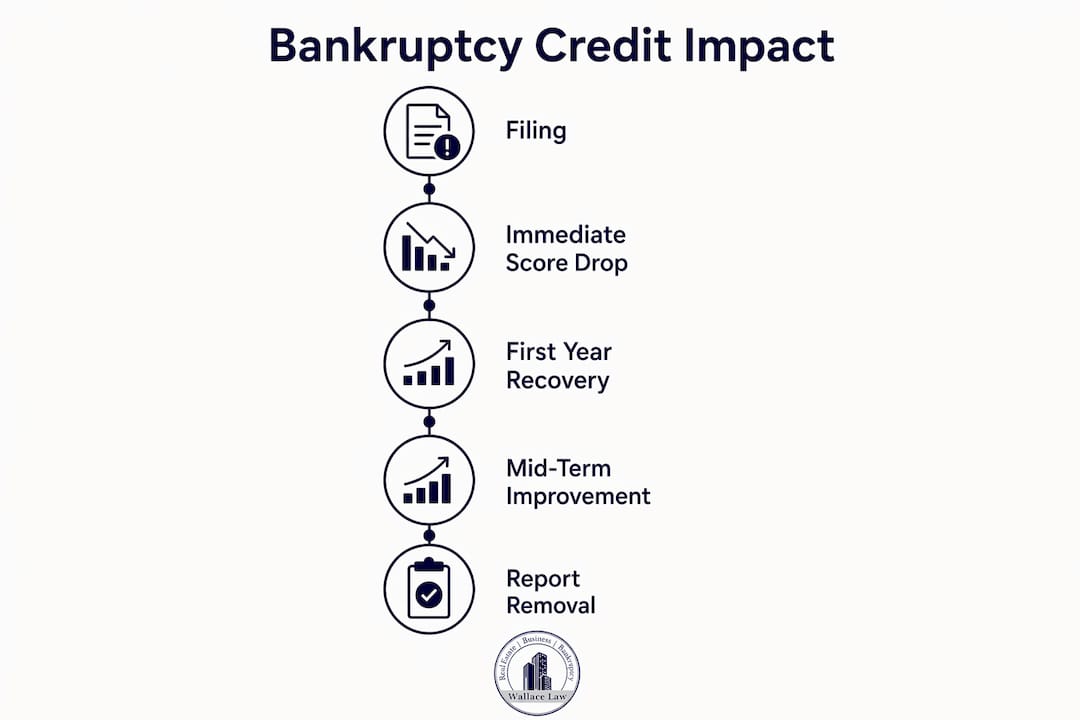
Bankruptcy causes an immediate, severe drop in your credit score, typically between 100 and 240 points depending on where your score started. The filing then remains on your credit report for 7 to 10 years, depending on which chapter you filed. That sounds brutal, and it is. But the impact is front-loaded: the damage is heaviest in the first months and shrinks steadily as you build positive history.
Here is what you need to know upfront:
- Chapter 7 bankruptcy stays on your credit report for 10 years from the filing date
- Chapter 13 stays on your credit report for 7 years from the filing date
- A person starting with a high credit score can lose a large number of points; someone with a moderate score typically loses fewer points
- Bankruptcy appears as a public record on all three major credit bureau reports
- Both FICO and VantageScore treat bankruptcy as one of the most serious negative events possible
- Individual accounts included in the filing are also flagged, though they drop off after 7 years from the original delinquency date
- Recovery is possible: many people see meaningful score improvement within 12–24 months of consistent, on-time payments
Table of Contents
- How bankruptcy affects credit score: Chapter 7 vs. Chapter 13
- What actually happens to your credit score and report after filing
- How long does bankruptcy stay on your credit report?
- Effective strategies to rebuild credit after bankruptcy
- How discharged secured vs. unsecured debts affect your credit differently
- How bankruptcy reshapes your credit utilization ratio
- Common misconceptions about bankruptcy’s credit impact
- Key Takeaways
- FAQ
How bankruptcy affects credit score: Chapter 7 vs. Chapter 13
The type of bankruptcy you file determines how long the damage lasts and how lenders perceive your risk going forward.
Chapter 7 is liquidation bankruptcy. Most unsecured debts, such as credit cards and medical bills, are generally discharged entirely. The process typically takes a few months, but the public record stays on your credit report for 10 years. Because no repayment occurs, lenders view it as higher risk.
Chapter 13 is reorganization bankruptcy. You keep your assets and follow a court-supervised repayment plan lasting several years. The filing stays on your report for only 7 years because lenders view partial repayment as a sign of lower risk than outright liquidation. If you are weighing these options, the Chapter 7 vs. Chapter 13 differences in credit impact are worth understanding before you file.
Key distinctions at a glance:
- Chapter 7 discharges most unsecured debt; Chapter 13 repays part or all of it
- Chapter 7 report duration: 10 years; Chapter 13: 7 years
- Chapter 13 repayment history can signal creditworthiness to future lenders
- The number of accounts included in either filing directly affects how much your score drops
- Both types trigger a public record flag visible to all lenders reviewing your report
What actually happens to your credit score and report after filing
The score drop is not a fixed number; it depends almost entirely on where you started.
Someone with a 780 score may lose roughly 220–240 points; someone at 680 typically loses 130–150 points. If your score is already low from missed payments and collections, the additional drop is usually smaller because much of the damage is already priced in. The more accounts included in the filing, the larger the hit.
Beyond the score itself, your credit report changes in specific ways:
- A public record entry for the bankruptcy appears, visible to any lender pulling your report
- Individual accounts included in the filing are updated to reflect zero balances or closed status
- Discharged debts must be reported with a zero balance, per federal reporting standards
- Payment history on included accounts is frozen at the delinquency status at time of filing
- FICO and VantageScore both treat the public record as a severe negative, though they weight factors slightly differently in their scoring models
How long does bankruptcy stay on your credit report?
The timeline is precise, and knowing it helps you plan.
Chapter 7 remains on a credit report for up to ten years from the date you filed with the court, not from when the case was discharged. Chapter 13 is removed from a credit report after 7 years from the filing date. Individual delinquent accounts included in the bankruptcy drop off separately, 7 years from the original date of delinquency, which may predate your filing by months or years.
Recovery milestones to track:
- Months 1–6: Score is at its lowest; new credit is difficult to obtain
- Months 12–24: Consistent on-time payments begin to reduce the bankruptcy’s weight in scoring models
- Year 2–4: Meaningful score improvement is common with disciplined credit behavior
- Year 7: Chapter 13 flag removed; score bump of about 10 points and credit limit increases typically follow
- Year 10: Chapter 7 flag removed; similar score and credit limit improvements commonly occur
The bankruptcy’s impact is heaviest early and diminishes each year as positive history accumulates. You do not have to wait for the flag to fall off to see real improvement.
Effective strategies to rebuild credit after bankruptcy
Start rebuilding the day after your discharge. Waiting costs you months of positive history that scoring models will eventually reward.
Secured credit cards are the most accessible tool. You deposit cash as collateral, use the card for small purchases, and pay the balance in full each month. That payment history reports to all three bureaus and directly offsets the negative public record over time. Credit-builder loans from credit unions work similarly.
Practical steps that move the needle:
- Pay every bill on time, every month. Payment history is 35% of your FICO score.
- Keep credit utilization below 30% on any new accounts you open
- Pull your free credit reports from all three bureaus and dispute any errors, such as discharged accounts still showing balances
- Avoid applying for multiple new credit lines at once; each hard inquiry adds a small negative
- If debt collectors contact you about accounts that were discharged, know your rights. If a collector is calling about a debt that is no longer yours, resources like handling wrong-number debt calls can help you push back effectively.
Pro Tip: Positive payment activity reduces the weight FICO assigns to your bankruptcy record well before the filing disappears from your report. You do not need a clean slate to see a meaningfully higher score.
How discharged secured vs. unsecured debts affect your credit differently
Not all discharged debt leaves the same mark on your credit profile.
Unsecured debts, such as credit cards, medical bills, and personal loans, are typically wiped out in Chapter 7. When they are discharged, those accounts are updated to show a zero balance. That removes the ongoing damage of high utilization and stops new delinquencies from accumulating. The account itself may still appear on your report, but the balance is gone.
Secured debts, like mortgages and auto loans, are handled differently. If you surrender the collateral, the account is reported as discharged with a zero balance. If you reaffirm the debt and keep making payments, the account continues reporting normally, which can actually help your credit recovery. A reaffirmed mortgage with on-time payments is a positive data point, even during a bankruptcy period.

How bankruptcy reshapes your credit utilization ratio
Credit utilization, the ratio of your balances to your credit limits, accounts for roughly 30% of your FICO score. Bankruptcy changes this ratio in ways that can cut both ways.
When high-balance unsecured accounts are discharged with zero balances, your total reported debt drops sharply. If you had maxed-out cards before filing, that discharge can actually lower your utilization ratio and, in some cases, nudge a very low score slightly upward. The catch is that bankruptcy also tends to close or restrict your available credit lines, which can offset the utilization benefit. Going forward, keeping any new accounts at low balances is the fastest lever you have for improving your score.
Common misconceptions about bankruptcy’s credit impact
Myth: Bankruptcy permanently destroys your credit.
False. The filing stays on your report for 7 or 10 years, but its weight in scoring models decreases every year. Many people reach scores in the 650–700 range within a few years of filing, especially with disciplined credit behavior.
Myth: You can pay someone to remove a bankruptcy early.
No legitimate service can remove an accurately reported bankruptcy before its expiration date. Courts do not control credit reporting, and credit bureaus compile public records independently. You can dispute genuine errors, but a correctly reported filing stays until its 7 or 10-year mark.
Myth: A higher score before filing means a faster recovery.
Not necessarily. A higher starting score means a larger initial drop, but it also means you had strong credit habits before the crisis. Those habits, rebuilt after filing, tend to produce faster recovery than someone who had poor credit long before bankruptcy.
Myth: All lenders treat bankruptcy the same way.
They do not. Some lenders deny credit to anyone with a bankruptcy on file, regardless of current score. Others use risk models that weigh how old the filing is and what positive history exists since then. Shopping lenders matters.
If you are navigating these decisions and want guidance specific to your situation, the bankruptcy attorneys at Wallacelawflorida work with individuals in Boynton Beach and across Florida to clarify your options and help you move forward with a clear plan.

Key Takeaways
Bankruptcy causes an immediate 100–240 point credit score drop, stays on your report for 7–10 years, and diminishes in impact each year as positive payment history builds.
| Point | Details |
|---|---|
| Score drop range | Expect a 130–150 point drop from a 680 score, or 220–240 points from a 780 score. |
| Report duration | Chapter 7 stays 10 years; Chapter 13 stays 7 years from the filing date. |
| Front-loaded damage | The impact is heaviest in the first months and shrinks each year as positive history accumulates. |
| Flag removal benefit | Removing the bankruptcy flag typically produces a small but noticeable score increase and increased credit limits. |
| Rebuild timeline | Most people see meaningful improvement within 12–24 months with on-time payments and low balances. |
FAQ
How many years does bankruptcy affect your credit?
Chapter 7 bankruptcy stays on your credit report for up to ten years from the filing date; Chapter 13 stays for 7 years. Individual accounts included in the filing drop off after 7 years from the original delinquency date.
Can you reach a 700 credit score after bankruptcy?
Yes. With consistent on-time payments, low credit utilization, and disciplined use of secured credit products, many people reach the 650–700 range within a few years of filing, well before the bankruptcy record falls off.
Can you reach an 800 credit score after Chapter 7?
Reaching a very high score after Chapter 7 is possible but typically requires years of spotless credit behavior after the 10-year flag is removed. High scores are achievable once the public record is gone and a long positive history is established.
Does bankruptcy flag removal improve your credit immediately?
Research from the Federal Reserve Bank of New York found that flag removal produces an immediate 10-point score increase and leads to higher credit limits in the years that follow.
Can bankruptcy ever improve your credit score?
In limited cases, yes. If your report is full of maxed-out accounts and missed payments, discharging those balances lowers your utilization and stops new delinquencies, which can nudge a very low score slightly upward right after filing.