

TL;DR:
- Creating a Florida LLC operating agreement is essential to customize default laws and protect members’ interests. Even without legal requirements, a well-drafted agreement clarifies ownership, management, voting, profits, and exit procedures, preventing costly disputes. Regular updates and comprehensive provisions, including buy-sell clauses and notarization, strengthen legal protections and ensure the agreement adapts to business changes.
A Florida LLC operating agreement is the internal governing document that defines ownership percentages, management authority, financial rules, and member rights for your business. Without one, Florida’s default statutes take over, and those defaults rarely match what you actually want. Florida LLC operating agreement drafting is not a formality. It is the single most important step you can take after filing your Articles of Organization.
What are the legal requirements for Florida LLCs without an operating agreement?
Florida does not legally require an LLC to have a written operating agreement. That surprises most business owners, and the surprise usually comes at the worst possible moment.
When no written agreement exists, Chapter 605 default rules automatically govern your LLC’s management authority, profit distribution, and voting rights. Those defaults were written for a generic LLC, not yours. They do not know your ownership split, your management structure, or your plans for growth.
Here is what the defaults can impose on you:
- Unanimous member consent for certain business decisions, even routine ones
- Equal profit splits regardless of how much each member contributed
- Equal voting rights regardless of ownership percentage
- No clear exit process when a member wants to leave or passes away
- No defined management authority, which creates overlap and conflict
Operating without an agreement can lead to disputes and weaken the legal protections your LLC structure is supposed to provide. That last point matters more than most people realize. Courts have used the absence of a written agreement as evidence that members did not treat the LLC as a separate legal entity, which can expose personal assets to business liability.
Pro Tip: Even single-member LLCs benefit from a written operating agreement. Banks, investors, and commercial landlords often require one before doing business with you.
The fix is straightforward. A written agreement lets you override every default that does not fit your business. You set the rules. Florida law respects that.
What key provisions should every Florida LLC operating agreement include?
A well-drafted operating agreement covers ownership, management authority, profit splits, voting rights, and member exit procedures. Each of those categories contains specific clauses that do real work when disputes arise.
Core ownership and identity clauses
Every agreement starts with the basics: the LLC’s legal name, its principal place of business, and the registered agent. Then it lists each member’s name and ownership percentage. These numbers control everything downstream, from profit allocation to voting weight.

Capital contributions belong here too. Spell out exactly what each member contributed at formation, whether cash, property, or services, and what happens if the business needs additional capital later.
Management and voting structure
Florida LLCs can be member-managed or manager-managed. Member-managed means all owners share day-to-day authority. Manager-managed means one or more designated managers run operations, and members step back from daily decisions. The agreement must state which structure you chose and define the scope of authority clearly.
Voting rules follow from that choice. Specify what percentage of votes is required for ordinary decisions versus major ones, such as admitting a new member, taking on debt, or selling the business.
| Provision | Member-managed | Manager-managed |
|---|---|---|
| Day-to-day authority | All members | Designated manager(s) |
| Voting on major decisions | Member vote required | Member vote required |
| Best for | Small, equal partnerships | Larger LLCs or investor-backed |
| Risk without clear terms | Overlapping authority | Manager overreach |
Financial and exit provisions
Profit and loss allocation should mirror ownership percentages unless you have a specific reason to deviate. State the distribution schedule clearly, whether quarterly, annually, or at the managers’ discretion.
Buy-sell provisions must address triggers such as death, disability, divorce, or voluntary departure. These clauses are the most commonly skipped and the most commonly regretted. Without them, a deceased member’s ownership interest can pass to an heir who has no interest in running your business.
Include a dissolution clause that explains how the LLC winds down if members vote to close it. Add an amendment procedure so you can update the agreement as the business evolves.
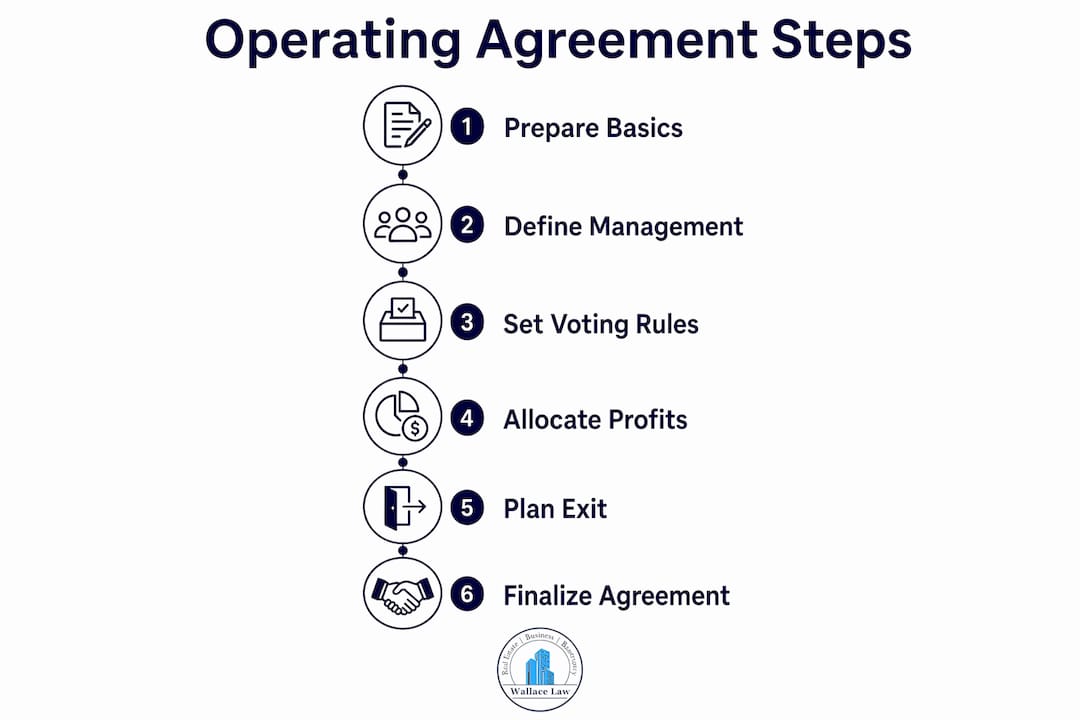
How to draft a strong Florida LLC operating agreement: a step-by-step process
Drafting a solid agreement follows a logical sequence. Skipping steps creates gaps that surface later as disputes or legal vulnerabilities. Here is the process Wallacelawflorida recommends for Florida entrepreneurs.
-
Gather ownership and contribution data. List every member’s full legal name, address, ownership percentage, and initial capital contribution. Confirm these numbers before drafting begins.
-
Choose your management structure. Decide between member-managed and manager-managed. If you choose manager-managed, name the manager and define the scope of their authority in writing.
-
Set financial distribution rules. Define how profits and losses are allocated. State the timing and method of distributions. Address whether members can take draws against future profits.
-
Establish voting procedures. Specify the vote threshold for ordinary decisions and for major ones. Define what counts as a major decision. Include rules for member meetings and written consents in lieu of meetings.
-
Plan for member exits and unexpected events. Draft buy-sell provisions that cover voluntary departure, death, disability, and divorce. Define how the departing member’s interest is valued and who has the right to purchase it.
-
Add an integration clause. An integration clause explicitly supersedes all prior oral or implied understandings. This prevents a member from later claiming a side conversation changed the terms of the agreement.
-
Include indemnification and dispute resolution clauses. Indemnification protects members and managers from personal liability for actions taken in good faith on behalf of the LLC. A dispute resolution clause, specifying mediation or arbitration before litigation, saves time and money.
-
Have all members sign. Every member must sign the final agreement. For multi-member LLCs, notarization strengthens evidentiary value in court, even though Florida does not require it.
Pro Tip: Store a signed copy with your registered agent and give each member a copy. Keep a digital backup in a secure, shared location. An agreement no one can find is nearly as useless as no agreement at all.
You can find a detailed operating agreement legal checklist from Wallacelawflorida to confirm you have covered every required provision before signing.
What are common drafting mistakes that put your Florida LLC at risk?
Most operating agreement problems are not caused by complex legal issues. They come from predictable oversights that a careful review would catch.
“The most expensive operating agreement is the one you never updated after your business changed.” This observation holds true across nearly every LLC dispute that reaches litigation.
Watch for these specific mistakes:
-
Using a generic template without customization. A template designed for a Delaware LLC or a generic small business does not account for Florida’s Chapter 605 rules or your specific ownership structure. Generic language creates gaps.
-
Ignoring buy-sell triggers. Buy-sell provisions are commonly neglected but protect the business from unexpected member departures. Skipping them is the single most common mistake in multi-member LLCs.
-
Skipping notarization for multi-member agreements. Notarization is optional in Florida, but it significantly bolsters the agreement’s weight as evidence if a dispute ends up in court.
-
Failing to update the agreement after major changes. Adding a new member, changing the management structure, or taking on outside investment all require an amendment. An outdated agreement can be worse than no agreement because it creates conflicting expectations.
-
Leaving management authority vague. If the agreement does not clearly define who can sign contracts, open bank accounts, or hire employees, members will fill that gap with their own interpretations. That is how disputes start.
A legal review before signing catches most of these issues. Wallacelawflorida’s Florida LLC formation guide covers the most common formation mistakes that carry into the operating agreement stage.
Florida’s default statutory rules may impose unwanted management and profit sharing structures that most business owners never anticipated. A customized agreement is the only reliable protection against that outcome.
Key takeaways
A written Florida LLC operating agreement is the most direct way to override the state’s default rules and protect every member’s interests from day one.
| Point | Details |
|---|---|
| Florida has no written agreement requirement | Default Chapter 605 rules apply automatically and often conflict with owner intentions. |
| Core provisions are non-negotiable | Every agreement must address ownership, management, voting, profits, and member exits. |
| Buy-sell provisions prevent the biggest disputes | Define exit triggers for death, disability, divorce, and voluntary departure before they happen. |
| Integration and notarization add legal strength | An integration clause blocks side-deal claims; notarization strengthens court evidentiary value. |
| Agreements must be updated regularly | Major business changes require amendments or the agreement becomes a source of conflict. |
Why I think most Florida LLCs are one bad day away from a serious dispute
I have seen what happens when members skip the operating agreement or rely on a two-page template they found online. The business runs fine for a year or two, and then someone wants out, or someone passes away, or two members disagree on a major decision. At that point, the absence of a clear written agreement stops being an administrative oversight and becomes a legal crisis.
The part that always strikes me is how avoidable it is. The role of an attorney in entity formation is not just to file paperwork. It is to ask the questions that founders do not think to ask until it is too late. What happens if one member wants to sell their share to an outsider? What if a member stops contributing but refuses to leave? What if the business needs more capital and one member cannot contribute?
Treat your operating agreement as a living document. Review it every time the business changes in a meaningful way. The cost of a legal review is trivial compared to the cost of a member dispute that ends up in court. I have watched businesses with real value get destroyed not by market forces, but by a missing clause in a document that should have taken a few hours to draft properly.
— Steven
How Wallacelawflorida helps Florida business owners draft effective LLC agreements
Florida entrepreneurs deserve more than a generic template and a hope-for-the-best approach to LLC formation. Wallacelawflorida provides personalized legal support for business owners in Boynton Beach and across South Florida, with experienced attorneys who know Florida’s Chapter 605 rules and how to draft agreements that actually protect your interests.

Whether you are forming a new LLC or updating an existing agreement after a business change, Wallacelawflorida’s Florida business law services cover every stage of the process. From reviewing your ownership structure to drafting buy-sell provisions and integration clauses, the firm works directly with you to build an agreement that fits your business, not a generic one. Contact Wallacelawflorida to schedule a consultation and get your operating agreement right from the start.
FAQ
Does Florida require a written LLC operating agreement?
Florida does not legally require a written operating agreement, but without one, Chapter 605 default rules govern your LLC automatically. Those defaults rarely match what business owners actually want.
What happens to a Florida LLC with no operating agreement?
Default rules under Chapter 605 take over, which can impose equal profit splits and unanimous consent requirements regardless of ownership percentages. This creates conflict and weakens the LLC’s legal protections.
What should a Florida LLC operating agreement include?
Every agreement should cover member names and ownership percentages, management structure, voting rules, profit allocation, and buy-sell provisions for member exits triggered by death, disability, or departure.
Is notarization required for a Florida LLC operating agreement?
Notarization is not legally required in Florida, but notarizing multi-member agreements significantly strengthens their evidentiary value if a dispute reaches court.
Can I use a free operating agreement template for my Florida LLC?
A generic template can serve as a starting point, but it must be customized to reflect Florida law and your specific ownership structure. Uncustomized templates often omit buy-sell provisions and integration clauses, which are the two most litigated gaps in LLC agreements.