

TL;DR:
- Student loans can be discharged in bankruptcy only if the debtor proves undue hardship through an adversary proceeding. Federal loans require completing a DOJ attestation process, while private loans depend on court litigation and loan type. Filing the bankruptcy stops collection efforts, but the adversary case is necessary for discharge.
Student loans can be discharged in bankruptcy, but not automatically. Under 11 U.S.C. §523(a)(8), you must prove “undue hardship” to a bankruptcy court, and for most federal loans, that now means navigating the Department of Justice’s attestation process introduced on November 17, 2022. The student loans bankruptcy discharge process is more accessible than it was five years ago, but it still requires deliberate legal steps.
Your two immediate actions:
- File a bankruptcy petition (Chapter 7 or Chapter 13) to trigger the automatic stay, which stops wage garnishments and collection calls the moment you file.
- File an adversary complaint in U.S. Bankruptcy Court to formally request discharge of your student loans under §523(a)(8).
Pro Tip: Filing bankruptcy without also filing an adversary proceeding leaves your student loans fully intact. The stay buys you breathing room; the adversary complaint is what actually pursues discharge.
Table of Contents
- What is the legal basis for discharging student loans in bankruptcy?
- How do federal and private student loans differ in the discharge process?
- How do you actually file: the step-by-step adversary proceeding roadmap
- What documentation do judges and AUSAs expect to see?
- What does the process cost and how long does it take?
- What are the alternatives to bankruptcy for student loan borrowers?
- When should you call a bankruptcy attorney, and what can Wallace Law do?
- Key Takeaways
- What courts and AUSAs actually look for after 2026
- Wallacelawflorida’s bankruptcy consultation: what to expect
- Authoritative sources, forms, and where to find them
- FAQ
What is the legal basis for discharging student loans in bankruptcy?
Section 523(a)(8) of the U.S. Bankruptcy Code creates a statutory presumption that student loans survive bankruptcy. The only way to override that presumption is a court determination that repayment would impose an “undue hardship” on you and your dependents. You, the debtor, carry the burden of proof.
Most federal circuits apply the Brunner test, which requires you to satisfy three prongs:
- Present inability: You cannot maintain a minimal standard of living for yourself and your dependents while repaying the loan.
- Persistence: Your financial situation is likely to remain that way for a significant portion of the repayment period.
- Good faith: You have made genuine efforts to repay the loan in the past.
Some circuits, notably the Eighth, use a totality-of-circumstances approach that weighs all relevant facts without requiring each Brunner prong to be met independently. Outcomes genuinely vary by circuit and by judge, which is one reason local counsel matters.
“Under Section 523(a)(8) of the Bankruptcy Code, certain student loans may not be discharged in bankruptcy unless the bankruptcy court determines that payment of the loan ‘would impose an undue hardship on the debtor and the debtor’s dependents.’” — U.S. Department of Justice, Student Loan Discharge Guidance (November 17, 2022)
For the full statutory text, Cornell Law’s Legal Information Institute publishes 11 U.S.C. §523 with annotations. For a broader look at which debts survive or discharge, Wallacelawflorida’s guide on debts dischargeable in bankruptcy is a useful companion read.
How do federal and private student loans differ in the discharge process?
The path you take depends almost entirely on who holds your loan.

Federal loans: the DOJ attestation process
On November 17, 2022, the Department of Justice and the Department of Education launched a standardized attestation process for DOE-held federal student loans. It covers Direct Loans and DOE-held FFEL and Perkins loans. The process applies to bankruptcy cases filed on or after that date, and closed cases can be reopened to use it.
The Attestation Form asks you to document three things that mirror the Brunner factors: your present inability to repay, why that inability is likely to persist, and your history of good-faith repayment efforts. The assigned Assistant U.S. Attorney (AUSA) reviews your submission and, when the facts support it, recommends that the DOJ stipulate to discharge. Partial discharge is also on the table: if you can pay something but not the full obligation, the AUSA may recommend a partial discharge rather than all-or-nothing relief.
Private loans: full litigation, different rules
Private loans are not subject to the DOJ attestation. Whether a private loan even falls under §523(a)(8) depends on whether it qualifies as an “education loan” under Internal Revenue Code Section 221. Loans that do not meet that definition may discharge automatically as general unsecured debt, without any adversary proceeding. For loans that do qualify under §523(a)(8), the lender bears the burden of proving the loan qualifies, but you still must prove undue hardship to get it discharged.
| Factor | Federal loans (DOJ attestation) | Private loans (adversary litigation) |
|---|---|---|
| Review pathway | DOJ/AUSA attestation review | Full court litigation |
| Partial discharge available | Yes | Depends on governing case law |
| Government stipulation possible | Yes | No |
| Automatic discharge possible | No | Yes, if loan is non-qualified |
How do you actually file: the step-by-step adversary proceeding roadmap
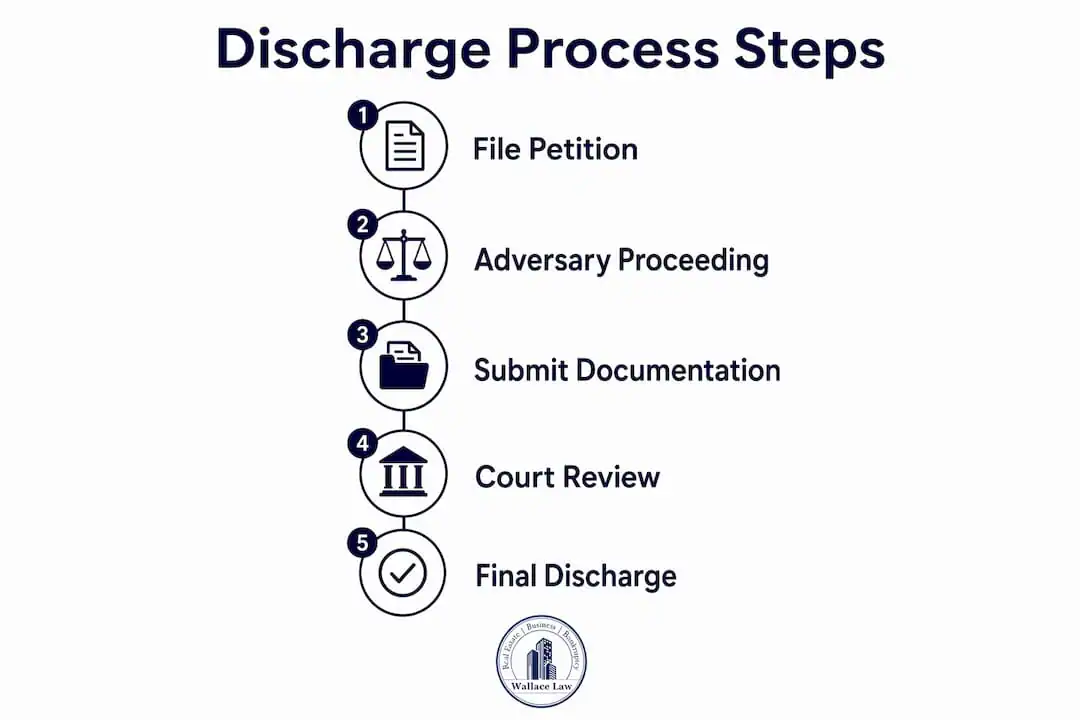
An adversary proceeding is a separate lawsuit inside your bankruptcy case, governed by Federal Rules of Bankruptcy Procedure (FRBP) 7001 through 7055. Without filing it, your student loans survive discharge regardless of how your main case resolves.
- Choose your chapter and file the main petition. Chapter 7 liquidates non-exempt assets and closes in roughly 3–6 months. Chapter 13 involves a 3–5 year repayment plan. Your choice affects timing and strategy for the adversary proceeding.
- Obtain the automatic stay. Filing the petition immediately triggers the stay under 11 U.S.C. §362, halting garnishments and most collection activity. Use this window to prepare your adversary complaint.
- File the adversary complaint under §523(a)(8). This complaint opens a new sub-case with its own docket number. It names your loan holders as defendants and formally alleges undue hardship.
- Serve summons and complaint. Service must comply with FRBP 7004. Improper service is a common procedural error that delays the case.
- Submit the DOJ attestation (federal loans). Once the AUSA is assigned, contact them promptly. Complete the Attestation Form with supporting exhibits. The Western District of Washington Bankruptcy Court publishes a fillable PDF and procedural notes that are useful regardless of your district.
- Discovery and negotiation. The AUSA reviews your attestation and may request additional documents. Many cases resolve by stipulated judgment at this stage, avoiding trial entirely.
- Trial or stipulated judgment. If the parties agree, the court enters a consent order. If not, you proceed to a hearing where you present evidence. The court then issues a ruling granting full discharge, partial discharge, or denial.
Note on reopening closed cases: If your bankruptcy closed without an adversary proceeding, you can move to reopen the case and file one. Prior denials are not always permanent if your financial circumstances have materially changed.
What documentation do judges and AUSAs expect to see?
Incomplete documentation is the single most common reason discharge requests stall or fail. Organize your exhibits before you file the adversary complaint.
Income and expense records:
- Last two years of federal tax returns
- Three to six months of recent pay stubs or proof of income (or lack thereof)
- Monthly expense ledger covering rent/mortgage, utilities, food, transportation, and medical costs
Medical and disability documentation:
- Physician letters or records establishing a chronic condition or disability
- Social Security Administration or VA disability determinations, if applicable
- Records showing how the condition limits earning capacity
Loan and repayment history:
- Current loan statements for all federal and private loans
- Enrollment records in income-driven repayment (IDR) plans
- Rehabilitation or consolidation records showing prior repayment attempts
Household and dependent records:
- Documentation of dependents (birth certificates, custody orders)
- Records of household costs attributable to dependents
The attestation form itself includes fields that trigger presumptions favorable to the debtor, including age 65 or older and qualifying disabilities. Careful completion, backed by labeled exhibits, materially speeds DOJ review.
Pro Tip: Create a numbered exhibit index (Exhibit A: 2023 Tax Return, Exhibit B: Pay Stubs, etc.) and attach a one-page declaration summarizing how each exhibit supports each Brunner factor. AUSAs work faster when the connection between evidence and legal standard is explicit. For help organizing and notarizing your attestation documents, document preparation services can reduce the administrative burden before you submit.
What does the process cost and how long does it take?
Set realistic expectations before you start.
Timeline:
- Chapter 7 main case: roughly 3–6 months from filing to discharge of other debts
- Chapter 13 plan period: 3–5 years
- Adversary proceeding: anywhere from several months (stipulated settlement after DOJ review) to more than a year if discovery is contested or trial is required
Direct costs:
- Bankruptcy filing fee: set by the court (check your local U.S. Bankruptcy Court for current amounts)
- Adversary proceeding filing fee: varies by district; some courts charge a separate fee, others do not
- Attorney fees for the main bankruptcy case: typically range from a few hundred dollars for simple Chapter 7 cases to several thousand for Chapter 13
- Attorney fees for the adversary proceeding: adversary litigation is billed separately and can run significantly higher, particularly if the case goes to trial
Since the 2022 policy change, discharge filings have increased and a higher proportion of cases are resolving by stipulated judgment rather than full trial, which keeps costs lower for qualifying borrowers.
Pro Tip: Ask any attorney you consult for a written scope-of-work that separates the main bankruptcy representation from the adversary proceeding. Flat fees for the main case and hourly or contingency arrangements for the adversary are both common. Get the fee structure in writing before you sign anything.
For a detailed look at Chapter 7 timing in Florida, Wallacelawflorida’s guide covers what to expect at each stage.
What are the alternatives to bankruptcy for student loan borrowers?
Bankruptcy is not the only path. Before filing, weigh these options against the discharge route.
- Income-driven repayment (IDR): Federal programs like SAVE, IBR, PAYE, and ICR cap monthly payments at a percentage of discretionary income and forgive remaining balances after 20–25 years of qualifying payments. No credit impact, but forgiveness is taxable income in most cases.
- Public Service Loan Forgiveness (PSLF): Forgives remaining Direct Loan balances after 120 qualifying payments while working full-time for a qualifying government or nonprofit employer. Takes 10 years minimum; losing qualifying employment restarts the clock.
- Total and Permanent Disability (TPD) discharge: Available through Federal Student Aid for borrowers who are totally and permanently disabled, as certified by a physician, the SSA, or the VA. No bankruptcy required.
- Consolidation and rehabilitation: Brings defaulted loans current and restores eligibility for IDR and PSLF, but does not reduce the principal balance.
- Refinancing into a private loan: Lowers interest rates in some cases but permanently forfeits federal protections, IDR eligibility, and PSLF access.
| Option | Speed | Certainty | Effect on federal benefits | Credit impact |
|---|---|---|---|---|
| Bankruptcy discharge | Months to years | Moderate (court-dependent) | Neutral (federal loans discharged) | Significant short-term |
| IDR forgiveness | 20–25 years | High if payments maintained | Preserves benefits | None |
| PSLF | 10 years minimum | High if employment qualifies | Preserves benefits | None |
| TPD discharge | Months | High if disability documented | Preserves benefits | None |
| Refinancing | Immediate | High (rate reduction only) | Loses federal protections | Minor inquiry |
For a deeper comparison of bankruptcy alternatives for debt relief, Wallacelawflorida’s 2026 guide walks through each option in detail.
When should you call a bankruptcy attorney, and what can Wallace Law do?
The adversary proceeding is not a form you fill out and mail in. It is active litigation, and the DOJ attestation process, while more structured than it used to be, still requires strategic judgment about what to submit and when.
A qualified bankruptcy attorney helps you with:
- Assessing whether you meet the undue-hardship standard before you spend money filing
- Choosing between Chapter 7 and Chapter 13 based on your income, assets, and loan types
- Drafting the adversary complaint and the attestation with exhibits that anticipate AUSA questions
- Communicating with the assigned AUSA and negotiating a stipulated judgment
- Managing discovery if the case is contested
- Presenting evidence at trial if settlement fails
Questions to ask any attorney before hiring them:
- How many student-loan adversary proceedings have you handled in this district?
- Have you worked directly with AUSAs on attestation submissions?
- What is your fee structure for the adversary proceeding specifically?
- What is your assessment of my undue-hardship claim based on what I’ve told you?
“Some debtors have been deterred from seeking discharge of student loans in bankruptcy due to the historically low probability of success and due to the mistaken belief that student loans are ineligible for discharge.” — U.S. Department of Justice, Student Loan Discharge Guidance (November 17, 2022)
Wallacelawflorida serves borrowers in Boynton Beach and the surrounding South Florida area. The firm’s bankruptcy practice covers both Chapter 7 and Chapter 13 cases, including adversary proceedings for student-loan discharge. Attorneys familiar with local court procedures and the South Florida federal bankruptcy docket can make a material difference in how efficiently your case moves.
Key Takeaways
Discharging student loans in bankruptcy requires an adversary proceeding, proof of undue hardship under §523(a)(8), and, for federal loans, completion of the DOJ attestation process introduced November 17, 2022.
| Point | Details |
|---|---|
| Adversary proceeding is mandatory | Student loans do not discharge automatically; you must file a separate complaint inside your bankruptcy case. |
| DOJ attestation covers federal loans | Direct, FFELP, and Perkins loans held by the DOE qualify; the attestation mirrors the Brunner three-prong test. |
| Partial discharge is possible | AUSAs can recommend partial relief when you can pay something but not the full balance. |
| Documentation drives outcomes | Incomplete expense records and weak proof of good-faith repayment are the most common reasons discharge requests fail. |
| Wallacelawflorida can help | The firm handles student-loan adversary proceedings and DOJ attestation submissions for borrowers in Boynton Beach and South Florida. |
What courts and AUSAs actually look for after 2026
The 2022 guidance changed the practical dynamics of these cases more than most borrowers realize. Before the attestation process, AUSAs had no standardized framework, which meant outcomes depended heavily on individual discretion and aggressive litigation. Now, when a debtor submits a complete, well-documented attestation, the AUSA has a clear path to recommend stipulated discharge without a trial. The cases that still go to trial are usually the ones where the attestation was incomplete, the income picture was ambiguous, or the good-faith repayment history was thin.
The most common evidentiary weaknesses judges cite: expense documentation that does not match actual bank statements, future-inability claims unsupported by medical evidence, and repayment histories that show years of non-payment with no IDR enrollment or other good-faith effort. Partial discharge is often the smarter settlement target than full discharge, especially when the debtor has some income. Accepting a partial discharge early, rather than litigating for full discharge and losing, leaves the borrower in a far better position. Early counsel matters precisely because these tactical decisions need to be made before the adversary complaint is filed, not after.
Wallacelawflorida’s bankruptcy consultation: what to expect

Facing student loan debt in bankruptcy is a legal problem that rewards preparation. Wallacelawflorida’s bankruptcy attorneys in Boynton Beach work directly with borrowers on Chapter 7 and Chapter 13 cases, adversary proceedings, and DOJ attestation submissions. The firm’s approach is straightforward: assess your situation honestly, explain your options clearly, and handle the procedural work so you are not navigating federal bankruptcy rules alone.
Documents to bring to your initial consultation:
- Most recent two years of federal tax returns
- Current loan statements (federal and private)
- Three to six months of pay stubs or income documentation
- Medical records or disability determinations, if applicable
- Prior bankruptcy case numbers, if any
To schedule a consultation, visit Wallacelawflorida’s bankruptcy practice page or download the firm’s free bankruptcy eBook for an overview of the process before your first meeting. The firm reviews your facts, identifies whether the DOJ attestation or a full adversary proceeding is the right path, and gives you a clear picture of costs and timeline before you commit to anything.
This article is general legal information, not legal advice for your specific situation. Consult a qualified bankruptcy attorney to evaluate your individual circumstances and confirm current rules with the relevant courts and agencies.
Authoritative sources, forms, and where to find them
- DOJ attestation guidance and fillable form: justice.gov/ust/student-loan-guidance — start here for federal loans; the attestation PDF (updated May 2025) is linked from this page.
- Full guidance text (November 17, 2022): DOJ Student Loan Discharge Guidance PDF — the complete memo explaining how AUSAs evaluate each Brunner factor.
- Statutory text, 11 U.S.C. §523: law.cornell.edu/uscode/text/11/523 — the exception-to-discharge provision with annotations.
- Automatic stay, 11 U.S.C. §362: law.cornell.edu/uscode/text/11/362 — confirms what collection activity stops upon filing.
- Local court procedural guidance and attestation PDF: Western District of Washington Bankruptcy Court — fillable attestation PDF, AUSA coordination notes, and exhibit guidance; useful as a model regardless of your district.
- Federal Student Aid forgiveness and discharge options: studentaid.gov/manage-loans/forgiveness-cancellation — overview of IDR, PSLF, TPD, and other non-bankruptcy options.
- TPD discharge application and eligibility: studentaid.gov/articles/tpd — step-by-step application instructions for total and permanent disability discharge.
- DIY filing and document organization guidance: cflegalformhelp.com — practical help for borrowers organizing attestation exhibits and bankruptcy documents.
Open the DOJ attestation guidance first if federal loans are at issue. Open your local bankruptcy court’s website second to confirm local rules for adversary proceedings and any district-specific forms.
FAQ
Can student loans actually be discharged in bankruptcy?
Yes. Under 11 U.S.C. §523(a)(8), student loans can be discharged if you prove undue hardship through an adversary proceeding; they do not discharge automatically.
How do I get my student loans discharged in bankruptcy?
File a bankruptcy petition, then file a separate adversary complaint in U.S. Bankruptcy Court. For federal loans, complete the DOJ attestation form and work with the assigned AUSA toward a stipulated discharge or trial.
Do student loans get wiped after 25 years?
Not through bankruptcy. Under income-driven repayment plans, remaining federal loan balances may be forgiven after 20–25 years of qualifying payments, but that forgiveness is separate from bankruptcy and may be treated as taxable income.
Can I reopen a closed bankruptcy case to discharge student loans?
Yes. Courts allow closed cases to be reopened to file an adversary proceeding, and prior denials are not always permanent if your financial circumstances have materially changed since the original case.
What is the difference between the DOJ attestation and a regular adversary proceeding?
The DOJ attestation is a structured review process for DOE-held federal loans that can lead to a stipulated discharge without a full trial. Private loans and non-DOE-held federal loans still require full adversary litigation with no government review pathway.