

TL;DR:
- A real estate attorney manages every legal aspect of property transfer from contract review to deed recording.
- Hiring an attorney early helps prevent costly errors, title issues, and delays before closing day.
A real estate attorney at closing is the licensed legal professional who manages every legal aspect of a property transfer, from contract review through deed recording. Most buyers and sellers focus on the signing table, but the attorney’s work starts weeks earlier and continues after the final signature. Understanding the full role of real estate attorney closing responsibilities protects you from costly surprises and deal failures that no title company or real estate agent can prevent.
What specific duties does a real estate attorney perform during closing?
A closing attorney’s responsibilities cover five distinct functions, each one legally critical to a clean property transfer.

Document preparation and legal review. The attorney drafts or reviews the deed, bill of sale, affidavits, and loan documents before the closing meeting. Every document must reflect the agreed terms exactly. A single error in a legal description can cloud title for years.
Title verification and defect resolution. The attorney orders a title search and examines the chain of ownership for liens, judgments, unpaid taxes, or competing claims. When a defect surfaces, the attorney negotiates its removal before closing day rather than after.
Escrow management and fund disbursements. The attorney often acts as escrow agent during closing, holding buyer funds in a trust account and disbursing them only when all legal conditions are met. This protects both parties from fraud and premature fund release.
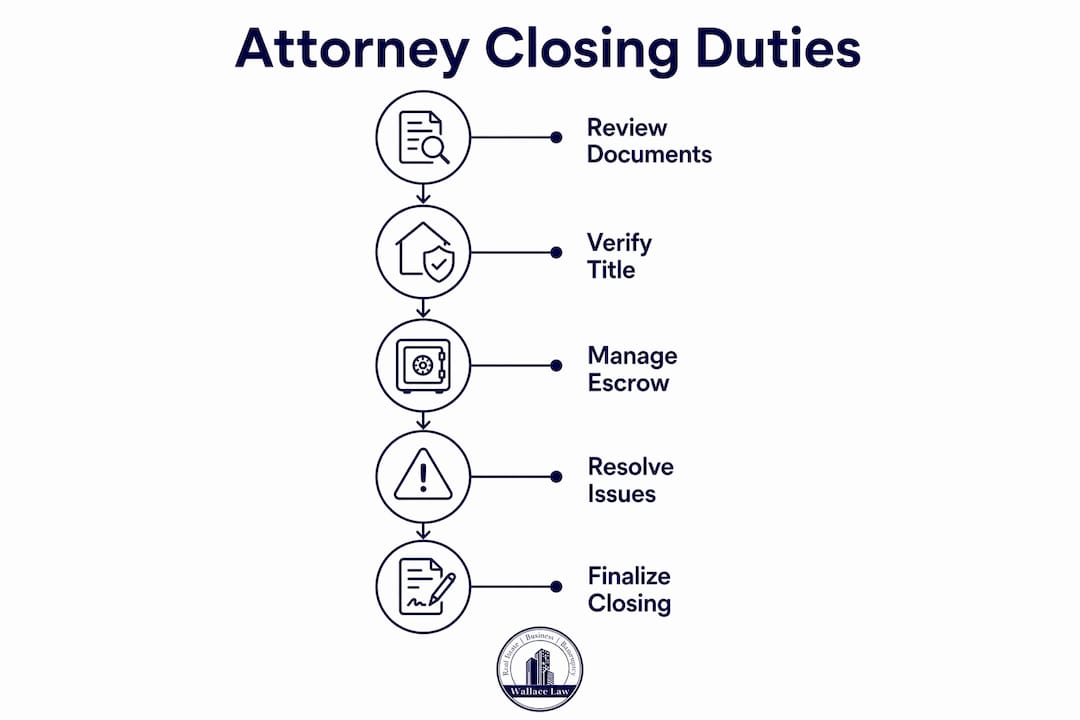
Closing meeting coordination. The real estate closing process typically takes 30 to 60 days, with the closing meeting itself lasting 1 to 2 hours. The attorney runs that meeting, explains each document, and confirms that every party signs in the correct capacity.
Deed recording and legal transfer. After signatures, the attorney submits the deed to the county recorder’s office. That recording is the legal moment of ownership transfer, not the signing itself.
- Reviews all loan terms and closing costs on the Closing Disclosure, which federal law requires buyers to receive at least 3 business days before closing
- Confirms that contingencies for financing, inspection, and appraisal are properly satisfied or waived
- Verifies that seller proceeds are calculated correctly after payoffs and prorations
- Ensures the title insurance policy is issued to protect the buyer’s ownership rights
Pro Tip: Ask your attorney to walk you through the Closing Disclosure line by line before the meeting. Errors in lender fees or prepaid items are common and easier to fix before you sit at the table.
How does the role of a real estate closing attorney vary by state?
State law determines whether an attorney is required at all, and that difference is significant. The United States divides into two broad categories: attorney states and escrow states.
| Factor | Attorney states | Escrow states |
|---|---|---|
| Attorney required at closing | Yes, by law | No, optional |
| Who handles closing | Licensed real estate attorney | Title or escrow company |
| Examples | Massachusetts, New York, Georgia, Florida | California, Texas, Arizona, Colorado |
| Legal advice available at table | Yes | No |
| Risk of unresolved legal issues | Lower | Higher without separate counsel |
In states like Massachusetts, a licensed attorney must be present at every residential closing. Florida sits in a hybrid position: an attorney is not always legally required, but the complexity of Florida real estate law makes one practically necessary for most transactions.
Commercial closings add another layer of complexity regardless of state. A commercial transaction involves zoning compliance, environmental reviews, lease assignments, and entity structuring that a title company cannot legally address. The commercial real estate closing checklist for a multi-tenant property looks nothing like a residential purchase. An attorney’s role expands accordingly.
Residential buyers in escrow states who skip legal counsel take on real risk. They receive no legal advice at the table, no one reviews contract language for liability traps, and no licensed professional confirms that the deed is legally sound before recording.
Why should you involve a real estate attorney before closing day?
Early legal involvement prevents costly errors and disputes that become far harder to fix once a contract is signed. Most clients hire an attorney only for the closing meeting. That approach leaves the most dangerous phase of the transaction unprotected.
- Review the purchase and sale agreement before signing. The contract sets every obligation, deadline, and remedy for both parties. An attorney identifies vague language, one-sided default clauses, and missing contingencies before you are legally bound.
- Negotiate contract terms and contingencies. In Illinois, for example, attorney review covers inspection terms, financing deadlines, and settlement documents. That review period is your best window to fix problems at no cost.
- Identify title issues early. A title search ordered at contract signing gives weeks to resolve liens or boundary disputes. The same issue discovered on closing day can kill the deal entirely.
- Prevent closing delays. Unsigned documents, missing payoffs, and unresolved contingencies are the most common causes of delayed closings. An attorney tracking deadlines catches these problems before they become emergencies.
- Protect against liability traps. Sellers face disclosure liability. Buyers face financing and inspection deadlines. An attorney structures both sides’ obligations to minimize exposure.
Pro Tip: Hire your attorney at the same time you make an offer, not after the contract is signed. The attorney review period in most states is your only no-cost exit window.
Common misconceptions about what a closing attorney actually does
The biggest misconception buyers and sellers carry is that the attorney’s job is simply to witness signatures on closing day. That belief leaves clients exposed during the most legally consequential weeks of the transaction.
- The attorney’s role does not start at the closing table. Clients often underestimate the range of pre-closing services attorneys provide, missing early-stage protections that prevent later issues entirely.
- Closing legally means recording the deed, not signing papers. The legal transfer of ownership occurs when the deed is recorded with the county and funds are properly disbursed. An attorney confirms both steps are executed correctly.
- A title company is not a substitute for legal counsel. Title companies issue insurance and process paperwork. They cannot give legal advice, negotiate on your behalf, or represent your interests if a dispute arises.
- Real estate attorney fees are part of closing costs. Attorney fees vary by state and transaction type, covered by buyers or sellers depending on local practice. They are a line item in the closing costs, not an unexpected add-on.
- The attorney protects you after closing too. If a title defect surfaces post-closing or a seller failed to disclose a known issue, your attorney is the professional who can pursue remedies on your behalf.
Watch the 3 fatal flaws that attorneys routinely prevent in Florida closings to understand how quickly a deal can unravel without proper legal oversight.
Key Takeaways
A real estate attorney’s role at closing extends from contract review through deed recording, covering every legal step that protects buyers and sellers from disputes, delays, and ownership defects.
| Point | Details |
|---|---|
| Attorney involvement starts early | Hire legal counsel at offer stage, not just for the closing meeting. |
| Deed recording is the true closing | Ownership transfers legally when the deed is recorded, not when papers are signed. |
| State law determines requirements | Attorney states mandate legal presence; escrow states make it optional but still advisable. |
| Title companies are not attorneys | Title companies process paperwork but cannot give legal advice or represent your interests. |
| Pre-closing review prevents failures | Early contract review catches liability traps and title defects before they derail the deal. |
What I’ve learned after watching too many closings go sideways
The clients who come to me most stressed are the ones who hired an attorney on closing day. By then, the contract is locked, the contingencies have expired, and whatever problems exist are already baked in. I have seen buyers lose earnest money deposits because a financing contingency was worded incorrectly. I have seen sellers face post-closing lawsuits over disclosure language that a 20-minute contract review would have fixed.
The real value of a closing attorney is not the hour at the table. It is the weeks before, when the deal is still flexible and problems are still fixable. Florida real estate law adds its own complexity: homestead rules, documentary stamp taxes, and title search requirements that differ from what buyers moving from other states expect. Local knowledge matters here in ways that a national title company simply cannot replicate.
My honest observation is that buyers in escrow states who skip legal counsel are making a financial decision that looks like savings and often costs far more. The risk-free investing advice that actually holds up in practice is simple: get an attorney before you sign anything, not after.
— Steven
How Wallacelawflorida protects your Florida real estate closing
Real estate transactions in Florida carry legal complexity that demands local expertise, not just a standard closing checklist. Wallacelawflorida serves buyers and sellers in Boynton Beach and surrounding South Florida communities with experienced attorneys who know Florida’s title requirements, documentary stamp rules, and disclosure obligations inside out.

Whether you are purchasing your first home, selling an investment property, or handling a commercial transaction, Wallacelawflorida provides attentive, personalized legal support from contract review through final recording. The firm’s Florida real estate legal services cover every stage of the closing process, with attorneys who treat your transaction as the significant legal event it is. Contact Wallacelawflorida today to schedule a consultation and protect your interests before you sign.
FAQ
What does a real estate attorney do at closing?
A real estate attorney prepares and reviews all legal documents, verifies title, manages escrow funds, runs the closing meeting, and confirms deed recording with the county. Their role covers legal compliance at every step of the transaction.
Is a real estate attorney required at closing in Florida?
Florida does not legally require an attorney at every residential closing, but the state’s complex title and tax rules make legal representation strongly advisable for both buyers and sellers.
When should I hire a real estate attorney?
Hire a real estate attorney when you make an offer, not after the contract is signed. Early involvement allows the attorney to review contract terms, negotiate contingencies, and identify title issues while the deal is still flexible.
How much do real estate attorney fees cost at closing?
Attorney fees vary by state and transaction complexity and are included as a line item in closing costs. Whether the buyer or seller pays depends on local custom and negotiated contract terms.
What is the difference between a closing attorney and a title company?
A closing attorney is a licensed lawyer who can give legal advice, represent your interests, and negotiate on your behalf. A title company processes paperwork and issues title insurance but cannot provide legal counsel or represent either party in a dispute.