

TL;DR:
- Many nondischargeable debts are protected by federal law and remain enforceable after bankruptcy. Certain debts, such as child support, recent taxes, and DUI injuries, survive automatically, while others require creditor action within strict deadlines. Understanding which debts persist and how Chapter 7 and Chapter 13 differ helps debtors plan effectively.
Nondischargeable debt is the legal term for any obligation that federal bankruptcy law explicitly protects from elimination, meaning it survives your bankruptcy filing and remains fully enforceable. 11 U.S.C. Section 523(a) lists 19 categories of these debts, covering everything from child support and recent taxes to student loans and fraud-related liabilities. Understanding why debts survive bankruptcy is not optional knowledge. It is the difference between filing with realistic expectations and discovering post-discharge that your most pressing obligations are still waiting for you. This guide breaks down every major category, explains the Chapter 7 versus Chapter 13 distinction, and tells you exactly where your options exist.
Why debts survive bankruptcy: the legal framework
Bankruptcy is a targeted legal tool, not a total debt reset. Congress designed the discharge system to balance debtor relief against public policy priorities. Certain debts survive because lawmakers decided that the interests behind them, such as protecting children, compensating fraud victims, and collecting taxes, outweigh a debtor’s right to a clean slate.

The core authority is 11 U.S.C. Section 523(a), which enumerates 19 specific debt categories that are presumed nondischargeable. Two broad mechanisms govern how these debts survive. Some are self-executing, meaning they survive automatically with no action required from the creditor. Others require the creditor to file an adversary proceeding, a separate lawsuit inside your bankruptcy case, within a strict deadline. Miss that deadline, and the debt may be discharged by default.
This distinction matters enormously for both debtors and creditors. A debtor who knows a creditor missed the filing window has a legitimate path to discharge. A creditor who does not act loses rights that the statute otherwise grants.
What debts are excluded from bankruptcy?
The 19 statutory categories cover a wide range of debt types. The most common ones you will encounter fall into these groups:
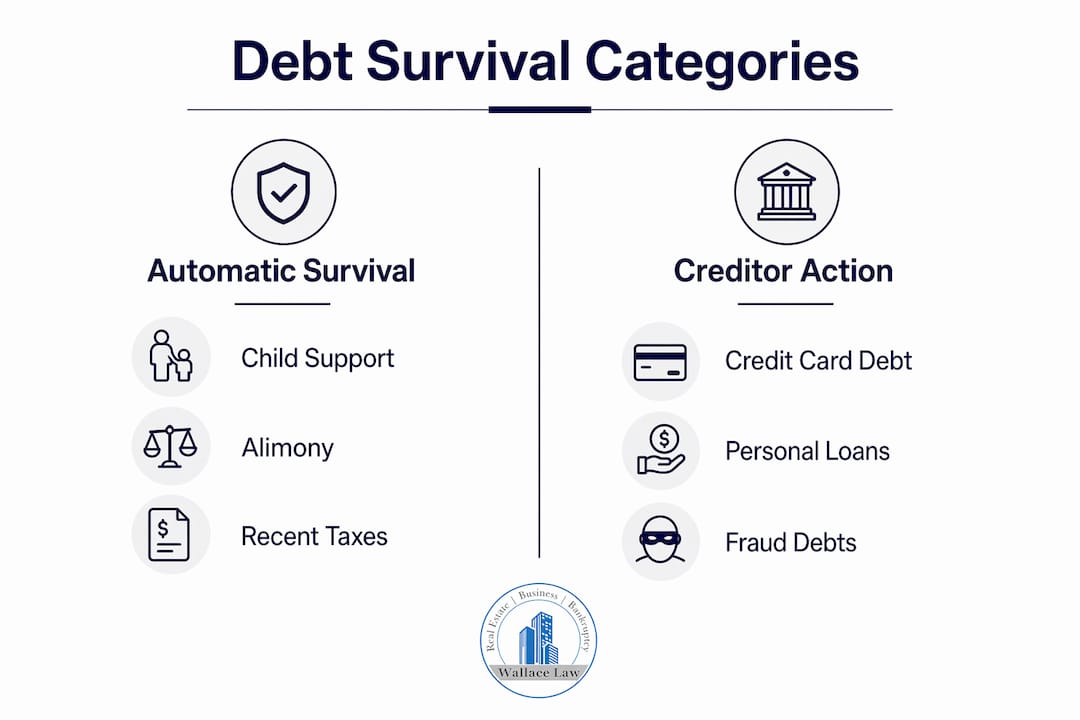
- Domestic support obligations: Child support and alimony survive automatically in every bankruptcy chapter. No creditor action is needed.
- Recent income taxes: The 3-2-240 rule governs tax discharge. The return must have been due more than 3 years ago, filed more than 2 years ago, and assessed more than 240 days ago. Miss any one of those thresholds and the tax debt survives. This timing complexity causes more debtor miscalculations than almost any other category.
- Student loans: Dischargeable only through a separate adversary proceeding proving “undue hardship” under 11 U.S.C. §523(a)(8).
- Fraud and false pretenses: Debts obtained through intentional misrepresentation survive, but only if the creditor files a timely adversary proceeding.
- Willful and malicious injury: Intentional harm to a person or property creates a nondischargeable debt.
- DUI-related liabilities: Debts from death or personal injury caused by driving under the influence survive automatically.
- Criminal fines and restitution: Government-imposed penalties and restitution orders are not dischargeable.
| Debt Type | Survives Automatically? | Creditor Action Required? |
|---|---|---|
| Child support / alimony | Yes | No |
| Recent income taxes | Yes | No |
| Student loans | Yes | No (but debtor can challenge) |
| Fraud-related debts | No | Yes, within 60 days |
| Willful injury debts | No | Yes, within 60 days |
| DUI injury liabilities | Yes | No |
| Criminal fines | Yes | No |
The table above shows a critical pattern. The debts society considers most morally serious, support for children, tax obligations, and DUI injuries, survive without any effort from the creditor. Debts tied to creditor-specific misconduct claims require the creditor to prove their case in court.
How do chapter 7 and chapter 13 handle surviving debts differently?
Chapter 7 and Chapter 13 bankruptcy do not treat nondischargeable debts identically. This difference is one of the most underused pieces of knowledge in personal bankruptcy planning.
Chapter 7 delivers a fast discharge, typically within 4–6 months, but its discharge scope is narrower. All 19 categories under Section 523(a) survive a Chapter 7 discharge. Fraud debts, divorce property settlements, and willful injury claims all remain if the creditor acts in time.
Chapter 13 offers what practitioners call the superdischarge. Upon successful completion of a 3–5 year repayment plan, Chapter 13 can eliminate certain debts that Chapter 7 cannot touch. These include:
- Debts from fraud or false pretenses in some circumstances
- Divorce property settlement obligations (not support, but property division)
- Certain willful injury claims not involving personal injury or death
For a deeper look at how each chapter structures debt relief differently, the Chapter 7 vs. Chapter 13 comparison at Wallacelawflorida covers the practical tradeoffs in detail.
Pro Tip: If you carry significant fraud-related debt or a divorce property settlement obligation, Chapter 13 may discharge debts that Chapter 7 legally cannot. Run the numbers with an attorney before defaulting to the faster Chapter 7 option.
The superdischarge is underutilized because most debtors and even some attorneys default to Chapter 7 without analyzing whether Chapter 13’s broader discharge scope justifies the longer commitment.
Why do some debts require creditor action to survive?
Not every debt on the Section 523(a) list survives automatically. For fraud, false financial statements, and willful injury claims, the creditor must take affirmative legal steps or the debt gets discharged along with everything else.
Here is how the process works:
- The 341 meeting occurs. This is the required creditors’ meeting held shortly after you file bankruptcy.
- The 60-day clock starts. Creditors have 60 days from the 341 meeting to file an adversary proceeding challenging the dischargeability of their specific debt.
- The creditor files or does not file. If they file, a mini-trial occurs inside your bankruptcy case. If they do not file within the deadline, the debt is discharged regardless of the underlying conduct.
- The court rules. The bankruptcy judge decides whether the debt meets the legal standard for nondischargeability.
- The outcome is binding. A ruling in the creditor’s favor makes the debt permanently nondischargeable. A ruling for the debtor eliminates it.
This structure creates a real opportunity for debtors. Creditors who miss the 60-day deadline lose their right to object, even when the underlying debt involves genuine fraud. Knowing this deadline exists is not about gaming the system. It is about understanding your legal rights accurately.
For IRS-related tax debts specifically, the timing rules under the 3-2-240 framework require precise calculation. A single miscalculation on the assessment date can mean the difference between a dischargeable and a nondischargeable tax liability.
Can student loans be discharged in bankruptcy?
Student loans are the most misunderstood category of debts excluded from bankruptcy. The common belief is that discharge is impossible. The reality is that 87% of borrowers who file an adversary proceeding succeed in getting at least a partial discharge. The problem is that 99.76% of borrowers never try. That gap between success rate and attempt rate is driven entirely by myths, not law.
Under 11 U.S.C. §523(a)(8), student loans survive bankruptcy unless the debtor proves “undue hardship” through a separate adversary proceeding. The undue hardship standard historically required meeting the Brunner test, which courts applied very strictly. Recent shifts in the Department of Justice’s litigation posture have moved toward case-by-case evaluation, giving more borrowers a realistic path to discharge.
Key facts about student loan discharge:
- Both federal and private student loans fall under Section 523(a)(8), though private loans sometimes face additional legal challenges from lenders.
- You must file a separate adversary proceeding inside your bankruptcy case. The discharge does not happen automatically.
- Partial discharge is common. Courts may reduce the principal, eliminate interest, or restructure the obligation even when full discharge is denied.
- The main barrier is legal counsel reluctance and borrower myths, not the legal framework itself.
Pro Tip: If you carry significant student loan debt and face long-term financial hardship, consult a bankruptcy attorney specifically about filing an adversary proceeding. The success rate for those who pursue discharge is far higher than most borrowers realize.
How do surviving debts affect you after bankruptcy?
Filing bankruptcy does not make nondischargeable debts disappear. You still owe them in full, and creditors retain all their collection rights for those specific obligations. Child support arrears, for example, can still result in wage garnishment and license suspension after your bankruptcy closes.
The practical impact depends on which debts survived and how large they are. Credit scores typically recover within 2–3 years after discharge when you manage credit responsibly. Bankruptcy is often a faster path to credit recovery than years of missed payments on unresolved debts. That context matters when you are weighing whether to file.
Your options for managing surviving debts include:
- Negotiating payment plans directly with creditors for tax debts and student loans. The IRS offers installment agreements, and federal student loan servicers offer income-driven repayment plans.
- Pursuing Chapter 13 if you have not yet filed, specifically to access the superdischarge for fraud or divorce-related obligations.
- Filing an adversary proceeding for student loans if you meet the undue hardship criteria.
- Monitoring creditor deadlines during your case. If a creditor misses the 60-day window on a fraud claim, that debt may be dischargeable.
For a clear picture of how bankruptcy affects your credit recovery timeline, the Wallacelawflorida resource on bankruptcy and credit scores explains what to expect month by month.
Key takeaways
Debts survive bankruptcy because federal law under 11 U.S.C. Section 523(a) explicitly excludes 19 categories from discharge, and knowing which ones apply to your situation determines your real post-bankruptcy obligations.
| Point | Details |
|---|---|
| 19 statutory categories | Section 523(a) lists every debt type that survives; review each one before filing. |
| Self-executing vs. creditor-action debts | Child support survives automatically; fraud debts require a creditor to file within 60 days. |
| Chapter 13 superdischarge | Chapter 13 can eliminate fraud and divorce settlement debts that Chapter 7 cannot discharge. |
| Student loan discharge is possible | 87% of borrowers who file an adversary proceeding succeed; most never try due to myths. |
| Post-bankruptcy credit recovery | Credit scores typically recover within 2–3 years with responsible management after discharge. |
What i have learned after years of bankruptcy cases
Clients come to me expecting bankruptcy to be a reset button. The hardest conversation I have is explaining that the debts causing them the most stress, the IRS balance, the student loans, the support arrears, are often the ones the law protects most aggressively.
What I have found is that the biggest mistake people make is not the decision to file. It is filing without a complete picture of what survives. Someone who files Chapter 7 to escape a fraud judgment, not knowing the creditor has 60 days to act, may get lucky if that creditor misses the deadline. But relying on creditor inaction is not a strategy. It is a gamble.
The Chapter 13 superdischarge is the most underused tool I see. Debtors who carry divorce property settlement obligations or certain fraud debts almost always default to Chapter 7 because it is faster. But three to five years in a Chapter 13 plan, with those debts eliminated at the end, is often the better financial outcome over a decade.
On student loans, I tell every client the same thing. The myth that discharge is impossible has cost borrowers billions in unnecessary repayments. The legal framework has shifted. If you have a genuine hardship case, the adversary proceeding process is worth pursuing. The common bankruptcy myths around student loans are exactly that: myths.
Bankruptcy works. But it works best when you understand its limits before you file, not after.
— Steven
How Wallacelawflorida can help you navigate surviving debts
If you are facing bankruptcy and need to understand which debts will follow you through it, Wallacelawflorida provides the kind of focused, personal attention that larger firms rarely offer.

The attorneys at Wallacelawflorida handle Chapter 7 and Chapter 13 cases across Boynton Beach and surrounding South Florida communities. They work directly with clients to identify nondischargeable debts before filing, evaluate whether the Chapter 13 superdischarge applies to your situation, and assess whether a student loan adversary proceeding is worth pursuing. Every client gets a strategy built around their specific debt profile, not a generic filing. If you are ready to understand your real options, start with bankruptcy legal support from a team that knows Florida bankruptcy law from the ground up.
FAQ
What debts always survive bankruptcy?
Child support, alimony, recent income taxes, DUI injury liabilities, and criminal fines survive automatically under 11 U.S.C. Section 523(a) without any creditor action required.
Why do student loans survive bankruptcy?
Student loans are nondischargeable by statute under 11 U.S.C. §523(a)(8) unless the borrower files a separate adversary proceeding and proves undue hardship. Most borrowers never attempt this despite a high success rate.
Can chapter 13 discharge debts that chapter 7 cannot?
Yes. Chapter 13’s superdischarge can eliminate certain fraud-related debts and divorce property settlement obligations that survive a Chapter 7 discharge, provided the debtor completes the full repayment plan.
What happens if a creditor misses the 60-day deadline?
If a creditor fails to file an adversary proceeding within 60 days of the 341 creditors’ meeting, fraud and willful injury debts that would otherwise survive may be discharged by default.
How long does it take to rebuild credit after bankruptcy?
Credit scores typically recover within 2–3 years after discharge when the debtor maintains responsible credit habits, making bankruptcy a faster recovery path than years of unresolved debt.